WWW.JNEUROSCI.ORG
-
The Journal of Neuroscience
 QUICK SEARCH:   [advanced]


-


HOME
  |  
SEARCH  |   ARCHIVE  |   SUBSCRIBE  |   CONTACT  |   HELP

The Journal of Neuroscience, February 11, 2004, 24(6):1319-1329; doi:10.1523/JNEUROSCI.2852-03.2004

This Article
Right arrow Full Text
Right arrow Full Text (PDF)
Right arrow Submit an eLetter
Right arrow Alert me when this article is cited
Right arrow Alert me when eLetters are posted
Right arrow Alert me if a correction is posted
Right arrow Citation Map
Services
Right arrow Email this article to a friend
Right arrow Similar articles in this journal
Right arrow Similar articles in Web of Science
Right arrow Similar articles in PubMed
Right arrow Alert me to new issues of the journal
Right arrow Download to citation manager
Right arrow reprints & permissions
Citing Articles
Right arrow Citing Articles via HighWire
Right arrow Citing Articles via Web of Science (21)
Right arrow Citing Articles via Google Scholar
Google Scholar
Right arrow Articles by Kaiser, K. M. M.
Right arrow Articles by Sakmann, B.
Right arrow Search for Related Content
PubMed
Right arrow PubMed Citation
Right arrow Articles by Kaiser, K. M. M.
Right arrow Articles by Sakmann, B.

 Previous Article  |  Next Article 

Cellular/Molecular
Postsynaptic Calcium Influx at Single Synaptic Contacts between Pyramidal Neurons and Bitufted Interneurons in Layer 2/3 of Rat Neocortex Is Enhanced by Backpropagating Action Potentials

Katharina M. M. Kaiser,1 Joachim Lübke,2 * Yuri Zilberter,1,3 * and Bert Sakmann1

1Abteilung Zellphysiologie, Max-Planck-Institut für Medizinische Forschung, D-69120 Heidelberg, Germany, 2Anatomisches Institut der Universität Freiburg, D-79104 Freiburg, Germany, and 3Division of Neuroanatomy and Brain Development, Department of Neuroscience, Karolinska Institute, S-17177 Stockholm, Sweden

Pyramidal neurons in layer 2/3 (L2/3) of the rat somatosensory cortex excite somatostatin-positive inhibitory bitufted interneurons located in the same cortical layer via glutamatergic synapses. A rise in volume-averaged dendritic [Ca2+]i evoked by backpropagating action potentials (APs) reduces glutamatergic excitation via a retrograde signal, presumably dendritic GABA. To measure the rise in local [Ca2+]i at synaptic contacts during suprathreshold excitation, we identified single synaptic contacts in the acute slice preparation in pairs of pyramidal and bitufted cells each loaded with a Ca2+ indicator dye. Repetitive APs (10-15 APs at 50 Hz) evoked in a L2/3 pyramidal neuron gave rise to facilitating unitary EPSPs in the bitufted cell. Subthreshold EPSPs evoked a transient rise in [Ca2+]i of 80-250 nM peak amplitude at the postsynaptic dendritic site. The local postsynaptic [Ca2+]i transient was restricted to ~10 µm of dendritic length, lasted for ~200 msec, and was mediated predominantly by NMDA receptor channels. When EPSPs were suprathreshold, the evoked AP backpropagated into the apical and basal dendritic arbor and increased the local [Ca2+]i transient at active contacts by approximately twofold, with a peak amplitude reaching 130-450 nM. This value is in the range of the half-maximal dendritic [Ca2+]i, evoking retrograde inhibition of glutamate release from boutons of pyramids. The localized enhancement of dendritic Ca2+ influx at synaptic contacts by synaptically evoked backpropagating APs could represent one mechanism by which a retrograde signal can limit the excitation of bitufted interneurons by L2/3 pyramids when these are repetitively active.


View larger version (36K):
[in this window]
[in a new window]
 
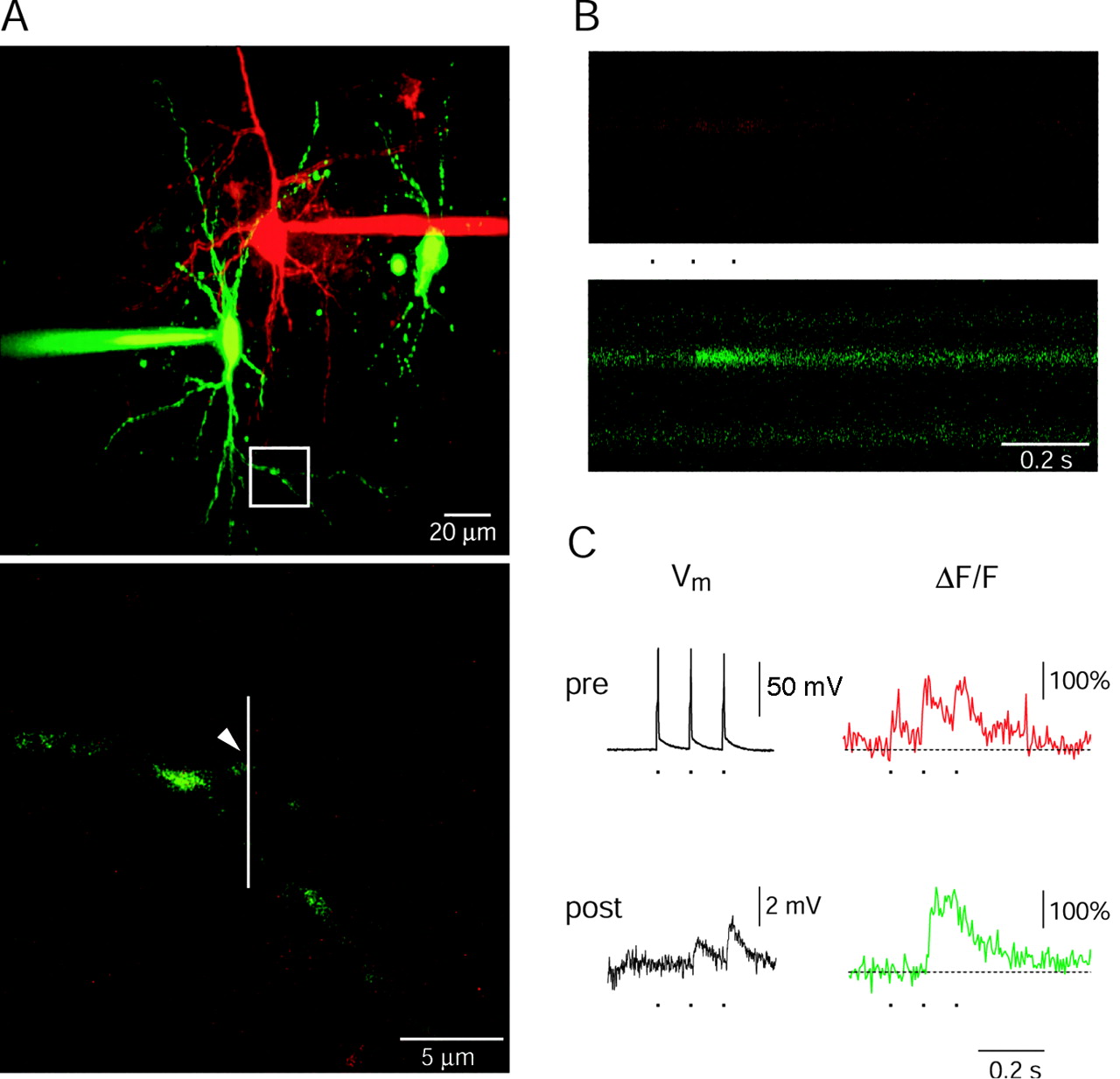
Figure 5. Presynaptic and postsynaptic Ca2+ influx at single synaptic contacts recorded by using two-photon excitation fluorescence microscopy. A, top, Fluorescence image of a pyramid-to-bitufted cell pair filled with rhod-2 and OGB-1, respectively. The pyramidal neuron is shown in red, the interneuron in green. The region with an identified synaptic contact is marked by the rectangle and shown at higher magnification at the bottom. The arrowhead points to a synaptic contact. The presynaptic axon is hardly visible, but lightens up during Ca2+ influx (see B). Line scans shown in B were performed at the region indicated by the white vertical line. B, Fluorescence line scans recorded during unitary synaptic stimulation on the presynaptic bouton (red) and the postsynaptic dendrite (green). In the pyramidal neuron three APs were evoked at 10 Hz (see C). C, Each of the three APs evoked in the pyramidal neuron gave rise to a Ca2+ influx into the presynaptic terminal (top traces, same experiment shown in B). The postsynaptic neuron responded with two EPSPs, but only during one was a postsynaptic Ca2+ signal also measured (lower traces). Presumably, the second EPSP was evoked at another contact. Fluorescence data were not filtered. Note: No Ca2+ transient was recorded on the other dendrite also covered by the line scan (see B), indicating the synaptic origin of the Ca2+ signals.


Key words: interneuron; neocortex; unitary synaptic stimulation; synaptic contact; calcium transient; calcium diffusion


Received Aug 15, 2003; revised November 27, 2003; accepted December 1, 2003.


This article has been cited by other articles:


Home page
J. Neurosci.Home page
I. Oren, W. Nissen, D. M. Kullmann, P. Somogyi, and K. P. Lamsa
Role of Ionotropic Glutamate Receptors in Long-Term Potentiation in Rat Hippocampal CA1 Oriens-Lacunosum Moleculare Interneurons
J. Neurosci., January 28, 2009; 29(4): 939 - 950.
[Abstract] [Full Text] [PDF]


Home page
J. Physiol.Home page
E. Calixto, E. J. Galvan, J. P. Card, and G. Barrionuevo
Coincidence detection of convergent perforant path and mossy fibre inputs by CA3 interneurons
J. Physiol., June 1, 2008; 586(11): 2695 - 2712.
[Abstract] [Full Text] [PDF]


Home page
Physiol. Rev.Home page
P. J. Sjostrom, E. A. Rancz, A. Roth, and M. Hausser
Dendritic Excitability and Synaptic Plasticity
Physiol Rev, April 1, 2008; 88(2): 769 - 840.
[Abstract] [Full Text] [PDF]


Home page
J. Physiol.Home page
B. A. Milojkovic, W.-L. Zhou, and S. D. Antic
Voltage and calcium transients in basal dendrites of the rat prefrontal cortex
J. Physiol., December 1, 2007; 585(2): 447 - 468.
[Abstract] [Full Text] [PDF]


Home page
J. Neurosci.Home page
J.-t. Lu, C.-y. Li, J.-P. Zhao, M.-m. Poo, and X.-h. Zhang
Spike-Timing-Dependent Plasticity of Neocortical Excitatory Synapses on Inhibitory Interneurons Depends on Target Cell Type
J. Neurosci., September 5, 2007; 27(36): 9711 - 9720.
[Abstract] [Full Text] [PDF]


Home page
J. Neurophysiol.Home page
B. Halabisky, F. Shen, J. R. Huguenard, and D. A. Prince
Electrophysiological Classification of Somatostatin-Positive Interneurons in Mouse Sensorimotor Cortex
J Neurophysiol, August 1, 2006; 96(2): 834 - 845.
[Abstract] [Full Text] [PDF]


Home page
NeuroscientistHome page
Y. Zilberter, T. Harkany, and C. D. Holmgren
Dendritic Release of Retrograde Messengers Controls Synaptic Transmission in Local Neocortical Networks
Neuroscientist, August 1, 2005; 11(4): 334 - 344.
[Abstract] [PDF]


Home page
J. Neurosci.Home page
L. Topolnik, P. Congar, and J.-C. Lacaille
Differential Regulation of Metabotropic Glutamate Receptor- and AMPA Receptor-Mediated Dendritic Ca2+ Signals by Presynaptic and Postsynaptic Activity in Hippocampal Interneurons
J. Neurosci., January 26, 2005; 25(4): 990 - 1001.
[Abstract] [Full Text] [PDF]


Home page
J. Physiol.Home page
A. Korngreen, K. M. M. Kaiser, and Y. Zilberter
Subthreshold inactivation of voltage-gated K+ channels modulates action potentials in neocortical bitufted interneurones from rats
J. Physiol., January 15, 2005; 562(2): 421 - 437.
[Abstract] [Full Text] [PDF]


Home page
J. Neurosci.Home page
I. Ismailov, D. Kalikulov, T. Inoue, and M. J. Friedlander
The Kinetic Profile of Intracellular Calcium Predicts Long-Term Potentiation and Long-Term Depression
J. Neurosci., November 3, 2004; 24(44): 9847 - 9861.
[Abstract] [Full Text] [PDF]


Home page
J. Physiol.Home page
J. H. Goldberg, C. O. Lacefield, and R. Yuste
Global dendritic calcium spikes in mouse layer 5 low threshold spiking interneurones: implications for control of pyramidal cell bursting
J. Physiol., July 15, 2004; 558(2): 465 - 478.
[Abstract] [Full Text] [PDF]


-
-

Home  |   Search  |   Archive  |   Subscribe  |   Contact  |   Help

-
Copyright 2009 by Society for Neuroscience ONLINE ISSN: 1529-2401
-