|
Previous Article | Next Article 
Volume 17, Number 9,
Issue of May 1, 1997
pp. 2959-2966
Copyright ©1997 Society for Neuroscience
Inhibition of GABAA Synaptic Responses by
Brain-Derived Neurotrophic Factor (BDNF) in Rat Hippocampus
Tatsuro Tanaka,
Hiroshi Saito, and
Norio Matsuki
Department of Chemical Pharmacology, Faculty of Pharmaceutical
Sciences, The University of Tokyo, Tokyo 113, Japan
ABSTRACT
INTRODUCTION
MATERIALS AND METHODS
RESULTS
DISCUSSION
FOOTNOTES
REFERENCES
ABSTRACT
Brain-derived neurotrophic factor (BDNF) is one of neurotrophins
involved in the development and maintenance of both the peripheral nervous system and CNS. Although the expression of BDNF and its receptor TrkB still occurs in the adult stage, their physiological role
in the mature CNS is not fully understood. In the present study we
examined in detail the possibility that BDNF modulates synaptic
neurotransmissions by using patch-clamp technique in rat hippocampal
CA1 region. BDNF (20-100 ng/ml) did not show any appreciable effect on
evoked EPSCs, but it markedly reduced both evoked and spontaneous IPSCs
within 5 min, and the reduction persisted while BDNF was present. BDNF
also attenuated GABAA receptor-mediated response to applied
GABA. However, BDNF failed to attenuate IPSCs when the postsynaptic
pyramidal neuron was loaded intracellularly with 200 nM
K252a, an alkaloid that inhibits the kinase activity of Trk receptor
family, through the patch pipette. Intracellular application of 200 nM K252b, a weaker inhibitor of Trk-type kinase, did not
affect the inhibition. The attenuating effect also was prevented by
postsynaptic injection of U73122 (5 µM), a broad-spectrum PLC inhibitor, and by strong chelation of intracellular
Ca2+ with 10 mM BAPTA. These data suggest that
BDNF modulates GABAA synaptic responses by postsynaptic
activation of Trk-type receptor and subsequent Ca2+
mobilization in the CNS.
Key words:
BDNF;
GABAA receptor;
disinhibition;
plasticity;
LTP;
hippocampus
INTRODUCTION
Brain-derived neurotrophic factor (BDNF) is one of
the neurotrophins involved in the development and maintenance of both
the peripheral nervous system and CNS. During brain development
neurotrophins and their receptors display distinct stage- and
tissue-specific patterns of expression (Ernfors et al., 1990a ; Phillips
et al., 1990 ; Merlio et al., 1992 ). BDNF mRNA is observed in the
embryonic stage and is still present in the postnatal and adult stages
(Ernfors et al., 1990b ; Maisonpierre et al., 1990 ; Freidman et al.,
1991). In the adult stage its expression level is modulated
dramatically by neuronal activity (Falkenberg et al., 1992 ; Patterson
et al., 1992 ; Rocamora et al., 1992 ; Bengzon et al., 1993 ; Kokaia et
al., 1993 ). Moreover, expression of TrkB, a functional BDNF receptor, not only increases during embryonic development but also continues to
increase until several weeks after birth in the hippocampus (Masana et
al., 1993 ; Ringstedt et al., 1993 ). These observations suggest that in
the adult CNS dynamic change in BDNF level still can trigger neuronal
plasticity via activation of TrkB. Indeed, neurotrophins are secreted
by neurons in both a constitutive and an activity-dependent manner
(Blöchl and Thoenen, 1995 , 1996 ; Griesbeck et al., 1995 ; Thoenen,
1995 ; Goodmann et al., 1996 ). Additionally, BDNF induces long-lasting
enhancement of synaptic transmission (Kang and Schuman, 1995 ) and
facilitates the induction of long-term potentiation (LTP) in the
hippocampus (Figurov et al., 1996 ); however, the site and mechanism of
action of BDNF remain unclear, because the effect of BDNF on synaptic
transmission has been assessed by analyzing field (extracellular)
potential changes in most cases. In the present study we examined in
detail the possibility that BDNF regulates synaptic neurotransmissions by using the patch-clamp technique in rat hippocampal CA1 region and
have presented evidence that BDNF directly modulates GABAA synaptic responses by postsynaptic activation of Trk-type receptor and
subsequent Ca2+ mobilization in the CNS.
MATERIALS AND METHODS
Slice preparation. Male Wistar rats, 12-18 d old,
were used to prepare 250-µm-thick hippocampal slices in ice-cold
artificial cerebrospinal fluid (ACSF). Rats were decapitated, and the
brains were removed. Transverse hippocampal slices were cut with a
vibratome. Slices were incubated at room temperature (22-25°C) in
ACSF oxygenated with 95% O2 and 5% CO2 in a
holding chamber at least for 1 hr. Then they were plated in the
recording chamber under a platinum-supported nylon mesh and perfused at
a rate of 2 ml/min with ACSF at room temperature. ACSF was composed of
(in mM): NaCl 124, NaHCO3 26, KCl 2, KH2PO4 1.24, MgSO4 5, CaCl2 2, glucose 10, and ascorbic acid 0.4.
Electrophysiological recordings. Whole-cell
patch-clamp recordings were performed with a blind approach. Patch
electrodes (2-4 M ) were fabricated from borosilicate glass. The
pipette solution contained (in mM): CsCl 140, CaCl2 0.2, EGTA 2, NaGTP 0.4, MgATP 4, and HEPES 10, pH 7.2 with CsOH. In some experiments 10 mM BAPTA and 125 mM CsCl were substituted for 2 mM EGTA and 140 mM CsCl, respectively. Chloride was used as a permeant
anion in the internal solution to reverse the polarity and increase the
amplitude of GABAA receptor-mediated IPSCs. Lidocaine
N-ethyl bromide (QX314, 5 mM; Research
Biochemicals, Natick, MA) also was included in the recording electrode
solution to prevent depolarizing IPSCs from triggering action
potentials. Voltage-clamp ( 60 mV) recordings from hippocampal CA1
pyramidal cells were obtained with an Axoclamp 1D amplifier, data
were digitized by a TL-1 DMA interface, and acquisition and analysis
were performed with the pCLAMP computer program (Axon Instruments,
Foster City, CA). The series resistance (usually 10-25 M ) was
monitored throughout the experiment; if it changed significantly, the
experiment was rejected. Evoked EPSCs were obtained by stimulation of
the Schaffer collateral-commissural afferents every 20 sec with
bipolar tungsten electrodes in the presence of 20 µM
picrotoxin to block inhibitory inputs. In most cases evoked
monosynaptic IPSCs were obtained by stratum pyramidal (SP) stimulation
at 0.1 Hz in the presence of 20 µM
6-cyano-7-nitroquinoxaline-2,3-dione (CNQX) and 50 µM 2-amino-5-phosphonovaleric acid (APV) to block excitatory inputs. Stable recordings of PSCs usually were obtained 20-30 min after the
rupture of the patch and continued for at least 30 min. In gramicidin perforated-patch recordings another pair of stimulating electrodes was positioned within 500 µm from the recording electrode in the stratum lacunosum-moleculare (SL-M) to obtain another type of
GABAA-mediated IPSCs (Pearce, 1993 ). IPSCs recorded for
every 2 min were averaged for evaluation of their amplitude.
Gramicidin perforated-patch recording. In simultaneous
recording of two types of IPSCs, we used the gramicidin
perforated-patch method. The antibiotic gramicidin (Sigma, St. Louis,
MO), when incorporated into lipid membranes, forms pores that are
permeable to monovalent cations and small uncharged molecules. This
method can avoid diffusion of cytoplasmic factors out of the recorded neuron and disturbance of intrinsic intracellular Cl
concentration. It is particularly important to avoid the latter problem
to gain stable and long-lasting recordings of IPSCs generated at
synapses distant from soma, such as IPSCs evoked by SL-M stimulation, because physiologically excess Cl in the pipette does not
distribute quickly to dendrites. The internal solution for gramicidin
recordings was prepared according to the methods reported previously
(Kyrozis and Reichling, 1995 ). Briefly, before each perforated-patch
experiment gramicidin (2 mg/ml) was dissolved in dimethyl sulfoxide
(DMSO). The gramicidin-DMSO solution was added to the electrode
solution (composed of 150 mM KCl and 10 mM
HEPES, pH 7.2 with KOH) to give a final concentration of 5 µg/ml. In
filling the electrode with gramicidin-containing solution, we usually
omitted the process of tip prefilling with gramicidin-free solution
because in our cases we encountered no significant difficulty in seal
formation.
Reagents. Human recombinant BDNF was dissolved (100 µg/ml) in phosphate buffer containing 0.1% BSA and stored at
30°C. Before every experiment the stock solution was diluted with
ACSF to the final concentration (20-100 ng/ml). Therefore, all
experiments were performed in ACSF containing 0.0001% BSA, which did
not have any detectable effect on EPSCs or IPSCs. K252a, K252b (Kyowa
Medex, Tokyo, Japan), and U73122 (Biomol Research Lab, Plymouth
Meeting, PA) were dissolved in DMSO. The final concentration of DMSO,
0.1% in bath-applied ACSF or 0.05% in patch-pipette solution, did not have any significant effect on synaptic responses.
RESULTS
Modulative effect of BDNF on IPSCs without
affecting EPSCs
CA1 pyramidal neurons are innervated by fast
excitatory synaptic inputs from the CA3 region. Stimulation of Schaffer
collaterals produced non-NMDA-type (CNQX-sensitive) glutamate
receptor-mediated EPSCs in voltage-clamped ( 60 mV) CA1 pyramidal
cells in whole-cell recordings in the presence of a GABAA
receptor antagonist, bicuculline (20 µM; see Fig.
2A). On the other hand, they are also under
inhibitory innervation of neighboring interneurons. SP stimulation, in
the presence of 50 µM APV and 20 µM CNQX to
block glutamatergic inputs, produced bicuculline- and
picrotoxin-sensitive GABAA receptor-mediated inward-directed IPSCs (Fig. 1A). BDNF
(20-100 ng/ml) showed no apparent effects on the amplitude of evoked
EPSCs (mean ± SEM; % of baseline, 90.5 ± 7.9;
n = 6) (Fig. 2B,C).
However, the amplitude of evoked IPSCs was reduced markedly within 5 min after the start of BDNF perfusion, and this reduction persisted
while BDNF was present (Fig. 1B,C). The attenuating
effect of BDNF was concentration-dependent [mean ± SEM; % of
baseline: BDNF 20 ng/ml, 70.9 ± 6.9 (n = 6), p < 0.05; 100 ng/ml, 55.6 ± 9.9 (n = 6), p < 0.05]. Although we did
not analyze the recovery of the amplitude of IPSCs systematically, the
washout of BDNF resulted in the recovery of the amplitude (>80% of
the baseline response) in 5 of 12 neurons within 30 min. The reduced
IPSCs did not recover in the rest of the neurons. In several cases we
observed transient increases in the amplitude of IPSCs as well as that
of EPSCs within 2 min after the start of 100 ng/ml BDNF perfusion
(Figs. 1C, 2C). This enhancement was accompanied
by an increase in the frequency of spontaneous postsynaptic currents
(data not shown), although it was not statistically significant.
Fig. 2.
BDNF did not affect non-NMDA-type glutamate
receptor-mediated EPSCs. A, Recording of the
CNQX-sensitive EPSCs from voltage-clamped ( 60 mV) CA1 pyramidal
neurons. Stimulation of Schaffer collaterals produced the inward
currents sensitive to 20 µM CNQX in the presence of 20 µM bicuculline. Representative traces are shown as the
average of eight consecutive responses (calibration: 25 pA, 30 msec). B, Effect of BDNF on evoked EPSCs. BDNF (100 ng/ml, 15 min) did not significantly affect non-NMDA-type glutamate
receptor-mediated EPSCs (right). Each trace represents
the averaged EPSCs of eight consecutive sweeps (calibration: 40 pA, 30 msec). C, The time courses of changes in EPSCs. BDNF
tended to increase the amplitude of EPSCs transiently (within 2 min)
but had no significant effect on subsequent EPSCs. Data are indicated
as mean ± SEM (n = 6).
[View Larger Version of this Image (18K GIF file)]
Fig. 1.
BDNF attenuated GABAA-mediated IPSCs
in CA1 pyramidal cells. A, Recording of the
bicuculline-sensitive IPSCs from voltage-clamped ( 60 mV) CA1
pyramidal neurons in the whole-cell mode. Electrical stimulation of the
stratum pyramidal generates the inward currents in the presence of
glutamate receptor blockers APV (50 µM) and CNQX (20 µM). The inward currents were blocked completely by a GABAA-receptor antagonist bicuculline (20 µM)
(left traces). The right trace is the
recovery after a 20 min wash of bicuculline (calibration: 100 pA, 50 msec). B, Effect of BDNF on evoked IPSCs. Bath-applied
BDNF (100 ng/ml, 15 min) dramatically reduced the amplitude of IPSCs.
Two representative IPSCs (left) are from the time points
indicated in C. In this neuron IPSCs recovered almost completely after a 30 min washout of BDNF (right). Each
trace represents the averaged IPSCs of eight consecutive sweeps
(calibration: 100 pA, 50 msec). C, The time courses of
inhibition of the amplitude of IPSCs. Perfusion of BDNF (indicated as a
horizontal solid bar) significantly reduced the
amplitude of IPSCs (solid circles, 20 ng/ml;
solid squares, 100 ng/ml;
#p < 0.05, *p < 0.05, **p < 0.01, Dunnett test;
n = 5-7). Data are indicated as mean ± SEM
normalized to the amplitudes at the time point just before the
application of BDNF.
[View Larger Version of this Image (18K GIF file)]
Modulation of two types of inhibitory inputs
To confirm the suppressive effect of BDNF on IPSCs, we used the
gramicidin-perforated patch-clamp technique (Kyrozis and Reichling, 1995 ), which avoids diffusion of cytoplasmic factors out of the recorded neuron and disturbance of intracellular Cl
concentration. CA1 pyramidal neurons receive inhibitory inputs from two
sources, SP and SL-M. The two GABAA-mediated inhibitory responses are distinct in terms of physiological, pharmacological, and
anatomical properties (Pearce, 1993 ; Pearce et al., 1995 ). Stimulation
of either SP or SL-M evoked GABAA-mediated IPSCs in the
perforated mode. The reversal potential of IPSCs evoked by SP or SL-M
stimulation was 72.6 ± 4.6 or 75.8 ± 4.9 mV, respectively (n = 6). Therefore, each type of IPSCs was recorded as
outward-directed currents when cells were voltage-clamped at 50 mV
(Fig. 3A). In the perforated mode, once
adequate access resistance (<30 M ) was achieved, we could obtain
stable and long-lasting recordings of IPSCs for at least 1 hr. One of
the typical simultaneous recordings of SP-evoked and SL-M-evoked IPSCs
from the same neuron is shown in Figure 3. Application of 100 ng/ml
BDNF silenced both types of IPSCs (Fig. 3B). In the
perforated mode we could obtain similar results to those observed in
the whole-cell mode. The reproducibility of the gramicidin-perforated
mode confirmed that the attenuating effect of BDNF was not caused by
experimental artifacts of the whole-cell mode.
Fig. 3.
Attenuation of two distinct types of inhibitory
inputs to CA1 pyramidal neurons by BDNF in the gramicidin
perforated-patch method. A, Stimulation of the stratum
pyramidal (SP stim.) and the stratum
lacunosum-moleculare (SL-M stim.) produced distinct types of outward-directed IPSCs in the same CA1 pyramidal cell voltage-clamped at 50 mV. In this mode BDNF (100 ng/ml) also reduced
both types of IPSCs. The representative traces are from the time points
indicated in B. B, The typical time
courses of reduction of the amplitude of IPSCs generated by stimulation
of two sources, SP (open circles) and SL-M (solid
circles). BDNF at 100 ng/ml (horizontal solid
bar) silenced both types of inhibitory inputs. Data are plotted
as the mean of eight IPSCs evoked by alternative stimulation of SP or
SL-M in the same neuron.
[View Larger Version of this Image (18K GIF file)]
Involvement of a postsynaptic Trk-type receptor
BDNF specifically binds to TrkB, a neurotrophin receptor,
including the catalytic domain of tyrosine kinase. When hippocampal slices were pretreated extracellularly with 200 nM K252a,
an alkaloid that inhibits the kinase activity of the Trk receptor
family (Knüsel and Hefti, 1992 ), BDNF failed to reduce the
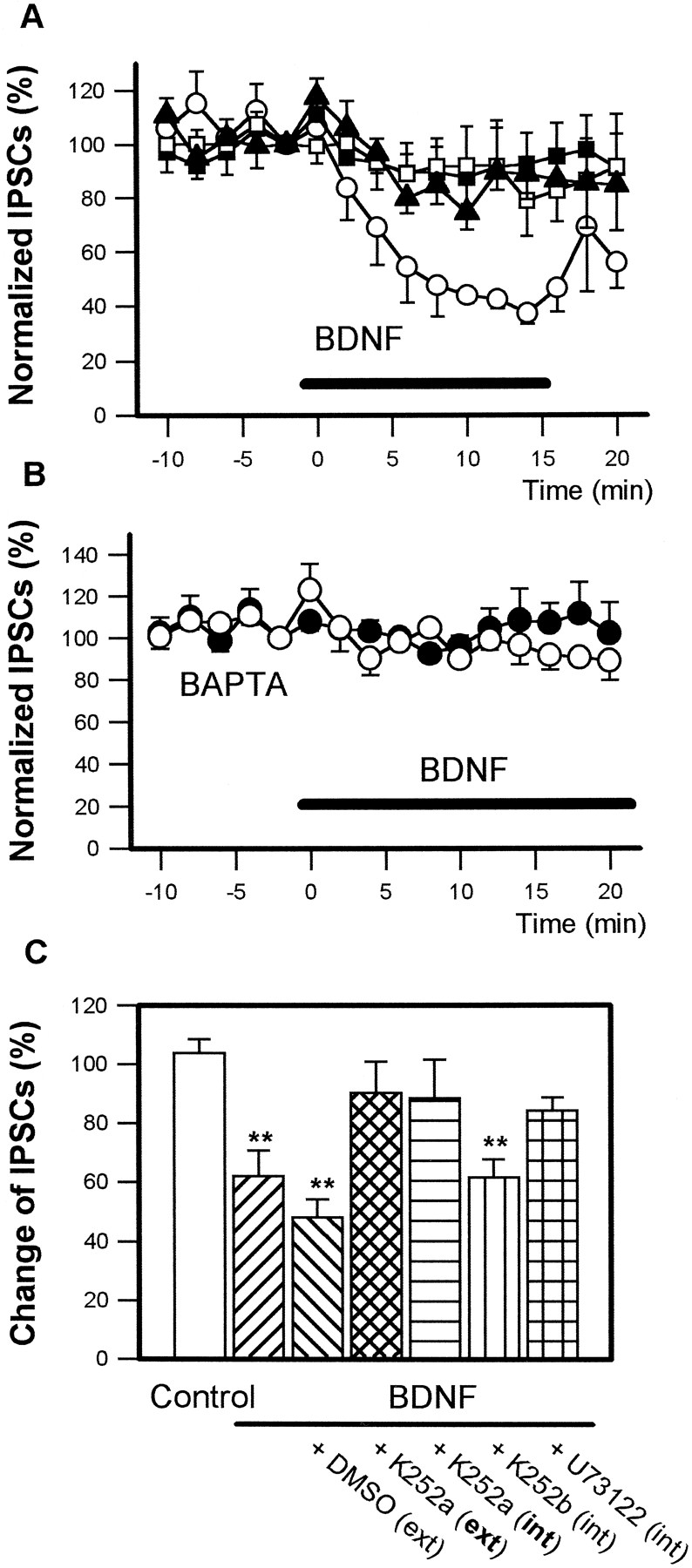
amplitude of IPSCs (Fig. 4A, solid
squares), suggesting that BDNF requires Trk-type receptor
activation for the depression of IPSCs. Attenuation of the amplitude of
IPSCs by BDNF also was prevented when the postsynaptic pyramidal neuron
was loaded intracellularly with K252a by use of a patch pipette
containing 200 nM K252a (Fig. 4A, open
squares), although it was not inhibited by intracellularly applied
200 nM K252b (Fig. 4C), which is a weaker
kinase inhibitor of Trk-type [mean ± SEM; % of baseline:
extracellular (ext) K252a, 90.2 ± 10.6 (n = 5);
intracellular (int) K252a, 88.5 ± 13.0 (n = 5); int K252b, 61.6 ± 6.1 (n = 4), p < 0.05]. These data suggest that BDNF modulates IPSCs via activation
of a postsynaptic Trk-type receptor.
Fig. 4.
BDNF-induced inhibition of IPSCs requires
postsynaptic activation of Trk-type receptor and subsequent
Ca2+ mobilization. A, Perfusion of 100 ng/ml
BDNF (horizontal solid bar) decreased the amplitude of
IPSCs (open circles). Incubation of slices
extracellularly with 200 nM K252a for 1 hr before the experiment prevented the 100 ng/ml BDNF-induced inhibition of IPSCs
(solid squares). BDNF (100 ng/ml) also failed to
attenuate IPSCs when CA1 pyramidal neurons were loaded intracellularly
with 200 nM K252a (open squares) or 5 µM U73122 (solid triangles) in the
whole-cell recording electrode. B, Intracellular BAPTA
(10 mM) also blocked the 100 ng/ml BDNF-induced attenuation
of IPSCs (open circles). Solid circles
indicate control responses in the absence of BDNF. C,
Summarized graph from A. Data are ensemble averages
measured between 8 and 14 min after the application of BDNF.
Extracellular application (ext) of 200 nM
K252a and intracellular application (int) of 200 nM K252a and 5 µM U73122 effectively prevented the attenuation by BDNF. Intracellular K252b (200 nM) was ineffective (**p < 0.01, Dunnett test; n = 5-6).
[View Larger Version of this Image (27K GIF file)]
Involvement of [Ca2+]i mobilization
In hippocampal pyramidal neurons phospholipase C- 1 (PLC- 1)
is abundant in the cell soma as well as in dendrites (Yamada et al.,
1991 ). This enzyme, activated by TrkB, generates inositol triphosphate
(IP3), which mobilizes intracellular Ca2+ from
endoplasmic reticulum (Widmer et al., 1992 , 1993 ; Zirrgiebel et al.,
1995 ). Thus, we investigated the possibility of involvement of
intracellular Ca2+ mobilization. BDNF failed to attenuate
IPSCs when U73122 (5 µM), a broad-spectrum PLC inhibitor
(Chen et al., 1994 ), was injected intracellularly into pyramidal
neurons (Fig. 4A, solid triangles) [mean ± SEM; % of baseline: int U73122, 84.3 ± 4.4 (n = 5)] or when intracellular Ca2+ concentration
([Ca2+]i) was reduced with 10 mM
BAPTA, a potent chelator (Fig. 4B) [mean ± SEM; % of baseline: control, 101.8 ± 7.6 (n = 7); BDNF 20 ng/ml, 97.1 ± 8.4 (n = 5); BDNF 100 ng/ml, 97.7 ± 3.7 (n = 7)]. These data suggest
that BDNF reduces the amplitude of IPSCs by postsynaptic elevation of
[Ca2+]i via IP3 production.
Reduction of postsynaptic responsiveness to applied GABA
As mentioned above, we found that the second messenger system in
postsynaptic neurons is necessary for the reduction of IPSCs. However,
whether postsynaptic Trk activation results in a decrease of
postsynaptic GABAA receptor responsiveness or in
attenuation of presynaptic GABA release remains to be clarified.
Metabotropic change in postsynaptic cells may influence presynaptic
GABA release. Previous works (Pilter and Alger, 1992 , 1994 ) indicate
that an increase in postsynaptic [Ca2+]i
induced by spike firing or depolarization reduces GABAergic synaptic
inhibition by decreasing the release of GABA presynaptically. Therefore, we analyzed the inhibitory effect of BDNF on the
responsiveness to applied GABA.
GABA was applied to a hippocampal slice by gravity-driven flow through
a multibarreled tube (diameter 1.5 mm) positioned <200 µm from the
recorded CA1 pyramidal neuron. Introduction of 10 µM GABA
for 2 sec at the CA1 region at 3 or 5 min intervals induced GABAA receptor-mediated inward current. Because GABA was
applied for only 2 sec, no apparent desensitization or running-down of the responses was observed at these intervals for at least 30 min
[96.4 ± 4.8% (n = 4) of the initial control
response]. Bath application of 50 ng/ml BDNF for 15 min decreased
GABA-induced current to 64.4 ± 8.8% (n = 4) of
the control response before treatment (Fig. 5). This
suggests that BDNF reduces postsynaptic responsiveness to GABA.
Fig. 5.
Reduction of postsynaptic responsiveness to GABA.
Gravity-driven introduction of 10 µM GABA for 2 sec
(horizontal solid bars) at 5 min intervals through a
multibarreled tube positioned <200 µm from the CA1 region elicited
inward-directed GABAA receptor-mediated current in
voltage-clamped ( 60 mV) CA1 pyramidal cells (left). This response was attenuated by a 15 min perfusion of 50 ng/ml BDNF
(middle). More than 30 min of washout of BDNF was
necessary for the recovery (right), but it was
incomplete.
[View Larger Version of this Image (15K GIF file)]
Effects on spontaneous IPSCs
Experiments on stimulus-evoked IPSCs were supplemented with
data on spontaneous events that result from action potentials generated
by interneurons, because these events probably reflect accurately the
normal functioning of GABA synapses (Mody et al., 1994 ). Numerous
spontaneously occurring currents were recorded from CA1 pyramidal
neurons in the presence of 50 µM APV and 20 µM CNQX. They were blocked by 10 µM
picrotoxin or bicuculline, indicating that they are IPSCs generated by
spontaneous GABA release from interneurons (Fig. 6).
Perfusion of a hippocampal slice with BDNF (50 ng/ml) for 15 min
markedly reduced the size of the events (Fig.
7A) and caused a significant decrease in the
average amplitude of IPSCs (control, 32.7 ± 10.2 pA; BDNF,
23.9 ± 9.9 pA; p < 0.01, paired t
test; n = 5), although the total frequency was not
changed significantly (control, 2.85 ± 0.62 Hz; BDNF, 2.56 ± 0.77 Hz). This decrease of the mean amplitude resulted in a leftward
shift in the amplitude distribution (Fig. 7B).
Fig. 6.
Recording of spontaneous IPSCs from CA1 pyramidal
cells. A, Numerous spontaneous events were recorded from
voltage-clamped ( 60 mV) CA1 pyramidal cells in the presence of 50 µM APV and 20 µM CNQX. B,
Bicuculline (20 µM), a GABAA receptor
antagonist, completely blocked the spontaneous events.
C, Shown is the recovery of the spontaneous events after
the washout of bicuculline.
[View Larger Version of this Image (21K GIF file)]
Fig. 7.
Reduction of the amplitude, but not the frequency,
of spontaneous IPSCs by BDNF. BDNF (50 ng/ml, 15 min) reduced the
amplitude, but not the frequency, of spontaneous IPSCs (lower
traces). B, Summarized histograms from the data
shown in A. BDNF caused a slight leftward shift in the
amplitude distribution, reflecting a decrease in the mean size of these
events. Data were sampled for 200 sec in the absence
(left) or presence (right) of 50 ng/ml BDNF.
[View Larger Version of this Image (23K GIF file)]
DISCUSSION
Inhibition of GABAA receptor-mediated IPSCs
by BDNF
The present experiments demonstrated that BDNF regulates
GABAA receptor responses via activation of a Trk-type
receptor located in postsynaptic neurons. In the hippocampus excitatory
neuronal networks are controlled by inhibitory innervation. An
anatomical and electrophysiological approach identified three distinct
types of GABAergic neurons (axo-axonic, basket, and bistratified cells) in the hippocampus. Each type of inhibitory neuron innervates a
different domain of the surface of the principal neurons by activation
of postsynaptic GABAA receptor. The axo-axonic cell primarily forms synapses on the axon initial segment of the principal cell, the basket cell primarily on the soma, and the bistratified cell
on the apical and basal dendrites (Buhl et al., 1994 ). GABAergic interneurons mediate different inhibitory effects, such as recurrent inhibition, shunting of dendritic excitatory inputs, or governing of
the firing threshold. Therefore, suppression of postsynaptic GABAA receptor by BDNF will facilitate neural excitation
and generation of action potential firing. Indeed, exogenous BDNF
promotes the induction of LTP in the young hippocampus; in turn,
endogenous BDNF is suggested to be involved in the triggering mechanism
of LTP in the adult (Figurov et al., 1996 ). Disinhibition induced by
BDNF will participate in the induction of LTP, because elimination of
GABAergic hyperpolarizing influence relieves voltage-dependent Mg2+ block of NMDA receptor-channel and facilitates the
induction of LTP (Davies et al., 1991 ; Mott and Lewis, 1991 ). This also is supported by the results of mutant mice lacking BDNF (Korte et al.,
1995 ), which showed significantly reduced LTP in the hippocampus. Moreover, judging from the figure, field EPSP of the mutant mice clearly was enhanced more by GABAA-receptor blocker than
that of control mice, although the authors did not mention it. This result agrees with our data that BDNF suppresses GABAA
synaptic responses. GABAA-mediated synaptic transmission in
the normal hippocampus may be regulated adequately by endogenous
BDNF.
Kim et al. (1994) reported previously that neurotrophin-3 (NT-3),
another member of neurotrophins, inhibits GABAA synaptic transmission in cultured embryonic cortical neurons. NT-3 primarily binds to TrkC but also can activate TrkB (Soppet et al., 1991 ; Squinto
et al., 1991 ). Therefore, it was not clear whether TrkB participates in
the regulation of GABAA receptor function. The present
study using BDNF, a specific ligand for TrkB, indicates that TrkB
participates in the modulation of GABAA receptor function, although TrkC also may regulate it. However, in contrast to BDNF expression, NT-3 expression level is downregulated in the adult brain
by neuronal activity (Lindvall et al., 1992 ; Rocamora et al., 1992 ,
1994 ; Bengzon et al., 1993 ) (but also see Patterson et al., 1992 ). In
this respect, it is difficult to regard NT-3 as a signal that is
secreted activity dependently, which triggers neural plasticity. BDNF
seems to be a more promising candidate for the signal because of its
mRNA upregulation (Falkenberg et al., 1992 ; Patterson et al., 1992 ;
Rocamora et al., 1992 ; Bengzon et al., 1993 ; Kokaia et al., 1993 ) and
secretion by neuronal activity (Griesbeck et al., 1995 ; Goodmann et
al., 1996 ). Generally, expression of NT-3 is highest in immature CNS
and dramatically decreases with maturation. On the contrary, expression
of BDNF is low in developing regions of the CNS and increases as these
regions mature (Maisonpierre et al., 1990 ). Therefore, TrkC activated
by NT-3 may modulate synaptic transmission in the developing synapses, but not in the matured synapses.
BDNF did not affect non-NMDA-type glutamate receptor-mediated EPSCs in
the present study. However, Levine et al. (1995) reported that BDNF
increased both the frequency and amplitude of excitatory transmission
in cultured embryonic neurons. Two contradictory results were reported
from the analysis of field potentials in hippocampal slices. Kang and
Schuman (1995) showed long-lasting BDNF-induced enhancement of synaptic
transmission, whereas Figurov et al. (1996) recently reported no change
of baseline response. We do not have a reasonable explanation for the
discrepancy; however, Kang et al. (1996) reported that the perfusion
rate is critical for the penetration of BDNF into the hippocampal
slices.
In several cases we observed transient increases in the amplitude of
EPSCs as well as that of IPSCs within 2 min after the start of BDNF
perfusion (Fig. 1B,D), although it was not
statistically significant. This enhancement was accompanied by an
increase in frequency of spontaneous postsynaptic currents, which was
similar to the results in cultured embryonic neurons (Le mann et al., 1994 ). The transient effect is probably attributable to the presynaptic enhancement, because the intracellular application of K252a or BAPTA
into postsynaptic neurons did not affect it.
Modulation of two types of inhibitory inputs
CA1 pyramidal neurons receive GABAA receptor-mediated
inhibitory inputs from two sources, SP and SL-M. The two
GABAA-mediated inhibitory responses are distinct in term of
physiological, pharmacological, and anatomical properties (Pearce,
1993 ; Pearce et al., 1995 ). However, BDNF inhibited both IPSCs evoked
by SP and SL-M stimulations, suggesting the colocalization of
GABAA receptor and BDNF receptor TrkB. TrkB
immunoreactivity is distributed widely to the pyramidal cell soma and
dendrites (Zhou et al., 1993 ). Additionally, PLC- 1 also is
distributed widely and abundantly in the pyramidal cell (Yamada et al.,
1991 ) in correspondence to the wide distribution of TrkB, suggesting
the functional coupling between GABAA receptor and TrkB
signaling cascade.
Involvement of postsynaptic TrkB activation
BDNF specifically binds to TrkB, a neurotrophin receptor,
including the catalytic domain of tyrosine kinase (Soppet et al., 1991 ;
Squinto et al., 1991 ). BDNF failed to reduce the amplitude of IPSCs
when the recorded neuron was loaded intracellularly with K252a as well
as when hippocampal slices were pretreated with K252a. K252a is an
alkaloid that inhibits biological activities of neurotrophins and
kinase activity of the Trk receptor family (Knüsel and Hefti,
1992 ). Therefore, these data suggest that BDNF modulates IPSCs via
activation of a postsynaptic Trk-type receptor. K252b (200 nM) could not inhibit BDNF-induced reduction in the
amplitude of IPSCs. It is a weaker inhibitor and is usually effective
at concentrations higher than 1 µM (Widmer et al.,
1992 ).
Involvement of intracellular Ca2+ mobilization
The binding of neurotrophins to the Trk receptor family initiates
a signaling cascade involving phosphorylation of intracellular proteins
on tyrosine residues. BDNF-activated TrkB rapidly associates with and
phosphorylates the cytoplasmic proteins, PLC- 1, SUS-associated neurotrophic factor-induced tyrosine-phosphor-ylated target (SNT), and Erk1 (Knüsel et al., 1994 ). In hippocampal pyramidal neurons PLC- 1 is abundant in the cell soma as well as in the dendrites (Yamada et al., 1991 ). This enzyme, activated by TrkB, generates inositol triphosphate (IP3), which mobilizes intracellular
Ca2+ from endoplasmic reticulum (Widmer et al., 1992 , 1993 ;
Zirrgiebel et al., 1995 ). BDNF failed to attenuate IPSCs when U73122, a
broad-spectrum PLC inhibitor (Chen et al., 1994 ), was injected
intracellularly into pyramidal neurons (Fig. 3A, solid
triangles) or when intracellular Ca2+ concentration
([Ca2+]i) was reduced with 10 mM
BAPTA, a potent chelator (Fig. 3B). These data suggest that
BDNF reduces the amplitude of IPSCs by postsynaptic elevation of
[Ca2+]i via IP3 production. BDNF
stimulates PLC- 1 phosphorylation within 20 sec (Widmer et al., 1993 )
and mobilizes intracellular Ca2+ within 1 min (Berninger et
al., 1993 ). In this respect, there seems to be a time lag between
elevation of [Ca2+]i and BDNF-induced
reduction of the amplitude of IPSCs, suggesting the involvement of
activation of some signal cascade after the rise in
[Ca2+]i. GABAA receptor function
is maintained by phosphorylation and disrupted by
[Ca2+]i elevation (Stelzer et al., 1988 ;
Marchenko, 1991 ; Gyenes et al., 1994 ; Moss et al., 1995 ). In this
respect, dephosphorylation induced by a Ca2+-dependent
phosphatase may be involved in the downstream of BDNF-activated signal
transduction and lead to the attenuation of GABAA response (Stelzer and Shi, 1994 ; Chen and Wong, 1995 ).
Reduction in the amplitude of spontaneous IPSCs
BDNF reduced the amplitude of spontaneous IPSCs (sIPSCs), but not
total frequency (Fig. 7). The spontaneous events that result from
action potentials generated by interneurons probably reflect accurately
the normal functioning of GABA synapse (Mody et al., 1994 ). These
sIPSCs result from the highly synchronous release of GABA at several
boutons, although stimulus-evoked IPSCs tends to reflect asynchronous
release. Therefore, analysis of sIPSCs attributes the decrease of
amplitude by BDNF to the reduction of postsynaptic receptor
responsiveness to released GABA. This result coincides with the
postsynaptic reduction of responses to exogenously applied GABA (Fig.
5) and also is supported by the pharmacological attempts to block
postsynaptic Trk-type receptor kinase activity (Fig. 4).
Conclusion
The present study demonstrates that BDNF directly modulates
GABAA function, but not glutamate receptor function, via
postsynaptic activation of Trk-type receptors. This disinhibition would
enhance synaptic responses and facilitate the induction of LTP by
eliminating dendritic shunting. BDNF not only enhances synaptic
efficacy but also may promote the transduction of output signal.
FOOTNOTES
Received Nov. 18, 1996; revised Feb. 3, 1997; accepted Feb. 11, 1997.
We thank Sumitomo Pharmaceutical Company for providing human
recombinant BDNF and Dr. Hiroshi Katsuki for excellent technical advice.
Correspondence should be addressed to Dr. Norio Matsuki at the above
address.
REFERENCES
-
Bengzon J,
Kokaia Z,
Ernfors P,
Kokaia M,
Leanza G,
Nilsson OG,
Persson H,
Lindvall O
(1993)
Regulation of neurotrophin and trkA, trkB, and trkC tyrosine kinase receptor messenger RNA expression in kindling.
Neuroscience
53:433-446[Web of Science][Medline].
-
Berninger B,
García DE,
Inagaki N,
Hahnel C,
Lindoholm D
(1993)
BDNF and NT-3 induce intracellular Ca2+ elevation in hippocampal neurons.
NeuroReport
4:1303-1306[Web of Science][Medline].
-
Blöchl A,
Thoenen H
(1995)
Characterization of nerve growth factor (NGF) release from hippocampal neurons: evidence for a constitutive and an unconventional sodium-dependent regulated pathway.
Eur J Neurosci
7:1220-1228[Web of Science][Medline].
-
Blöchl A,
Thoenen H
(1996)
Localization of cellular storage compartments and sites of constitutive and activity-dependent release of nerve growth factor (NGF) in primary cultures of hippocampal neurons.
Mol Cell Neurosci
7:173-190[Web of Science][Medline].
-
Buhl EH,
Halasy K,
Somogyi P
(1994)
Diverse sources of hippocampal unitary inhibitory postsynaptic potentials and the number of synaptic release sites.
Nature
368:823-828[Medline].
-
Chen P,
Xie H,
Sekar C,
Gupta K,
Wells A
(1994)
Epidermal growth factor receptor-mediated cell motility: phospholipase C activity is required, but mitogen-activated protein kinase activity is not sufficient for induced cell movement.
J Cell Biol
127:847-857[Abstract/Free Full Text].
-
Chen QX,
Wong RKS
(1995)
Suppression of GABAA receptor responses by NMDA application in hippocampal neurons acutely isolated from the adult guinea-pig.
J Physiol (Lond)
482:353-362[Abstract/Free Full Text].
-
Davies CH,
Starkey SJ,
Pozza MF,
Collingridge GL
(1991)
GABAB autoreceptors regulate the induction of LTP.
Nature
349:609-611[Medline].
-
Ernfors P,
Ibáñez CF,
Ebendal T,
Olson L,
Persson H
(1990a)
Molecular cloning and neurotrophic activities of a protein with structural similarities to nerve growth factor: developmental and topographical expression in the brain.
Proc Natl Acad Sci USA
87:5454-5458[Abstract/Free Full Text].
-
Ernfors P,
Wetmore C,
Olson L,
Persson H
(1990b)
Identification of cells in rat brain and peripheral tissues expressing mRNA for members of the nerve growth factor family.
Neuron
5:511-526[Web of Science][Medline].
-
Falkenberg T,
Ernfors P,
Persson H,
Lindefors N
(1992)
Cortical trans-synaptic activation of tyrosine kinase receptor trkB messenger RNA expression in rat hippocampus.
Neuroscience
51:883-889[Web of Science][Medline].
-
Figurov A,
Pozzo-Miller L,
Olafsson P,
Wang T,
Lu B
(1996)
Regulation of synaptic responses to high-frequency stimulation and LTP by neurotrophins in the hippocampus.
Nature
381:706-709[Medline].
-
Friedman WJ,
Ernfors P,
Persson H
(1991)
Transient and persistent expression of NT-3/HDNF mRNA in the rat brain during postnatal development.
J Neurosci
11:1577-1584[Abstract].
-
Goodmann LJ,
Valverde J,
Lim F,
Geschwind MD,
Federoff HJ,
Geller AI,
Hefti F
(1996)
Regulated release and polarized localization of brain-derived neurotrophic factor in hippocampal neurons.
Mol Cell Neurosci
7:222-238[Web of Science][Medline].
-
Griesbeck O, Blöchl A, Carnahan JF, Nawa H, Thoenen
H (1995) Characterization of brain-derived neurotrophic
factor (BDNF) secretion from hippocampal neurons. Soc Neurosci Abstr
21[part 2]:1046.
-
Gyenes M,
Wang Q,
Gibbs TT,
Farb DH
(1994)
Phosphorylation factors control neurotransmitter and neuromodulator actions at the
-aminobutyric acid type A receptor.
Mol Pharmacol
46:542-549[Abstract]. -
Kang H,
Schuman EM
(1995)
Long-lasting neurotrophin-induced enhancement of synaptic transmission in the adult hippocampus.
Science
264:1658-1662[Web of Science].
-
Kang H,
Jia LZ,
Suh KY,
Tang L,
Schuman EM
(1996)
Determination of BDNF-induced hippocampal synaptic plasticity: role of the TrkB receptor and the kinetics of neurotrophin delivery.
Learn Mem
3:188-196.[Abstract/Free Full Text]
-
Kim HG,
Wang T,
Olafsson P,
Lu B
(1994)
Neurotrophin 3 potentiates neuronal activity and inhibits
-aminobutyratergic synaptic transmission in cortical neurons.
Proc Natl Acad Sci USA
91:12341-12345[Abstract/Free Full Text]. -
Knüsel B,
Hefti F
(1992)
K252 compounds: modulators of neurotrophin signal transduction.
J Neurochem
59:1987-1996[Web of Science][Medline].
-
Knüsel B,
Rabin SJ,
Hefti F,
Kaplan DR
(1994)
Regulated neurotrophin receptor responsiveness during neural migration and early differentiation.
J Neurosci
14:1542-1554[Abstract].
-
Kokaia Z,
Bengzon J,
Metsis M,
Kokaia M,
Persson H,
Lindvall O
(1993)
Coexpression of neurotrophins and their receptors in neurons of the central nervous system.
Proc Natl Acad Sci USA
90:6711-6715[Abstract/Free Full Text].
-
Korte M,
Carroll P,
Wolf E,
Brem G,
Thoenen H,
Bonhoeffer T
(1995)
Hippocampal long-term potentiation is impaired in mice lacking brain-derived neurotrophic factor.
Proc Natl Acad Sci USA
92:8856-8860[Abstract/Free Full Text].
-
Kyrozis A,
Reichling DB
(1995)
Perforated-patch recording with gramicidin avoids artifactual changes in intracellular chloride concentration.
J Neurosci Methods
57:27-35[Web of Science][Medline].
-
Le
mann V,
Gottmann K,
Heumann R
(1994)
BDNF and NT-4/5 enhance glutamatergic synaptic transmission in cultured hippocampal neurons.
NeuroReport
6:21-25[Web of Science][Medline]. -
Levine ES,
Dreyfus CF,
Black IB,
Plummer MR
(1995)
Brain-derived neurotrophic factor rapidly enhances synaptic transmission in hippocampal neurons via postsynaptic tyrosine kinase receptors.
Proc Natl Acad Sci USA
92:8074-8077[Abstract/Free Full Text].
-
Lindvall O,
Ernfors P,
Bengzon J,
Kokaia Z,
Smith ML,
Siesjö BK,
Persson H
(1992)
Differential regulation of mRNAs for nerve growth factor, brain-derived neurotrophic factor, and neurotrophin 3 in the adult rat brain following cerebral ischemia and hypoglycemic coma.
Proc Natl Acad Sci USA
89:648-652[Abstract/Free Full Text].
-
Maisonpierre PC,
Belluscio L,
Friedman B,
Alderson RF,
Wiegand SJ,
Furth ME,
Lindsay RM,
Yancopoulos GD
(1990)
NT-3, BDNF, and NGF in the developing rat nervous system: parallel as well as reciprocal patterns of expression.
Neuron
5:501-509[Web of Science][Medline].
-
Marchenko SM
(1991)
Mechanism of modulation of GABA-activated current by internal calcium in rat central neurons.
Brain Res
546:355-357[Web of Science][Medline].
-
Masana Y,
Wanaka A,
Kato H,
Asai T,
Tohyama M
(1993)
Localization of trkB mRNA in postnatal development.
J Neurosci Res
35:468-479[Web of Science][Medline].
-
Merlio JP,
Ernfors MJ,
Persson H
(1992)
Molecular cloning of rat trkC and distribution of cells expressing messenger RNAs for members of the trk family in the rat central nervous system.
Neuroscience
51:513-532[Web of Science][Medline].
-
Mody I,
Koninck D,
Otis TS,
Sotesz I
(1994)
Bridging the cleft at GABA synapses in the brain.
Trends Neurosci
17:517-525[Web of Science][Medline].
-
Moss SJ,
Gorrie GH,
Amato A,
Smart TG
(1995)
Modulation of GABAA receptors by tyrosine phosphorylation.
Nature
377:344-348[Medline].
-
Mott DD,
Lewis DV
(1991)
Facilitation of the induction of long-term potentiation by GABAB receptors.
Science
252:1718-1720[Abstract/Free Full Text].
-
Patterson SL,
Grover LM,
Schwartzkroin PA,
Bothwell M
(1992)
Neurotrophin expression in rat hippocampal slices: a stimulus paradigm inducing LTP in CA1 evokes increases in BDNF and NT-3 mRNA.
Neuron
9:1081-1088[Web of Science][Medline].
-
Pearce RA
(1993)
Physiological evidence for two distinct GABAA responses in rat hippocampus.
Neuron
10:189-200[Web of Science][Medline].
-
Pearce RA,
Grunder SD,
Faucher LD
(1995)
Different mechanisms for use-dependent depression of two GABAA-mediated IPSCs in rat hippocampus.
J Physiol (Lond)
484:425-435[Abstract/Free Full Text].
-
Phillips HS,
Hains HM,
Laramee GR,
Rosenthal A,
Winslow A
(1990)
Widespread expression of BDNF but not NT3 by target areas of basal forebrain cholinergic neurons.
Science
250:290-294[Abstract/Free Full Text].
-
Pilter TA,
Alger BE
(1992)
Postsynaptic spike firing reduces synaptic GABAA responses in hippocampal pyramidal cells.
J Neurosci
12:4122-4132[Abstract].
-
Pilter TA,
Alger BE
(1994)
Depolarization-induced suppression of GABAergic inhibition in rat hippocampal pyramidal cells: G-protein involvement in a presynaptic mechanism.
Neuron
13:1447-1455[Web of Science][Medline].
-
Ringstedt T,
Lagercrantz H,
Persson H
(1993)
Expression of members of the trk family in the developing postnatal rat brain.
Dev Brain Res
72:119-131[Medline].
-
Rocamora N,
Palacios JM,
Mengod G
(1992)
Limbic seizures induce a differential regulation of the expression of nerve growth factor, brain-derived neurotrophic factor, and neurotrophin-3 in the rat hippocampus.
Mol Brain Res
13:27-33[Medline].
-
Rocamora N,
Massieu L,
Boddeke HWGM,
Palacios JM,
Mengod G
(1994)
Differential regulation of the expression of nerve growth factor, brain-derived neurotrophic factor, and neurotrophin-3 mRNAs in adult rat brain after intrahippocampal injection of quinolinic acid.
Mol Brain Res
26:89-98[Medline].
-
Soppet D,
Escandon D,
Maragos J,
Middlemas DS,
Reid SW,
Blair J,
Burton LE,
Stanton BR,
Kaplan DR,
Hunter T,
Nikolics K,
Parada LF
(1991)
The neurotrophic factors, brain-derived neurotrophic factor and neurotrophin-3, are ligands for the trkB tyrosine kinase receptor.
Cell
65:895-903[Web of Science][Medline].
-
Squinto SP,
Stitt TN,
Aldrich TH,
Davis S,
Bianco SM,
Radziejewski C,
Glass DJ,
Masiakowski P,
Furth ME,
Valenzuela DM,
DiStefano PS,
Yancopoulos GD
(1991)
TrkB encodes a functional receptor for brain-derived neurotrophic factor and neurotrophin-3, but not nerve growth factor.
Cell
65:885-893[Web of Science][Medline].
-
Stelzer A,
Shi H
(1994)
Impairment of GABAA receptor function by N-methyl-D-aspartate-mediated calcium influx in isolated CA1 pyramidal cells.
Neuroscience
62:813-828[Web of Science][Medline].
-
Stelzer A,
Kay AR,
Wong RKS
(1988)
GABAA-receptor function in hippocampal cells is maintained by phosphorylation factors.
Science
241:339-341[Abstract/Free Full Text].
-
Stuart GJ,
Sakmann B
(1994)
Active propagation of somatic action potentials into neocortical pyramidal cell dendrites.
Nature
367:69-72[Medline].
-
Thoenen H
(1995)
Neurotrophins and neuronal plasticity.
Science
270:593-598[Abstract/Free Full Text].
-
Widmer HR,
Knüsel B,
Hefti F
(1992)
Stimulation of phosphatidylinositol hydrolysis by brain-derived neurotrophic factor and neurotrophin-3 in rat cerebral cortical neurons developing in culture.
J Neurochem
59:2113-2124[Web of Science][Medline].
-
Widmer HR,
Kaplan DR,
Rabin SJ,
Beck KD,
Hefti F,
Knüsel B
(1993)
Rapid phosphorylation of phospholipase C
1 by brain-derived neurotrophic factor and neurotrophin-3 in cultures of embryonic rat cortical neurons.
J Neurochem
60:2111-2123[Web of Science][Medline]. -
Yamada M,
Mizuguchi M,
Rhee SG,
Kim SU
(1991)
Developmental changes of three phosphoinositide-specific phospholipase C isozymes in the rat nervous system.
Dev Brain Res
59:7-16[Medline].
-
Zhou XF,
Parada LF,
Soppet D,
Rush RA
(1993)
Distribution of TrkB tyrosine kinase immunoreactivity in the rat central nervous system.
Brain Res
622:63-70[Web of Science][Medline].
-
Zirrgiebel U,
Ohga Y,
Carter B,
Berninger B,
Inagaki N,
Thoenen H,
Lindoholm D
(1995)
Characterization of TrkB receptor-mediated signaling pathways in rat cerebellar granule neurons: involvement of protein kinase C in neuronal survival.
J Neurochem
65:2241-2250[Web of Science][Medline].
This article has been cited by other articles:

|
 |

|
 |
 
K. Sakata, N. H. Woo, K. Martinowich, J. S. Greene, R. J. Schloesser, L. Shen, and B. Lu
Critical role of promoter IV-driven BDNF transcription in GABAergic transmission and synaptic plasticity in the prefrontal cortex
PNAS,
April 7, 2009;
106(14):
5942 - 5947.
[Abstract]
[Full Text]
[PDF]
|
 |
|

|
 |

|
 |
 
L. Pozzo-Miller
GABAergic synapse maturation: evidence of the instructive role of activity-dependent BDNF release
J. Physiol.,
November 1, 2008;
586(21):
5041 - 5041.
[Full Text]
[PDF]
|
 |
|

|
 |

|
 |
 
N. Kuczewski, A. Langlois, H. Fiorentino, S. Bonnet, T. Marissal, D. Diabira, N. Ferrand, C. Porcher, and J.-L. Gaiarsa
Spontaneous glutamatergic activity induces a BDNF-dependent potentiation of GABAergic synapses in the newborn rat hippocampus
J. Physiol.,
November 1, 2008;
586(21):
5119 - 5128.
[Abstract]
[Full Text]
[PDF]
|
 |
|

|
 |

|
 |
 
C. C. Fernandes, A. Pinto-Duarte, J. A. Ribeiro, and A. M. Sebastiao
Postsynaptic Action of Brain-Derived Neurotrophic Factor Attenuates {alpha}7 Nicotinic Acetylcholine Receptor-Mediated Responses in Hippocampal Interneurons
J. Neurosci.,
May 21, 2008;
28(21):
5611 - 5618.
[Abstract]
[Full Text]
[PDF]
|
 |
|

|
 |

|
 |
 
I. Abidin, U. T. Eysel, V. Lessmann, and T. Mittmann
Impaired GABAergic inhibition in the visual cortex of brain-derived neurotrophic factor heterozygous knockout mice
J. Physiol.,
April 1, 2008;
586(7):
1885 - 1901.
[Abstract]
[Full Text]
[PDF]
|
 |
|

|
 |

|
 |
 
S. Lei, P.-Y. Deng, J. E. Porter, and H.-S. Shin
Adrenergic Facilitation of GABAergic Transmission in Rat Entorhinal Cortex
J Neurophysiol,
November 1, 2007;
98(5):
2868 - 2877.
[Abstract]
[Full Text]
[PDF]
|
 |
|

|
 |

|
 |
 
Y. Ben-Ari, J.-L. Gaiarsa, R. Tyzio, and R. Khazipov
GABA: A Pioneer Transmitter That Excites Immature Neurons and Generates Primitive Oscillations
Physiol Rev,
October 1, 2007;
87(4):
1215 - 1284.
[Abstract]
[Full Text]
[PDF]
|
 |
|

|
 |

|
 |
 
R. Kolarow, T. Brigadski, and V. Lessmann
Postsynaptic Secretion of BDNF and NT-3 from Hippocampal Neurons Depends on Calcium Calmodulin Kinase II Signaling and Proceeds via Delayed Fusion Pore Opening
J. Neurosci.,
September 26, 2007;
27(39):
10350 - 10364.
[Abstract]
[Full Text]
[PDF]
|
 |
|

|
 |

|
 |
 
C. Wang, E. Bomberg, C. Billington, A. Levine, and C. M. Kotz
Brain-derived neurotrophic factor in the hypothalamic paraventricular nucleus increases energy expenditure by elevating metabolic rate
Am J Physiol Regulatory Integrative Comp Physiol,
September 1, 2007;
293(3):
R992 - R1002.
[Abstract]
[Full Text]
[PDF]
|
 |
|

|
 |

|
 |
 
M. H. Mohajerani, S. Sivakumaran, P. Zacchi, P. Aguilera, and E. Cherubini
Correlated network activity enhances synaptic efficacy via BDNF and the ERK pathway at immature CA3 CA1 connections in the hippocampus
PNAS,
August 7, 2007;
104(32):
13176 - 13181.
[Abstract]
[Full Text]
[PDF]
|
 |
|

|
 |

|
 |
 
N. Wanaverbecq, A. Semyanov, I. Pavlov, M. C. Walker, and D. M. Kullmann
Cholinergic Axons Modulate GABAergic Signaling among Hippocampal Interneurons via Postsynaptic {alpha}7 Nicotinic Receptors
J. Neurosci.,
May 23, 2007;
27(21):
5683 - 5693.
[Abstract]
[Full Text]
[PDF]
|
 |
|

|
 |

|
 |
 
M. V. Caldeira, C. V. Melo, D. B. Pereira, R. Carvalho, S. S. Correia, D. S. Backos, A. L. Carvalho, J. A. Esteban, and C. B. Duarte
Brain-derived Neurotrophic Factor Regulates the Expression and Synaptic Delivery of{alpha}-Amino-3-hydroxy-5-methyl-4-isoxazole Propionic Acid Receptor Subunits in Hippocampal Neurons
J. Biol. Chem.,
April 27, 2007;
282(17):
12619 - 12628.
[Abstract]
[Full Text]
[PDF]
|
 |
|

|
 |

|
 |
 
G. Lynch, E. A. Kramar, C. S. Rex, Y. Jia, D. Chappas, C. M. Gall, and D. A. Simmons
Brain-Derived Neurotrophic Factor Restores Synaptic Plasticity in a Knock-In Mouse Model of Huntington's Disease
J. Neurosci.,
April 18, 2007;
27(16):
4424 - 4434.
[Abstract]
[Full Text]
[PDF]
|
 |
|

|
 |

|
 |
 
J. O. McNamara, Y. Z. Huang, and A. S. Leonard
Molecular Signaling Mechanisms Underlying Epileptogenesis
Sci. Signal.,
October 10, 2006;
2006(356):
re12 - re12.
[Abstract]
[Full Text]
[PDF]
|
 |
|

|
 |

|
 |
 
T. Kanematsu, A. Yasunaga, Y. Mizoguchi, A. Kuratani, J. T. Kittler, J. N. Jovanovic, K. Takenaka, K. I. Nakayama, K. Fukami, T. Takenawa, et al.
Modulation of GABAA Receptor Phosphorylation and Membrane Trafficking by Phospholipase C-related Inactive Protein/Protein Phosphatase 1 and 2A Signaling Complex Underlying Brain-derived Neurotrophic Factor-dependent Regulation of GABAergic Inhibition
J. Biol. Chem.,
August 4, 2006;
281(31):
22180 - 22189.
[Abstract]
[Full Text]
[PDF]
|
 |
|

|
 |

|
 |
 
G. L. Dunbar, M. I. Sandstrom, J. Rossignol, and L. Lescaudron
Neurotrophic Enhancers as Therapy for Behavioral Deficits in Rodent Models of Huntington's Disease: Use of Gangliosides, Substituted Pyrimidines, and Mesenchymal Stem Cells.
Behav Cogn Neurosci Rev,
June 1, 2006;
5(2):
63 - 79.
[Abstract]
[PDF]
|
 |
|

|
 |

|
 |
 
S. A. Hewitt and J. S. Bains
Brain-Derived Neurotrophic Factor Silences GABA Synapses Onto Hypothalamic Neuroendocrine Cells Through a Postsynaptic Dynamin-Mediated Mechanism
J Neurophysiol,
April 1, 2006;
95(4):
2193 - 2198.
[Abstract]
[Full Text]
[PDF]
|
 |
|

|
 |

|
 |
 
N. H. Woo and B. Lu
Regulation of Cortical Interneurons by Neurotrophins: From Development to Cognitive Disorders
Neuroscientist,
February 1, 2006;
12(1):
43 - 56.
[Abstract]
[PDF]
|
 |
|

|
 |

|
 |
 
R. Koyama and Y. Ikegaya
To BDNF or Not to BDNF: That Is the Epileptic Hippocampus
Neuroscientist,
August 1, 2005;
11(4):
282 - 287.
[Abstract]
[PDF]
|
 |
|

|
 |

|
 |
 
T. Yasui, S. Fujisawa, M. Tsukamoto, N. Matsuki, and Y. Ikegaya
Dynamic synapses as archives of synaptic history: state-dependent redistribution of synaptic efficacy in the rat hippocampal CA1
J. Physiol.,
July 1, 2005;
566(1):
143 - 160.
[Abstract]
[Full Text]
[PDF]
|
 |
|

|
 |

|
 |
 
P. Gubellini, Y. Ben-Ari, and J.-L. Gaiarsa
Endogenous Neurotrophins Are Required for the Induction of GABAergic Long-Term Potentiation in the Neonatal Rat Hippocampus
J. Neurosci.,
June 15, 2005;
25(24):
5796 - 5802.
[Abstract]
[Full Text]
[PDF]
|
 |
|

|
 |

|
 |
 
S. Ohba, T. Ikeda, Y. Ikegaya, N. Nishiyama, N. Matsuki, and M. K. Yamada
BDNF Locally Potentiates GABAergic Presynaptic Machineries: Target-selective Circuit Inhibition
Cereb Cortex,
March 1, 2005;
15(3):
291 - 298.
[Abstract]
[Full Text]
[PDF]
|
 |
|

|
 |

|
 |
 
R. Blum and A. Konnerth
Neurotrophin-Mediated Rapid Signaling in the Central Nervous System: Mechanisms and Functions
Physiology,
February 1, 2005;
20(1):
70 - 78.
[Abstract]
[Full Text]
[PDF]
|
 |
|

|
 |

|
 |
 
R. Koyama, M. K. Yamada, S. Fujisawa, R. Katoh-Semba, N. Matsuki, and Y. Ikegaya
Brain-Derived Neurotrophic Factor Induces Hyperexcitable Reentrant Circuits in the Dentate Gyrus
J. Neurosci.,
August 18, 2004;
24(33):
7215 - 7224.
[Abstract]
[Full Text]
[PDF]
|
 |
|

|
 |

|
 |
 
E. A. Kramar, B. Lin, C.-Y. Lin, A. C. Arai, C. M. Gall, and G. Lynch
A Novel Mechanism for the Facilitation of Theta-Induced Long-Term Potentiation by Brain-Derived Neurotrophic Factor
J. Neurosci.,
June 2, 2004;
24(22):
5151 - 5161.
[Abstract]
[Full Text]
[PDF]
|
 |
|

|
 |

|
 |
 
T. L. Spires, H. E. Grote, N. K. Varshney, P. M. Cordery, A. van Dellen, C. Blakemore, and A. J. Hannan
Environmental Enrichment Rescues Protein Deficits in a Mouse Model of Huntington's Disease, Indicating a Possible Disease Mechanism
J. Neurosci.,
March 3, 2004;
24(9):
2270 - 2276.
[Abstract]
[Full Text]
[PDF]
|
 |
|

|
 |

|
 |
 
J. N. Jovanovic, P. Thomas, J. T. Kittler, T. G. Smart, and S. J. Moss
Brain-Derived Neurotrophic Factor Modulates Fast Synaptic Inhibition by Regulating GABAA Receptor Phosphorylation, Activity, and Cell-Surface Stability
J. Neurosci.,
January 14, 2004;
24(2):
522 - 530.
[Abstract]
[Full Text]
[PDF]
|
 |
|

|
 |

|
 |
 
H. E. Scharfman, T. C. Mercurio, J. H. Goodman, M. A. Wilson, and N. J. MacLusky
Hippocampal Excitability Increases during the Estrous Cycle in the Rat: A Potential Role for Brain-Derived Neurotrophic Factor
J. Neurosci.,
December 17, 2003;
23(37):
11641 - 11652.
[Abstract]
[Full Text]
[PDF]
|
 |
|

|
 |

|
 |
 
Y. Mizoguchi, T. Kanematsu, M. Hirata, and J. Nabekura
A Rapid Increase in the Total Number of Cell Surface Functional GABAA Receptors Induced by Brain-derived Neurotrophic Factor in Rat Visual Cortex
J. Biol. Chem.,
November 7, 2003;
278(45):
44097 - 44102.
[Abstract]
[Full Text]
[PDF]
|
 |
|

|
 |

|
 |
 
R. A. Wardle and M.-m. Poo
Brain-Derived Neurotrophic Factor Modulation of GABAergic Synapses by Postsynaptic Regulation of Chloride Transport
J. Neurosci.,
September 24, 2003;
23(25):
8722 - 8732.
[Abstract]
[Full Text]
[PDF]
|
 |
|

|
 |

|
 |
 
K. Kohara, A. Kitamura, N. Adachi, M. Nishida, C. Itami, S. Nakamura, and T. Tsumoto
Inhibitory But Not Excitatory Cortical Neurons Require Presynaptic Brain-Derived Neurotrophic Factor for Dendritic Development, as Revealed by Chimera Cell Culture
J. Neurosci.,
July 9, 2003;
23(14):
6123 - 6131.
[Abstract]
[Full Text]
[PDF]
|
 |
|

|
 |

|
 |
 
Y. Mizoguchi, H. Ishibashi, and J. Nabekura
The action of BDNF on GABAA currents changes from potentiating to suppressing during maturation of rat hippocampal CA1 pyramidal neurons
J. Physiol.,
May 1, 2003;
548(3):
703 - 709.
[Abstract]
[Full Text]
[PDF]
|
 |
|

|
 |

|
 |
 
Q. Cheng and H. H Yeh
Brain-derived neurotrophic factor attenuates mouse cerebellar granule cell GABAA receptor-mediated responses via postsynaptic mechanisms
J. Physiol.,
May 1, 2003;
548(3):
711 - 721.
[Abstract]
[Full Text]
[PDF]
|
 |
|

|
 |

|
 |
 
M. Neal, J. Cunningham, I. Lever, S. Pezet, and M. Malcangio
Mechanism by which Brain-Derived Neurotrophic Factor Increases Dopamine Release from the Rabbit Retina
Invest. Ophthalmol. Vis. Sci.,
February 1, 2003;
44(2):
791 - 798.
[Abstract]
[Full Text]
[PDF]
|
 |
|

|
 |

|
 |
 
C. Rivera, H. Li, J. Thomas-Crusells, H. Lahtinen, T. Viitanen, A. Nanobashvili, Z. Kokaia, M. S. Airaksinen, J. Voipio, K. Kaila, et al.
BDNF-induced TrkB activation down-regulates the K+-Cl- cotransporter KCC2 and impairs neuronal Cl- extrusion
J. Cell Biol.,
December 9, 2002;
159(5):
747 - 752.
[Abstract]
[Full Text]
[PDF]
|
 |
|

|
 |

|
 |
 
X.-P. He, L. Minichiello, R. Klein, and J. O. McNamara
Immunohistochemical Evidence of Seizure-Induced Activation of trkB Receptors in the Mossy Fiber Pathway of Adult Mouse Hippocampus
J. Neurosci.,
September 1, 2002;
22(17):
7502 - 7508.
[Abstract]
[Full Text]
[PDF]
|
 |
|

|
 |

|
 |
 
M. K. Yamada, K. Nakanishi, S. Ohba, T. Nakamura, Y. Ikegaya, N. Nishiyama, and N. Matsuki
Brain-Derived Neurotrophic Factor Promotes the Maturation of GABAergic Mechanisms in Cultured Hippocampal Neurons
J. Neurosci.,
September 1, 2002;
22(17):
7580 - 7585.
[Abstract]
[Full Text]
[PDF]
|
 |
|

|
 |

|
 |
 
C. Henneberger, R. Juttner, T. Rothe, and R. Grantyn
Postsynaptic Action of BDNF on GABAergic Synaptic Transmission in the Superficial Layers of the Mouse Superior Colliculus
J Neurophysiol,
August 1, 2002;
88(2):
595 - 603.
[Abstract]
[Full Text]
[PDF]
|
 |
|

|
 |

|
 |
 
Y. Kovalchuk, E. Hanse, K. W. Kafitz, and A. Konnerth
Postsynaptic Induction of BDNF-Mediated Long-Term Potentiation
Science,
March 1, 2002;
295(5560):
1729 - 1734.
[Abstract]
[Full Text]
[PDF]
|
 |
|

|
 |

|
 |
 
M. Canossa, E. Giordano, S. Cappello, C. Guarnieri, and S. Ferri
Nitric oxide down-regulates brain-derived neurotrophic factor secretion in cultured hippocampal neurons
PNAS,
February 20, 2002;
(2002)
42504299.
[Abstract]
[Full Text]
[PDF]
|
 |
|

|
 |

|
 |
 
D. C. Gillespie, M. C. Crair, and M. P. Stryker
Neurotrophin-4/5 Alters Responses and Blocks the Effect of Monocular Deprivation in Cat Visual Cortex during the Critical Period
J. Neurosci.,
December 15, 2000;
20(24):
9174 - 9186.
[Abstract]
[Full Text]
[PDF]
|
 |
|

|
 |

|
 |
 
J. Du, L. Feng, F. Yang, and B. Lu
Activity- and Ca2+-dependent Modulation of Surface Expression of Brain-derived Neurotrophic Factor Receptors in Hippocampal Neurons
J. Cell Biol.,
September 18, 2000;
150(6):
1423 - 1434.
[Abstract]
[Full Text]
[PDF]
|
 |
|

|
 |

|
 |
 
B. Xu, W. Gottschalk, A. Chow, R. I. Wilson, E. Schnell, K. Zang, D. Wang, R. A. Nicoll, B. Lu, and L. F. Reichardt
The Role of Brain-Derived Neurotrophic Factor Receptors in the Mature Hippocampus: Modulation of Long-Term Potentiation through a Presynaptic Mechanism involving TrkB
J. Neurosci.,
September 15, 2000;
20(18):
6888 - 6897.
[Abstract]
[Full Text]
[PDF]
|
 |
|

|
 |

|
 |
 
N. Taniguchi, N. Takada, F. Kimura, and T. Tsumoto
Actions of brain-derived neurotrophic factor on evoked and spontaneous EPSCs dissociate with maturation of neurones cultured from rat visual cortex
J. Physiol.,
September 15, 2000;
527(3):
579 - 592.
[Abstract]
[Full Text]
[PDF]
|
 |
|

|
 |

|
 |
 
F.-Q. Liang, G. Allen, and D. Earnest
Role of Brain-Derived Neurotrophic Factor in the Circadian Regulation of the Suprachiasmatic Pacemaker by Light
J. Neurosci.,
April 15, 2000;
20(8):
2978 - 2987.
[Abstract]
[Full Text]
[PDF]
|
 |
|

|
 |

|
 |
 
E. Kumura, F. Kimura, N. Taniguchi, and T. Tsumoto
Brain-derived neurotrophic factor blocks long-term depression in solitary neurones cultured from rat visual cortex
J. Physiol.,
April 1, 2000;
524(1):
195 - 204.
[Abstract]
[Full Text]
[PDF]
|
 |
|

|
 |

|
 |
 
T. Hamakawa, M. A. Woodin, M. C. Bjorgum, S. D. Painter, M. Takasaki, K. Lukowiak, G. T. Nagle, and N. I. Syed
Excitatory Synaptogenesis between Identified Lymnaea Neurons Requires Extrinsic Trophic Factors and Is Mediated by Receptor Tyrosine Kinases
J. Neurosci.,
November 1, 1999;
19(21):
9306 - 9312.
[Abstract]
[Full Text]
[PDF]
|
 |
|

|
 |

|
 |
 
C. T. Drake, T. A. Milner, and S. L. Patterson
Ultrastructural Localization of Full-Length trkB Immunoreactivity in Rat Hippocampus Suggests Multiple Roles in Modulating Activity-Dependent Synaptic Plasticity
J. Neurosci.,
September 15, 1999;
19(18):
8009 - 8026.
[Abstract]
[Full Text]
[PDF]
|
 |
|

|
 |

|
 |
 
N. T. Sherwood and D. C. Lo
Long-Term Enhancement of Central Synaptic Transmission by Chronic Brain-Derived Neurotrophic Factor Treatment
J. Neurosci.,
August 15, 1999;
19(16):
7025 - 7036.
[Abstract]
[Full Text]
[PDF]
|
 |
|

|
 |

|
 |
 
K. Hashimoto, M. Fukaya, X. Qiao, K. Sakimura, M. Watanabe, and M. Kano
Impairment of AMPA Receptor Function in Cerebellar Granule Cells of Ataxic Mutant Mouse Stargazer
J. Neurosci.,
July 15, 1999;
19(14):
6027 - 6036.
[Abstract]
[Full Text]
[PDF]
|
 |
|

|
 |

|
 |
 
H. E. Scharfman, J. H. Goodman, and A. L. Sollas
Actions of Brain-Derived Neurotrophic Factor in Slices from Rats with Spontaneous Seizures and Mossy Fiber Sprouting in the Dentate Gyrus
J. Neurosci.,
July 1, 1999;
19(13):
5619 - 5631.
[Abstract]
[Full Text]
[PDF]
|
 |
|

|
 |

|
 |
 
X.-B. Gao and A N van den Pol
Neurotrophin-3 potentiates excitatory GABAergic synaptic transmission in cultured developing hypothalamic neurones of the rat
J. Physiol.,
July 1, 1999;
518(1):
81 - 95.
[Abstract]
[Full Text]
[PDF]
|
 |
|

|
 |

|
 |
 
L. D. Pozzo-Miller, W. Gottschalk, L. Zhang, K. McDermott, J. Du, R. Gopalakrishnan, C. Oho, Z.-H. Sheng, and B. Lu
Impairments in High-Frequency Transmission, Synaptic Vesicle Docking, and Synaptic Protein Distribution in the Hippocampus of BDNF Knockout Mice
J. Neurosci.,
June 15, 1999;
19(12):
4972 - 4983.
[Abstract]
[Full Text]
[PDF]
|
 |
|

|
 |

|
 |
 
D. K. Binder, M. J. Routbort, and J. O. McNamara
Immunohistochemical Evidence of Seizure-Induced Activation of trk Receptors in the Mossy Fiber Pathway of Adult Rat Hippocampus
J. Neurosci.,
June 1, 1999;
19(11):
4616 - 4626.
[Abstract]
[Full Text]
[PDF]
|
 |
|

|
 |

|
 |
 
S. E. McKay, A. L. Purcell, and T. J. Carew
Regulation of Synaptic Function by Neurotrophic Factors in Vertebrates and Invertebrates: Implications for Development and Learning
Learn. Mem.,
May 1, 1999;
6(3):
193 - 215.
[Abstract]
[Full Text]
|
 |
|

|
 |

|
 |
 
B. Berninger, A. F. Schinder, and M.-m. Poo
Synaptic Reliability Correlates with Reduced Susceptibility to Synaptic Potentiation by Brain-Derived Neurotrophic Factor
Learn. Mem.,
May 1, 1999;
6(3):
232 - 242.
[Abstract]
[Full Text]
|
 |
|

|
 |

|
 |
 
W. A. Gottschalk, H. Jiang, N. Tartaglia, L. Feng, A. Figurov, and B. Lu
Signaling Mechanisms Mediating BDNF Modulation of Synaptic Plasticity in the Hippocampus
Learn. Mem.,
May 1, 1999;
6(3):
243 - 256.
[Abstract]
[Full Text]
|
 |
|

|
 |

|
 |
 
R. A. Crozier, I. B. Black, and M. R. Plummer
Blockade of NR2B-Containing NMDA Receptors Prevents BDNF Enhancement of Glutamatergic Transmission in Hippocampal Neurons
Learn. Mem.,
May 1, 1999;
6(3):
257 - 266.
[Abstract]
[Full Text]
|
 |
|

|
 |

|
 |
 
M. A. Woodin, T. Hamakawa, M. Takasaki, K. Lukowiak, and N. I. Syed
Trophic Factor-Induced Plasticity of Synaptic Connections Between Identified Lymnaea Neurons
Learn. Mem.,
May 1, 1999;
6(3):
307 - 316.
[Abstract]
[Full Text]
|
 |
|

|
 |

|
 |
 
S. Kinoshita, H. Yasuda, N. Taniguchi, R. Katoh-Semba, H. Hatanaka, and T. Tsumoto
Brain-Derived Neurotrophic Factor Prevents Low-Frequency Inputs from Inducing Long-Term Depression in the Developing Visual Cortex
J. Neurosci.,
March 15, 1999;
19(6):
2122 - 2130.
[Abstract]
[Full Text]
[PDF]
|
 |
|

|
 |

|
 |
 
M. Narisawa-Saito, A. J. Silva, T. Yamaguchi, T. Hayashi, T. Yamamoto, and H. Nawa
Growth factor-mediated Fyn signaling regulates alpha -amino-3- hydroxy-5-methyl-4-isoxazolepropionic acid (AMPA) receptor expression in rodent neocortical neurons
PNAS,
March 2, 1999;
96(5):
2461 - 2466.
[Abstract]
[Full Text]
[PDF]
|
 |
|

|
 |

|
 |
 
D. K. Binder, M. J. Routbort, T. E. Ryan, G. D. Yancopoulos, and J. O. McNamara
Selective Inhibition of Kindling Development by Intraventricular Administration of TrkB Receptor Body
J. Neurosci.,
February 15, 1999;
19(4):
1424 - 1436.
[Abstract]
[Full Text]
[PDF]
|
 |
|

|
 |

|
 |
 
F. Rage, B. Riteau, G. Alonso, and L. Tapia-Arancibia
Brain-Derived Neurotrophic Factor and Neurotrophin-3 Enhance Somatostatin Gene Expression through a Likely Direct Effect on Hypothalamic Somatostatin Neurons
Endocrinology,
February 1, 1999;
140(2):
909 - 916.
[Abstract]
[Full Text]
|
 |
|

|
 |

|
 |
 
Y.-X. Li, Y. Zhang, H. A. Lester, E. M. Schuman, and N. Davidson
Enhancement of Neurotransmitter Release Induced by Brain-Derived Neurotrophic Factor in Cultured Hippocampal Neurons
J. Neurosci.,
December 15, 1998;
18(24):
10231 - 10240.
[Abstract]
[Full Text]
[PDF]
|
 |
|

|
 |

|
 |
 
M. Frerking, R. C. Malenka, and R. A. Nicoll
Brain-Derived Neurotrophic Factor (BDNF) Modulates Inhibitory, But Not Excitatory, Transmission in the CA1 Region of the Hippocampus
J Neurophysiol,
December 1, 1998;
80(6):
3383 - 3386.
[Abstract]
[Full Text]
[PDF]
|
 |
|

|
 |

|
 |
 
C. Vicario-Abejon, C. Collin, R. D. G. McKay, and M. Segal
Neurotrophins Induce Formation of Functional Excitatory and Inhibitory Synapses between Cultured Hippocampal Neurons
J. Neurosci.,
September 15, 1998;
18(18):
7256 - 7271.
[Abstract]
[Full Text]
[PDF]
|
 |
|

|
 |

|
 |
 
W. Gottschalk, L. D. Pozzo-Miller, A. Figurov, and B. Lu
Presynaptic Modulation of Synaptic Transmission and Plasticity by Brain-Derived Neurotrophic Factor in the Developing Hippocampus
J. Neurosci.,
September 1, 1998;
18(17):
6830 - 6839.
[Abstract]
[Full Text]
[PDF]
|
 |
|

|
 |

|
 |
 
X. Qiao, L. Chen, H. Gao, S. Bao, F. Hefti, R. F. Thompson, and B. Knusel
Cerebellar Brain-Derived Neurotrophic Factor-TrkB Defect Associated with Impairment of Eyeblink Conditioning in Stargazer Mutant Mice
J. Neurosci.,
September 1, 1998;
18(17):
6990 - 6999.
[Abstract]
[Full Text]
[PDF]
|
 |
|

|
 |

|
 |
 
E. S. Levine, R. A. Crozier, I. B. Black, and M. R. Plummer
Brain-derived neurotrophic factor modulates hippocampal synaptic transmission by increasing N-methyl-D-aspartic acid receptor activity
PNAS,
August 18, 1998;
95(17):
10235 - 10239.
[Abstract]
[Full Text]
[PDF]
|
 |
|

|
 |

|
 |
 
E. Messaoudi, K. Bardsen, B. Srebro, and C. R. Bramham
Acute Intrahippocampal Infusion of BDNF Induces Lasting Potentiation of Synaptic Transmission in the Rat Dentate Gyrus
J Neurophysiol,
January 1, 1998;
79(1):
496 - 499.
[Abstract]
[Full Text]
[PDF]
|
 |
|

|
 |

|
 |
 
S. T. Lockhart, G. G. Turrigiano, and S. J. Birren
Nerve Growth Factor Modulates Synaptic Transmission between Sympathetic Neurons and Cardiac Myocytes
J. Neurosci.,
December 15, 1997;
17(24):
9573 - 9582.
[Abstract]
[Full Text]
[PDF]
|
 |
|

|
 |

|
 |
 
M. Canossa, O. Griesbeck, B. Berninger, G. Campana, R. Kolbeck, and H. Thoenen
Neurotrophin release by neurotrophins: Implications for activity-dependent neuronal plasticity
PNAS,
November 25, 1997;
94(24):
13279 - 13286.
[Abstract]
[Full Text]
[PDF]
|
 |
|

|
 |

|
 |
 
Y. Akaneya, T. Tsumoto, S. Kinoshita, and H. Hatanaka
Brain-Derived Neurotrophic Factor Enhances Long-Term Potentiation in Rat Visual Cortex
J. Neurosci.,
September 1, 1997;
17(17):
6707 - 6716.
[Abstract]
[Full Text]
[PDF]
|
 |
|

|
 |

|
 |
 
M. Canossa, E. Giordano, S. Cappello, C. Guarnieri, and S. Ferri
Nitric oxide down-regulates brain-derived neurotrophic factor secretion in cultured hippocampal neurons
PNAS,
March 5, 2002;
99(5):
3282 - 3287.
[Abstract]
[Full Text]
[PDF]
|
 |
|

|
 |

|
 |
 
D. Muller, Z. Djebbara-Hannas, P. Jourdain, L. Vutskits, P. Durbec, G. Rougon, and J. Z. Kiss
Brain-derived neurotrophic factor restores long-term potentiation in polysialic acid-neural cell adhesion molecule-deficient hippocampus
PNAS,
April 11, 2000;
97(8):
4315 - 4320.
[Abstract]
[Full Text]
[PDF]
|
 |
|
|