WWW.JNEUROSCI.ORG
-
The Journal of Neuroscience
 QUICK SEARCH:   [advanced]


-


HOME
  |  
SEARCH  |   ARCHIVE  |   SUBSCRIBE  |   CONTACT  |   HELP

This Article
Right arrow Abstract Freely available
Right arrow Full Text (PDF)
Right arrow Submit an eLetter
Right arrow Alert me when this article is cited
Right arrow Alert me when eLetters are posted
Right arrow Alert me if a correction is posted
Right arrow Citation Map
Services
Right arrow Email this article to a friend
Right arrow Similar articles in this journal
Right arrow Similar articles in Web of Science
Right arrow Similar articles in PubMed
Right arrow Alert me to new issues of the journal
Right arrow Download to citation manager
Right arrow reprints & permissions
Citing Articles
Right arrow Citing Articles via HighWire
Right arrow Citing Articles via Web of Science (320)
Right arrow Citing Articles via Google Scholar
Google Scholar
Right arrow Articles by Kawarabayashi, T.
Right arrow Articles by Younkin, S. G.
Right arrow Search for Related Content
PubMed
Right arrow PubMed Citation
Right arrow Articles by Kawarabayashi, T.
Right arrow Articles by Younkin, S. G.

 Previous Article  |  Next Article 

The Journal of Neuroscience, January 15, 2001, 21(2):372-381

Age-Dependent Changes in Brain, CSF, and Plasma Amyloid beta  Protein in the Tg2576 Transgenic Mouse Model of Alzheimer's Disease

Takeshi Kawarabayashi1, 2, Linda H. Younkin1, Takaomi C. Saido3, Mikio Shoji2, Karen Hsiao Ashe4, and Steven G. Younkin1

1 Mayo Clinic Jacksonville, Jacksonville, Florida 32224, 2 Department of Neurology, Gunma University, Gunma, Japan 371-8511, 3 Proteolytic Neuroscience Laboratory, RIKEN Brain Science Institute, Saitama, Japan 351-0198, and 4 Departments of Neurology and Neuroscience, Center for Clinical and Molecular Neurobiology, University of Minnesota, Minneapolis, Minnesota 55455


    ABSTRACT
TOP
ABSTRACT
INTRODUCTION
MATERIALS AND METHODS
RESULTS
DISCUSSION
REFERENCES

The accumulation of amyloid beta  protein (Abeta ) in the Tg2576 mouse model of Alzheimer's disease (AD) was evaluated by ELISA, immunoblotting, and immunocytochemistry. Changes in Abeta begin at 6-7 months as SDS-insoluble forms of Abeta 42 and Abeta 40 that require formic acid for solubilization appear. From 6 to 10 months, these insoluble forms increase exponentially. As insoluble Abeta appears, SDS-soluble Abeta decreases slightly, suggesting that it may be converting to an insoluble form. Our data indicate that it is full-length unmodified Abeta that accumulates initially in Tg2576 brain. SDS-resistant Abeta oligomers and most Abeta species that are N-terminally truncated or modified develop only in older Tg2576 mice, in which they are present at levels far lower than in human AD brain. Between 6 and 10 months, when SDS-insoluble Abeta 42 and Abeta 40 are easily detected in every animal, histopathology is minimal because only isolated Abeta cores can be identified. By 12 months, diffuse plaques are evident. From 12 to 23 months, diffuse plaques, neuritic plaques with amyloid cores, and biochemically extracted Abeta 42 and Abeta 40 increase to levels like those observed in AD brains. Coincident with the marked deposition of Abeta in brain, there is a decrease in CSF Abeta and a substantial, highly significant decrease in plasma Abeta . If a similar decline occurs in human plasma, it is possible that measurement of plasma Abeta may be useful as a premorbid biomarker for AD.

Key words: Alzheimer's disease; neurodegeneration; Tg2576 transgenic animal model; amyloid beta  protein; cerebrospinal fluid; plasma


    INTRODUCTION
TOP
ABSTRACT
INTRODUCTION
MATERIALS AND METHODS
RESULTS
DISCUSSION
REFERENCES

Amyloid beta  protein (Abeta ), the principal protein in the senile plaques of Alzheimer's disease (AD), is an ~4 kDa secreted polypeptide that is derived from several isoforms of a large protein referred to as the amyloid beta  protein precursor (beta APP) (Glenner and Wong, 1984; Masters et al., 1985; Kang et al., 1987). Secreted Abeta is readily detected in CSF, plasma, and in medium conditioned by a wide variety of cultured cells (Cai et al., 1993; Citron et al., 1994, 1997; Suzuki et al., 1994; Scheuner et al., 1996; Younkin et al., 1998). In each situation, most secreted Abeta is Abeta 1-40, but a small percentage (5-15%) is Abeta 1-42. Abeta 1-42 is especially important in AD. Synthetic Abeta 1-42 forms amyloid fibrils in vitro much more readily than Abeta 1-40 (Jarrett et al., 1993), and there is good evidence that Abeta 1-42 is deposited early and selectively in senile plaques (Iwatsubo et al., 1994).

Early onset Alzheimer's disease can be caused by mutations in the APP (Chartier-Harlin et al., 1991; Goate et al., 1991; Murrell et al., 1991; Mullan et al., 1992), presenilin 1 (PS1) (Sherrington et al., 1995), and presenilin 2 (PS2) (Levy-Lahad et al., 1995) genes. Studies of human plasma, human fibroblasts, transfected cells, and transgenic mice have shown that each of these genetic forms of AD either selectively increases the extracellular concentration of Abeta 42 (Suzuki et al., 1994; Borchelt et al., 1996; Duff et al., 1996; Scheuner et al., 1996; Citron et al., 1997) or increases both Abeta 42 and Abeta 40 (Cai et al., 1993; Citron et al., 1994; Scheuner et al., 1996). Thus, in all of these genetic forms of AD, Abeta metabolism is altered in a way that fosters Abeta aggregation and deposition.

The Tg2576 mouse model of Alzheimer's disease (Hsiao et al., 1996) expresses the Swedish mutation of APP (APPK670N,M671L) at high level under control of the hamster prion protein (PrP) promoter. It is well established that this mutation causes concomitant increases in secreted Abeta 42 and Abeta 40 (Cai et al., 1993; Citron et al., 1994; Scheuner et al., 1996). As Tg2576 mice age, classic neuritic plaques with Congo red-positive amyloid cores appear that are similar to those seen in Alzheimer's disease (Irizarry et al., 1997). In addition, Tg2576 mice develop age-dependent behavioral deficits as assessed by Y maze, T maze, and Morris water maze testing (Hsiao et al., 1996; Chapman et al., 1999; Westerman et al., 2000).

To exploit the Tg2576 model of AD, it is essential to obtain baseline information on the amount and rate at which various forms of Abeta are deposited in the Tg2576 model compared with human AD. In this study, we obtain this information using an analytic paradigm that combines sandwich ELISAs, immunoblots, and immunocytochemistry based on antibodies to specific domains in the various forms of Abeta .


    MATERIALS AND METHODS
TOP
ABSTRACT
INTRODUCTION
MATERIALS AND METHODS
RESULTS
DISCUSSION
REFERENCES

Transgenic mice and extraction. Transgenic mice and nontransgenic littermates, bred by mating Tg2576 males with C57B6/SJL F1 females, were killed at 1-25 months (M). Plasma was collected in 0.1% EDTA, and CSF was obtained according to the method of Carp et al. (1971). One hemibrain was frozen in liquid nitrogen, and the other hemibrain was fixed in 4% paraformaldehyde with 0.1 M phosphate buffer, pH 7.6. Plasma, CSF, and frozen brains were stored at -80°C. Frozen hemibrains were sequentially extracted. At each step, sonication (35 sec at level 10; XL-2000 Microson Ultrasonic Cell Disruptor; Misonix Inc., Farmingdale, NY) in an appropriate buffer was followed by centrifugation at 100,000 × g for 1 hr at 4°C. The supernatant was then removed, and the pellet was sonicated in the next solution used in the sequential extraction process. For four-step extraction, sonication of the frozen brain (150 mg/ml wet weight) began in Tris-buffered saline (TBS) (20 mM Tris and 137 mM NaCl, pH 7.6), which contained protease inhibitors (complete protease inhibitor cocktail, 1 tablet in 50 ml solution; Boehringer Mannheim, Mannheim, Germany). The next three sequential extraction steps used 1% Triton X-100 in TBS with protease inhibitors, 2% SDS in water with the same protease inhibitors, and 70% formic acid (FA) in water. For two-step extraction, the initial sonication of brain (150 mg/ml wet weight) took place in 2% SDS with protease inhibitors, and the resultant pellet was then extracted with 70% formic acid in water.

Antibodies. The following antibodies to Abeta were used: monoclonal, BAN-50 (anti-Abeta 1-16), BA-27 (anti-Abeta 1-40), BC-05 (anti-Abeta 35-43), BNT-77 (anti-Abeta 11-28), 4G8 (anti-Abeta 17-24), and 6E10 (anti-Abeta 1-16); polyclonal, 3160 (anti-Abeta 1-40), Saeko (anti-C-terminal 30 amino acids of APP) (Kawarabayashi et al., 1996), and five antibodies described by Saido et al. (1995, 1996), which specifically detect N termini of Abeta , anti-Abeta N1(D), for the unmodified Abeta N terminus (N1(D)); anti-L-iso-Asp for isomerized forms of Abeta N1 (N1(iD)); anti-rectus Asp for stereoisomerized forms of Abeta N1 (N1(rD)); anti-Abeta N3-pyroglutamate (N3(pE)); and anti-Abeta N11-pyroglutamate (N11(pE)).

Sandwich ELISA for Abeta . Brain extracts were measured by sandwich ELISA as described previously (Suzuki et al., 1994; Gravina et al., 1995). The following systems were used: (1) BAN-50 capture and BC-05 or BA-27 detection or (2) 3160 capture and BC-05 or BA-27 detection, both of which detect Abeta 1-42 and Abeta 1-40, respectively, and (3) BC-05 or BA-27 capture and 4G8 detection, which detect Abeta x-42 and Abeta x-40, respectively. Direct comparison of many Tg2576 brains from mice of all ages showed that the amounts of Abeta 42 and Abeta 40 detected with 3160 capture ELISAs were essentially the same as when BAN-50 was used for capture. For measurement of plasma and CSF Abeta , BNT-77 capture and BC-05 detection was used for Abeta 42, and BAN-50 capture and BA-27 detection was used for Abeta 40.

The 2% SDS extracts were diluted at least 1:40 so that Abeta capture took place in EC buffer [0.02 M phosphate buffer, pH 7, 0.4 M NaCl, 2 mM EDTA, 0.4% Block Ace (Dainipponseiyaku, Suita, Osaka, Japan), 0.2% bovine serum albumin, 0.05% CHAPS and 0.05% sodium azide] containing 0.05% SDS. The TBS (at least 1:10) and Triton X-100 (at least 1:20) extracts were also diluted so that Abeta capture took place in EC buffer containing 0.05% SDS. Formic acid extracts were neutralized initially by 1:20 dilution into M Tris phosphate buffer, pH 11, and then diluted as necessary in EC buffer. The program Softmax (Molecular Devices, Menlo Park, CA) was used to calculate Abeta concentration (in picomolar) by comparing the sample absorbance with the absorbance of known concentrations of synthetic Abeta 1-42 or Abeta 1-40 standards assayed identically on the same plate. Using the wet weight of brain in the original homogenate, the final values of Abeta in brain were expressed as picomoles per gram wet weight. Nontransgenic tissues were processed identically in parallel with the transgenic tissues.

Immunoblots. To detect SDS-soluble Abeta around the critical period (4M-10M) when deposition begins, SDS fractions were immunoprecipitated with 3160 by diluting 40 µl of each extract 40-fold with RIPA buffer (150 mM NaCl, 1% Triton X-100, 0.5% cholic acid, 0.1% SDS, and 50 mM Tris, pH 8) containing protease inhibitors and immunoprecipitating with protein G-agarose that had been incubated with 1 µl of 3160. To detect SDS-soluble Abeta in 21M transgenic and AD brain, SDS fractions were directly applied to the gel. The formic acid fractions were evaporated using a Speed-Vac concentrator (Savant, Holbrook, NY), and dissolved in dimethyl sulfoxide. SDS and FA fractions were separated on 10-20 or 16% Tricine SDS gels (Novex, Wadsworth, OH) and electrotransferred to Immobilon P (Millipore, Bedford, MA) at 100 V for 1.5 hr. Membranes were labeled with primary antibody (BAN50 or 4G8) overnight at 4°C, incubated with horseradish peroxidase-linked secondary antibody (Amersham Pharmacia Biotech, Arlington Heights, IL) for 1 hr, and detected using Supersignal (Pierce, Rockford, IL). To detect full-length beta APP and C-terminal fragments, SDS fractions by two-step extraction were separated on 10% Tricine SDS gels and detected with Saeko anti-C-terminal antibody or 6E10.

Immunocytochemistry. Tissue samples were fixed in 4% paraformaldehyde in 0.1 M phosphate buffer, pH 7.6, for 8 hr at 4°C. Paraffin sections (5 µm) were pretreated with 70% formic acid for 5 min and immersed in 0.5% periodic acid for 10 min to block intrinsic peroxidase. They were then incubated with 1.5% blocking serum in PBS for 1 hr, with primary antibodies (BC-05, 0.1 µg/ml; BA-27, 0.4 µg/ml; or antibodies to specific N termini of Abeta , 2.5 µg/ml) overnight, and with horseradish peroxidase-conjugated secondary antibody (1:100; Dako, High Wycombe, UK) for 1 hr. Immunoreactivity was visualized by incubation with 0.03% 3,3'-diaminobenzidine, 0.065% sodium azide, and 0.02% H2O2. To stain anti-Abeta N1(D), anti-N1(iD), and anti-N1(rD), PBS containing 500 nmol/l NaCl was used to prevent cross-reaction. Methyl green was used for nuclear staining. Sections from seven AD brains were stained in parallel.


    RESULTS
TOP
ABSTRACT
INTRODUCTION
MATERIALS AND METHODS
RESULTS
DISCUSSION
REFERENCES

Human APP expression in Tg2576 mice is not confined to the brain

SDS extracts from Tg2576 brain were analyzed on immunoblots labeled with anti-C (Saeko), a rabbit polyclonal antibody that recognizes the C terminus of both human and mouse APP (Fig. 1A), or with 6E10, a mouse monoclonal antibody specific for human APP (Fig. 1B). The APP holoprotein and its 8-14 kDa C-terminal fragments (CTFs) were elevated in the brains of Tg2576 mice as expected and showed no increase in older mice (Fig. 1A,B) as reported previously (Hsiao et al., 1996). SDS extracts of other organs from Tg2576 mice (10.9M) and their nontransgenic littermates (9.3M) were analyzed similarly (Fig. 1C-F). In nontransgenic mice, the level of endogenous mouse APP holoprotein was highest in brain and lung (Fig. 1E), and none of the endogenous proteins in any mouse organ cross-reacted appreciably with the human-specific 6E10 antibody (Fig. 1F). In Tg2576 transgenic mice, human APP was present at high level not only in brain but also in spleen and lung (Fig. 1D). Moderate levels of transgenic human APP were present in Tg2576 heart, skin, bone, and muscle, and there was some human APP in pancreas, stomach, and large intestine (Fig. 1D). Thus, transgenic APP expression is not confined to the brain in the Tg2576 mouse model of AD. The Abeta in various organs of 10.9M Tg2576 mice was analyzed by immunoprecipitation followed by immunoblotting. With this approach, Abeta was detected only in the brain (Fig. 1G). The more sensitive sandwich ELISA assays (Fig. 1H) were able to detect small amounts of SDS-extractable Abeta in all systemic organs (10-24 pmol/gm), but the amount of SDS-extractable Abeta in the brain was much larger (400 pmol/gm). Analysis of SDS-insoluble Abeta (formic acid extract of the pellet left after SDS extraction) in various organs from 10.9M Tg2576 mice showed that insoluble Abeta accumulates only in the brain (Fig. 1G,H).


View larger version (68K):
[in this window]
[in a new window]
 
Figure 1.   Expression of beta APP, CTF, and Abeta in brain and systemic organs of Tg2576 and nontransgenic mice. Immunoblots in A-F were labeled with anti-C (Saeko) (A, C, E), which detects both human and mouse beta APP, or with 6E10 (B, D, F), which specifically detects human beta APP. A, B, Immunoblots of beta APP and CTF in transgenic and nontransgenic mice of various ages (months). Immunoblots were prepared from 16% Tricine gels. C-F, Immunoblots of SDS extracts from systemic organs of a 10.9 month Tg2576 mouse (C, D) and a 9.3 month nontransgenic mouse (E, F). Immunoblots were prepared from 10-20% Tricine gels loaded at 20 mg/lane total protein. Tg, Transgenic; NTg, nontransgenic; Br, brain; H, heart; Lg, lung; Lv, liver; K, kidney; P, pancreas; Sp, spleen; St, stomach; Si, small intestine; Li, large intestine; M, muscle; Bo, bone; Sk, skin. G, Immunoblot of Abeta in SDS and FA extracts of systemic organs. The Abeta in SDS extracts (40 µl) was analyzed by 4G8 immunoprecipitation followed by immunoblotting with 4G8; FA acid extracts (40 µl), dried and resuspended, were also analyzed by immunoblotting with 4G8. H, Total Abeta (Abeta 42 plus Abeta 40) in SDS and FA extracts of systemic organs. Abeta 42 and Abeta 40 were analyzed by 3160/BC-05 and 3160/BA-27 ELISAs, respectively.

Cored plaques appear early in Tg2576 brain

At 7-8 months, dense cored plaques that contain both Abeta 40 (BA-27) and Abeta 42 (BC-05) appeared in the Tg2576 brain (Fig. 2M,N). These early cored plaques were stained by Congo red and showed green birefringence with polarized light (data not shown). They increased between 7 and 10 months but, even at 10 months, only a few cores were present in each section (Fig. 2K,L). At 12-15 months, diffuse plaques appeared that were labeled preferentially by the BC-05 antibody to Abeta 42 (Fig. 2G-J). Between 15 and 23 months, Abeta plaques in the Tg2576 brain (Fig. 2C-H) accumulated to levels like those seen in AD brain (Fig. 2A,B) as reported previously (Irizarry et al., 1997). Both meningeal and parenchymal blood vessels in the brain also showed progressive Abeta accumulation. The Abeta in blood vessels of the aging Tg2576 brain was preferentially labeled by the BA-27 antibody to Abeta 40 (data not shown).


View larger version (110K):
[in this window]
[in a new window]
 
Figure 2.   Immunohistochemistry of AD (A, B) and aging Tg2576 (C-P) brains. Serial sections of temporal cortex from AD brain and Tg2576 brains were labeled with BA-27, which is specific for Abeta 40, or BC-05, which is specific for Abeta 42. The age (months) of the Tg2576 brains is shown above the serial sections stained with BA-27 (top panel) and BC-05 (bottom panel). Abeta 40 (stained by BA-27) and Abeta 42 (stained by BC-05) are detected as dense microdeposits from 8 (M, N) to 12 (I, J) months. From 15 to 23 months (C-H), Abeta deposits increase in number and size and are detected both as cored plaques labeled by both BC-05 and BA-27 and as diffuse plaques, which are selectively labeled by BC-05. Sections are 5-µm-thick. Scale bar, 15 µm.

Most Abeta in normal mouse brain requires SDS for extraction

The brains of Tg2576 mice and nontransgenic littermates were extracted sequentially in TBS, 1% Triton X-100, 2% SDS, and 70% FA as described in Materials and Methods. The Abeta 42 and Abeta 40 in the supernatants produced by this four-step extraction were analyzed by 3160/BC-05 and 3160/BA-27 ELISAs, respectively (Table 1). In normal nontransgenic and young transgenic mouse brains in which there is no Abeta deposition, most Abeta required SDS for solubilization and surprisingly little was extracted into TBS or Triton X-100. In 6 month Tg2576 mice, for example, the percentages of total Abeta extracted into TBS, Triton X-100, and SDS were 5% (0.7% Abeta 42, 4% Abeta 40), 28% (7% Abeta 42, 21% Abeta 40), and 67% (20% Abeta 42, 47% Abeta 40), respectively (Table 1). As expected, there was essentially no insoluble Abeta in normal mouse brain that required formic acid for solubilization.


View this table:
[in this window]
[in a new window]
 
Table 1.   Four-step extraction of Abeta in nontransgenic and Tg2576 transgenic mouse brain

Abeta that requires formic acid for extraction appears at 6-8 months in Tg2576 brain and increases with aging to a level like that seen in AD brain

It is well established that much of the Abeta deposited as amyloid in AD brain is resistant to SDS extraction and requires formic acid for solubilization (Roher et al., 1993). In the brains of 21 month Tg2576 mice, in which there are numerous amyloid-containing senile plaques (Fig. 2), there also was abundant Abeta that required formic acid for solubilization (Table 1). To track the time course of formation of this insoluble (formic acid-requiring) Abeta in Tg2576 mice, we used a simplified two-step extraction procedure in which brains were first extracted in 2% SDS and then in 70% formic acid. The results of our analysis of the resultant supernatants using 3160/BC-05 (Abeta 42) and 3160/BA-27 (Abeta 40) ELISAs are shown in Figure 3. Abeta 42 and Abeta 40 first appeared in the FA fraction at ~7 months (Fig. 3C,D). By 8-9 months, FA-requiring Abeta 42 and Abeta 40 appeared unequivocally in the brain of every Tg2576 mouse examined. Between 6 and 12 months, FA-requiring Abeta 42 and Abeta 40 increased exponentially, and both forms continued to increase substantially from 12 to 23 months, reaching levels like those seen in the AD brain (Gravina et al., 1995).


View larger version (20K):
[in this window]
[in a new window]
 
Figure 3.   Abeta in aging Tg2576 brain. Abeta 42 (A, C) and Abeta 40 (B, D) were analyzed in Tg2576 brains sequentially extracted in 2% SDS (A, B) and 70% formic acid (C, D). The ELISA assay was 3160/BC05 for Abeta 42 and 3160/BA27 for Abeta 40. Note that the y-axes are logarithmic and that there was no detectable Abeta 40 or Abeta 42 in the formic acid extract of young (2-5 months) Tg2576 mice.

Remarkably, the unequivocal biochemical change that occurred between 6 and 10 months was accompanied by minimal immunocytochemical evidence of Abeta deposition, although isolated, cored plaques were observed in virtually every section on careful inspection (Fig. 2). Thus, biochemical assessment of brain Abeta is a sensitive way to quantitate the early AD-like changes that occur in Tg2576 mice.

The Abeta initially extracted into SDS decreases when FA-requiring Abeta first appears

The increase in FA-requiring Abeta that occurred between 6 and 10 months was accompanied by a small decrease in the Abeta extracted initially into SDS (Fig. 3A,B). Both declines were significant when analyzed by Spearman's rank correlation (Abeta 42, p = 0.02; Abeta 40, p = 0.003). In the four-step extraction (Table 1), in which TBS, Triton X-100, and SDS fractions were obtained before formic acid extraction, it was the TBS and Triton X-100 fractions that significantly decreased as FA-requiring Abeta appeared (Mann-Whitney comparison of 5M vs 7M; p = 0.009 for TBS Abeta 42, TBS Abeta 40, and Triton Abeta 40; p = 0.05 for Triton Abeta 42).

The percentage of Abeta in SDS and FA extracts of depositing Tg2576 and AD brain is influenced by the extraction procedure

The total amounts of Abeta 42 and Abeta 40 extracted by two-step and four-step protocols are virtually identical, although slightly more Abeta is extracted with the four-step method. In Tg2576 and AD brains, in which there is Abeta deposition, the relative amounts of Abeta extracted into SDS and FA with the two methods are considerably different. A much higher percentage of total Abeta is extracted into SDS in the four-step method. The relevant percentages in 21 month Tg2576 are 66.2% SDS versus 33.1% FA with the four-step extraction and 10.6% SDS versus 89.4% FA with the two-step procedure, and in AD brains, 81.5% SDS versus 18.2% FA with four-step and 13.8% SDS versus 86.2% FA with two-step extraction.

Compared with AD, Tg2576 brain has much less Abeta that is truncated or modified at its N terminus

In our previous examination of insoluble Abeta in 27 AD brains (Gravina et al., 1995), Abeta 42 predominated in 70% and, in 33%, there was essentially no Abeta 40 deposited. In the 30% in which Abeta 40 was the predominant species deposited, there was typically prominent congophilic angiopathy. As shown in Table 2, the amounts of total Abeta 40 and Abeta 42 deposited in Tg2576 brain most closely resemble the AD brains in which Abeta 40 deposition predominates. In our previous study (Gravina et al., 1995), ELISAs for Abeta x-42 (BC-05/4G8) and Abeta x-40 (BA-27/4G8) showed that most of the Abeta in AD brain is N-terminally truncated or modified. This is not the case in Tg2576 mice (Table 2). In the brains of the oldest mice examined (21-23 month), the amount of insoluble Abeta detected by BAN-50 or 3160 capture was 95% of that detected with the BC-05/4G8 and BA-27/4G8 assays that can detect additional modified-truncated forms of Abeta . This indicates that, in Tg2576 brain, only 5% of insoluble Abeta is N-terminally truncated or modified, whereas in AD brain, the corresponding percentage is 69-85% (Table 2). Thus, it appears that N-terminally modified or truncated forms of Abeta , which predominate in AD brain (Saido et al., 1995, 1996; Hosoda et al., 1998), are minor species in Tg2576 brain that only begin to appear in very old mice.


View this table:
[in this window]
[in a new window]
 
Table 2.   Modified and unmodified Abeta in AD and Tg2576 mouse brain

The results obtained by sandwich ELISAs are confirmed by immunoblotting

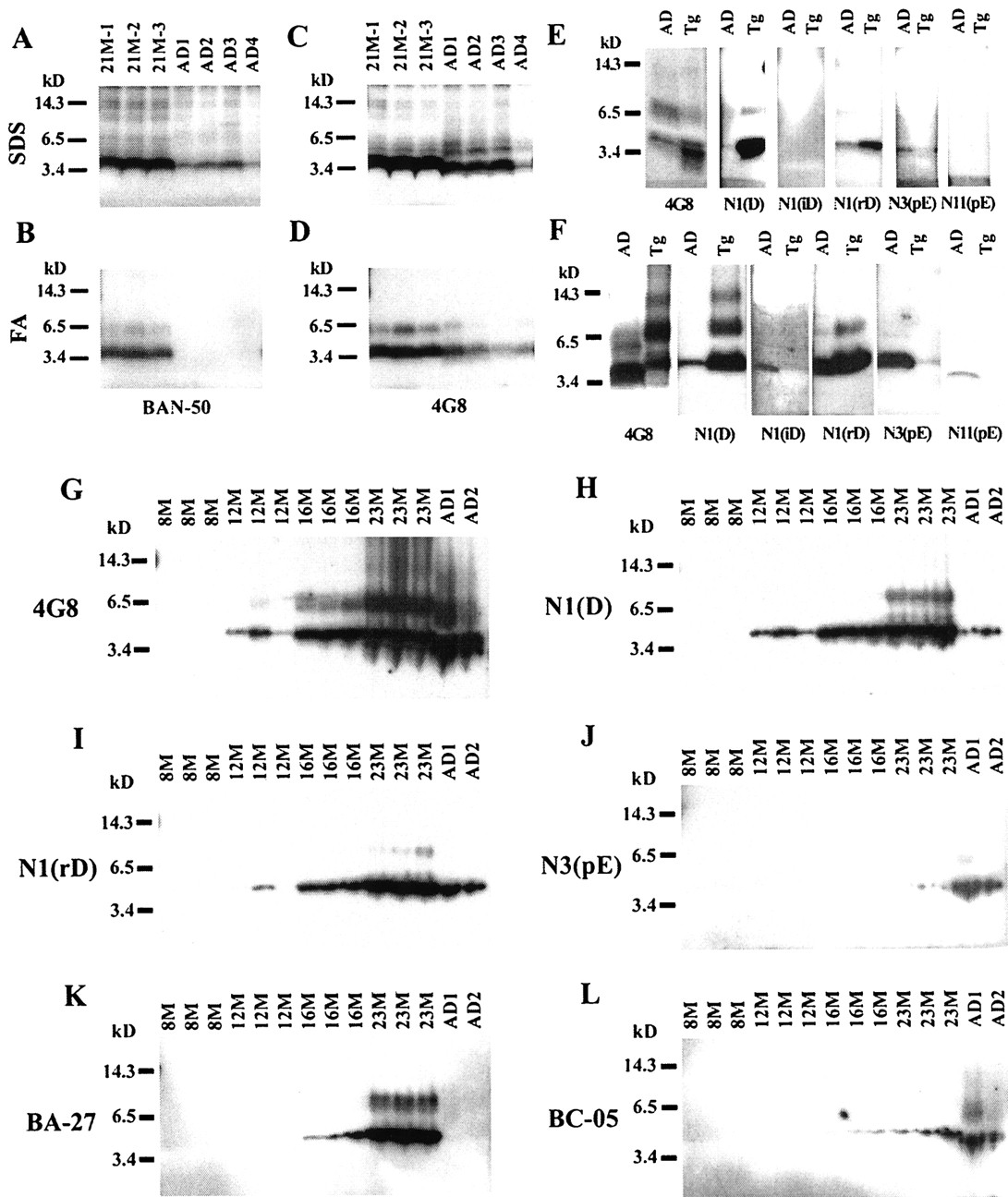
Immunoblotting of the SDS and FA fractions obtained by two-step extraction (Fig. 4A-D) gave results that were consistent with the results from sandwich ELISAs performed on the same extracts (Fig. 3). SDS-insoluble 4 kDa Abeta labeled by both BAN-50 (Fig. 4B) and 4G8 (Fig. 4D) appeared at 6-8 months and increased substantially by 10 months. To analyze the SDS-extractable Abeta , the SDS extracts were immunoprecipitated with 3160, a rabbit polyclonal antibody to Abeta 1-40, and the immunoprecipitate was analyzed by immunoblotting with BAN-50 (Fig. 4A) or 4G8 (Fig. 4B). As expected from ELISA analysis (Fig. 3A,B), the total 4 kDa Abeta extracted into SDS decreased slightly between 6 and 8 months before beginning to increase substantially at 10 months (Fig. 4A,C, arrowhead). beta APP CTFbeta , which contains full-length Abeta , was detected by both BAN-50 (Fig. 4A, arrow) and 4G8 (Fig. 4C, arrow) in the SDS extracts but not in the formic acid extracts (Fig. 4B,D). As expected, CTFbeta in Tg2576 brain showed no change with aging.


View larger version (33K):
[in this window]
[in a new window]
 
Figure 4.   Analysis by immunoblotting of early Abeta deposition in Tg2576 brain. Abeta in the SDS (A, C) and formic acid (B, D) extracts from 4-10 month Tg2576 brains was analyzed on immunoblots labeled with BAN-50 (anti-Abeta 1-16) (A, B) and 4G8 (anti-Abeta 17-24) (C, D). Proteins were separated on 10-20% Tricine gels, and each lane shows the Abeta in 40 µl of the formic acid or SDS extract as described in Materials and Methods. Immunoblotting was first performed with BAN-50. The blots were then stripped and reblotted with 4G8. Note that SDS-soluble Abeta decreases transiently at 8 months, when SDS-resistant, formic acid-soluble Abeta appears. The arrows identify CTFbeta , and the arrowheads identify Abeta .

The full-length, unmodified Abeta in AD compared with 21 month Tg2576 brain was analyzed by immunoblotting two-step SDS and FA extracts (Fig. 5A-D). In the FA extracts, BAN-50 (anti-Abeta 1-16) detected abundant full-length 4 kDa Abeta in the three Tg2576 brains but almost nothing in any of the four AD brains examined (Fig. 5B), a result that is in good agreement with the ELISA data shown in Table 2. In contrast, 4G8 (anti-Abeta 17-24), which recognizes both full-length Abeta and Abeta that is N-terminally truncated or modified, detected substantial amounts of Abeta in the FA extract of both Tg2576 and AD brains (Fig. 5D). Similarly, in SDS extracts, BAN-50 labeled far more 4 kDa Abeta in Tg2576 than in AD brains (Fig. 5A), whereas 4G8 labeled large amounts of Abeta in both Tg2576 and AD brains (Fig. 5C). It is noteworthy that the Abeta detected by 4G8 appeared to be slightly smaller in AD than in Tg2576 brain (Fig. 5C, and to a lesser extent D), consistent with the Abeta in AD brain being truncated at its N terminus.


View larger version (65K):
[in this window]
[in a new window]
 
Figure 5.   Specific forms of Abeta in Tg2576 and AD brains. A-D, Immunoblot analysis of SDS (A, C) and formic acid (B, D) extracts of 21M Tg2576 mouse brains and AD brains labeled with BAN-50 (A, B) or 4G8 (C, D). Two microliters of the SDS or FA extract (dried and resuspended) were directly added to each lane; proteins were separated on 10-20% Tricine gels. E, F, Immunoblot analysis of SDS (E) and formic acid (F) extracts of AD and 23M Tg2576 brains labeled with the following: 4G8, which detects both N-terminally modified and unmodified Abeta ; anti-Abeta N1(D), which detects the unmodified N terminus; anti-N1(iD), which recognizes isomerized forms (L-iso-Asp) of Abeta N1; anti-N1(rD), which detects stereoisomerized forms (rectus Asp) of Abeta N1; anti-Abeta N3(pE), which detects forms beginning with pyroglutamate at position 3; or anti-Abeta N11(pE), which recognizes forms beginning with pyroglutamate at position 11. The Abeta in 10 µl of SDS or FA extracts was examined on each lane. In the SDS extracts, Abeta was immunoprecipitated with the indicated antibody as described in Materials and Methods before separation and immunoblotting with the same antibody. In the FA extracts, Abeta was dried and resuspended as described in Materials and Methods before separation and immunoblotting. Proteins were separated on 16% Tricine gels. G-L, Time course of accumulation of formic acid-soluble Abeta in Tg2576 brains (8M-23M) and AD brains labeled with 4G8 (G), anti-N1(D) (H), anti-N1(rD) (I), anti-N3(pE) (J), BA-27 (K), or BC-05 (L). The Abeta in 10 µl of formic acid extract was examined on each lane, and proteins were separated on 16% Tricine gels.

The immunoblots in Figure 5A-D show that 4G8 and BAN-50 label Abeta oligomers that are present in both SDS and FA fractions from 21 month Tg2576 brains. Similar oligomers are observed in the SDS and FA extracts of AD brains. As shown in Figures 4A-D and 5G, these oligomers are not detectable at 8 months but are definitely present by 12 months and increase substantially thereafter. Even with prolonged exposure, we have been unable to demonstrate oligomers in either SDS or FA extracts from brains in the critical 6-8 month period when Abeta aggregation begins.

BA-27, a monoclonal antibody that specifically detects the C terminus of Abeta 40, and BC-05, which is specific for the C terminus of Abeta 42, were used to analyze 6-23 month Tg2576 by immunocyochemistry (Fig. 2) and immunobloting (Fig. 5K,L). This analysis confirmed that Abeta s terminating at both Abeta 40 and Abeta 42 accumulate in aging Tg2576 brain with Abeta 40 predominating (Figs. 2, 5K,L). In contrast, virtually all Abeta terminated at Abeta 42 in the two AD brains examined (Fig. 5 K,L), as occurs in ~33% of AD cases (Gravina et al., 1995).

N-terminally modified Abeta s accumulate in aging Tg2576 brain

Antibodies that detect specific N-terminal modifications of Abeta (Saido et al., 1995, 1996) were used to analyze 23 month Tg25676 brain by immunoblotting (Fig. 5E-J) and immunocytochemistry (Fig. 6). Comparison of 4G8, which detects virtually all Abeta regardless of modification, and anti-N1(D), which specifically detects unmodified Abeta , confirmed that most Abeta in AD brains is N-terminally modified or truncated (Fig. 5G,H), whereas most Abeta in 8-23 month Tg2576 brains is unmodified (Fig. 5G,H and 6, N1(D) versus 4G8). Isomerized Abeta (N1iD) was labeled well in FA extracts of AD brain (Fig. 5F) and accumulated at a low level in 8-23 month Tg2576 brain (Fig. 6), but the amount of Abeta in Tg2576 brain was far less than in AD brain (Fig. 5F). Stereoisomerized Abeta (N1rD) accumulated with aging between 8 and 23 months in Tg2576 brain and, at 23 months, was intensely labeled in Tg2576 brain (Figs. 5I, 6) as it was in AD brain (Fig. 5I). Abeta N3-pyroglutamate (N3(pE)) is a major form of Abeta in AD brain but a minor form in aged Tg2576 brain (Fig. 5J). Histochemical analysis (Fig. 6) showed that Abeta N3-pyroglutamate (N3(pE)) appears late in Tg2576 brain, accumulating between 16 and 23 months. Abeta N11-pyroglutamate was not detected in Tg2576 brains but was definitely detected in AD brain (Fig. 5F). In both Tg2576 and AD brains, the N-terminally modified Abeta s were more evident in the SDS-insoluble Abeta found in FA extracts (Fig. 5F) than in SDS extracts (Fig. 5E). Collectively, these findings indicate that, with the exception of Abeta N11-pyroglutamate, N-terminal modifications or truncations of Abeta , which are thought to make Abeta more insoluble in human brain, also occur in the aging Tg2576 brain. With the exception of stereoisomerized Abeta , all of these modified forms are, however, far less abundant in Tg2576 than in AD brain.


View larger version (115K):
[in this window]
[in a new window]
 
Figure 6.   Immunohistochemical analysis of modified forms of Abeta in aging Tg2576 brain. Serial sections (5 µm) of Tg2576 cerebral cortex were labeled with anti-N1(D), anti-N1(iD), anti-N1(rD), anti-N3(pE), and 4G8. The age of the mouse brain analyzed is shown at the top of each set of serial sections. Scale bar, 17 µm.

CSF and plasma Abeta decline as Abeta is deposited in the Tg2576 brain

It is well established that Abeta 42 declines in the CSF of patients with typical late onset AD (Motter et al., 1995; Nitsch et al., 1995; Kanai et al., 1998; Andreasen et al., 1999), and this decrease could conceivably cause plasma Abeta 42 to decline because CSF Abeta , which has a high concentration relative to plasma Abeta , is normally cleared into blood (Ghersi-Egea et al., 1996). To determine whether CSF and plasma Abeta decline in Tg2576 mice as Abeta 42 and Abeta 40 are deposited in the brain, we analyzed brain (Fig. 7A,B), CSF (Fig. 7C, D), and plasma (Fig. 7E,F) Abeta 42 and Abeta 40 in parallel. This analysis showed that, in aged Tg2576 brain, as in human AD brain, there is a decline in CSF Abeta 42. This decline in CSF Abeta 42 (p = 0.03) occurred in parallel with the marked increases in brain Abeta 42 and Abeta 40 that occur between 9 and 23 months, and it was accompanied by a decline in CSF Abeta 40, although this decrease did not achieve significance. Remarkably, plasma Abeta 42 (p = 0.008) and Abeta 40 (p = 0.006) both showed highly significant decreases (Fig. 7E,F) that paralleled the marked accumulation of brain Abeta and the decline in CSF Abeta that occurred between 6 and 23 months. To be sure that the declines in CSF and plasma Abeta that occur in aging Tg2576 mice are linked to Abeta deposition and not to aging alone, Abeta 42 and Abeta 40 were analyzed in CSF (Fig. 7G, H) and plasma (Fig. 7I, J) of aging nontransgenic littermates (Fig. 7G, H). In these nontransgenic mice, there was no suggestion of a decline in Abeta because Abeta 42 and Abeta 40 both showed a slight upward trend in CSF (Fig. 7G,H) and plasma (Fig. 7I,J) with aging.


View larger version (34K):
[in this window]
[in a new window]
 
Figure 7.   CSF and plasma Abeta in Tg2576 mice decline as Abeta is deposited in the brain. Total brain Abeta 42 (A) and Abeta 40 (B) were assayed by 3160/BC05 or 3160/BA27 ELISAs, respectively; see also Figure 2 and Table 2. Tg2576 CSF and plasma Abeta 42 (C, E) were assayed by BNT77/BC05 ELISA, and Tg2576 CSF and plasma Abeta 40 (D, F) were assayed by BAN50/BA27 ELISA. Both nontransgenic (NTg) CSF and plasma Abeta 42 (G, I) and Abeta 40 (H, J) were assayed with BNT77 capture. The number of Tg2576 CSF samples assayed for the four time groups are 9, 9, 16, and 11, totaling 45. The number of Tg2576 plasma samples assayed for the four time groups are 30, 18, 64, and 19, totaling 131. The decline for CSF Abeta 42 is significant (p = 0.02), and the declines for plasma Abeta 40 and Abeta 42 are highly significant (Abeta 42, p = 0.008; Abeta 40, p = 0.006; Spearman's rank correlation for the 6-23 month age range). The number of nontransgenic CSF samples assayed for the three time groups are 2, 2, and 6, totaling 10. The number of nontransgenic plasma samples assayed for the four time groups are 7, 6, 12, and 6, totaling 31.


    DISCUSSION
TOP
ABSTRACT
INTRODUCTION
MATERIALS AND METHODS
RESULTS
DISCUSSION
REFERENCES

As Tg2576 animals age, Abeta is altered beginning at 6-7 months with the appearance and subsequent increase of Abeta in the FA-extracted fraction. As insoluble (FA-requiring) Abeta appears at 6-9 months, the remaining Abeta in the brain (SDS-extracted in two-step, or TBS- and Triton-extracted in four-step) decreases slightly, suggesting that it is converting to an insoluble form. The definite biochemical change that occurs by 10 months in Tg2576 mice is accompanied by minimal histological evidence of Abeta deposition, although single plaque cores can be observed in many sections. From studies of trisomy 21 brains (Iwatsubo et al., 1994), it is generally believed that, in human AD, Abeta deposition begins with the formation of diffuse plaques. In Tg2576 brains, diffuse plaques are not observed in appreciable number until 12 months, 4 months after biochemically detectable alterations in Abeta have begun in every animal. Thus, there is an early period from 6 to 10 months in Tg2576 mice in which insoluble Abeta appears accompanied only by rare cored plaques.

Support for the view that there may be a similar early period in human brain comes from a study by Funato et al.(1998), who used the same ELISA system used here. They report that both SDS-dissociable and -insoluble forms of Abeta accumulate in human cortex, that insoluble Abeta correlates with amyloid load, and that its biochemical detection precedes plaque formation. They calculate that immunodetection of Abeta in human cortex requires 400 pmol/gm insoluble Abeta 42 (or 200 pmol/gm in hippocampus) (Funato et al., 1998). These values are similar to those in 10-month-old Tg2576 mice, the time when plaques become evident.

Our immunohistochemical and biochemical analyses show that, from 10 to 21 months, there is a rapid increase in both diffuse and cored plaques in Tg2576 brain and a coordinate marked increase in SDS-dissociable and FA-requiring Abeta , with both the biochemical and histological changes rising to levels like those observed in human AD. In most AD patients, very little Abeta 40 is deposited in the brain, but in ~33%, extraordinary amounts of Abeta 40 are deposited, and most of these patients show substantial amyloid angiopathy (Gravina et al., 1995). The Tg2576 model is like this latter group of AD patients in that there is marked congophilic angiopathy and the deposition of a large amount of Abeta 40. It is not clear why large amounts of Abeta 40 are deposited in the Tg2576 model. It may be that more than one factor contributes and that some combination of species, strain, promoter, expression level, and mutated transgene causes the large amount of Abeta 40 deposition in this model.

Much of the Abeta in AD brain is N-terminally truncated or modified (Saido et al., 1995, 1996; Hosoda et al., 1998), and it has been suggested that the formation of SDS stable Abeta oligomers may be an early event in AD (Enya et al., 1999). Because N-terminally truncated or modified Abeta [especially forms beginning with pyroglutamate at position 3 (3pE)] and oligomers are resistant to proteolysis (Saido et al., 1996; Kuo et al., 1998), these modifications of Abeta are thought to be important for amyloid deposition. Our studies indicate that, in Tg2576 brain, it is full-length, unmodified Abeta that becomes insoluble initially. After this early period, oligomers and most modified forms (e.g., forms beginning at 3pE) appear, but at levels far below those observed in AD brain. It is not clear whether this late development and relative paucity of modified or oligomeric forms reflects the much shorter time over which Abeta aggregates in Tg2576 brain or is attributable to fundamental biochemical differences between the human and mouse brain. One intriguing possibility is that the Abeta modifications observed in the AD brain may play an important pathogenic role and that the relative paucity of these forms in Tg2576 brain may account for the minimal neurofibrillary pathology and neuronal loss observed in Tg2576 brain.

In Tg2576 mice, the APPK670N,M671L transgene is expressed at highest level in the brain, but there is also substantial expression in other organs (Fig. 1), although expression is driven by the hamster PrP promoter. Thus, in Tg2576 mice as in human subjects, plasma Abeta is likely to be derived from both peripheral organs and brain, where Abeta may enter the bloodstream either through the normal flow of CSF or by directly crossing CNS endothelium. In a previous study of human plasma (Scheuner et al., 1996), we showed that the Swedish APPK670N,M671L mutation increases both Abeta 42 and Abeta 40 and that other FAD-linked APP, PS1, and PS2 mutations selectively increase Abeta 42. In that report, we suggested that cerebral Abeta deposition in FAD occurs because of an increase in CNS Abeta that develops as part of a generalized genetic effect that also increases plasma Abeta . We emphasized that Abeta deposition in FAD probably does not occur as a direct effect of increased plasma Abeta . We have reported previously a transgenic mouse line (NORbeta 0304) that expresses an Abeta containing CTF of APP (Kawarabayashi et al., 1996). Because expression in NORbeta 0304 is driven by the beta -actin promoter, the transgenic APP CTF is expressed in all organs, and expression is much higher in many peripheral organs than in brain. Significantly, plasma Abeta is even higher in NORbeta 0304 (1400 pM Abeta 42; 5600 pM Abeta 40) than in Tg2576, but NORbeta 0304 mice do not develop age-dependent Abeta deposition in brain. Thus, elevated plasma Abeta can be a good indicator that deposition will occur when it occurs as part of a generalized response in human subjects or in transgenic mice in which expression is under the control of a promoter such as PrP, which causes expression to be highest in brain. Elevated plasma Abeta does not directly drive deposition, however, because NORbeta 0304 mice, which have a beta -actin promoter that causes expression to be highest in the periphery, show no deposition, although they have higher plasma Abeta levels than the Tg2576 line.

We have shown recently that human plasma Abeta 42 and Abeta 40 increase with aging over age 65 and that plasma Abeta 42 and Abeta 40 are heritable traits that are increased in first degree relatives of patients with typical late onset AD (Younkin et al., 1998). These findings suggest that, in typical late onset AD as in early onset FAD, elevated plasma Abeta may be associated with the development of AD. If so, one would expect plasma Abeta to be elevated in typical late onset AD. Our initial analysis of typical AD patients (Scheuner et al., 1996) showed, however, that very few AD patients have high plasma Abeta 42 when compared with age-matched controls. Other published studies of plasma Abeta in AD have shown no change or a slight increase in plasma Abeta 42 (Iwatsubo, 1998; Matsubara et al., 1999). Because it is well established that CSF Abeta 42 decreases in AD, one way to account for these negative results is to postulate that plasma Abeta 42 also declines as AD develops. If so, then analysis of symptomatic late onset patients could miss many patients whose disease was initiated by increased Abeta in the presymptomatic period.

To test the hypothesis that plasma and CSF Abeta both decline as Abeta is deposited in the brain, plasma, CSF, and brain Abeta were analyzed coordinately in aging Tg2576 mice. This analysis showed that, coincident with the marked deposition of Abeta 42 and Abeta 40 in brain, there is not only a decline in CSF Abeta but also a substantial, highly significant decrease in plasma Abeta 42 and Abeta 40. If this also occurs in human subjects, then declining plasma Abeta could be a useful marker for subjects in whom there is cerebral Abeta deposition and who are, therefore, at risk for AD. Similarly, elevated plasma Abeta could be an excellent premorbid biomarker for AD, although it is not useful as a diagnostic marker, if it identifies those who are destined to deposit Abeta and those who are in the early stages of deposition.


    FOOTNOTES

Received Sept. 5, 2000; revised Oct. 23, 2000; accepted Oct. 30, 2000.

This work was supported by National Institutes of Health Grant AG15453. We thank Dennis Dickson for help with immunocytochemistry, Virginia Phillips and Linda Rousseau for cutting sections, and Blaze Birinyi for technical assistance.

Correspondence should be addressed to Steven G. Younkin, Mayo Clinic Jacksonville, 4500 San Pablo Road, Jacksonville, FL 32224. E-mail: younkin{at}mayo.edu.


    REFERENCES
TOP
ABSTRACT
INTRODUCTION
MATERIALS AND METHODS
RESULTS
DISCUSSION
REFERENCES

  • Andreasen N, Hesse C, Davidsson P, Minthon L, Wallin A, Winblad B, Vanderstichele H, Vanmechelen E, Blennow K (1999) Cerebrospinal fluid beta -amyloid(1-42) in Alzheimer disease: differences between early- and late-onset Alzheimer disease and stability during the course of disease. Arch Neurol 56:673-680[Abstract/Free Full Text].
  • Borchelt DR, Thinakaran G, Eckman CB, Lee MK, Davenport F, Ratovitsky T, Prada CM, Kim G, Seekins S, Yager D, Slunt HH, Wang R, Seeger M, Levey AI, Gandy SE, Copeland NG, Jenkins NA, Price DL, Younkin SG, Sisodia SS (1996) Familial Alzheimer's disease-linked presenilin 1 variants elevate Abeta 1-42/1-40 ratio in vitro and in vivo. Neuron 17:1005-1013[Web of Science][Medline].
  • Cai XD, Golde TE, Younkin SG (1993) Release of excess amyloid beta  protein from a mutant amyloid beta  protein precursor. Science 259:514-517[Abstract/Free Full Text].
  • Carp RI, Davidson AL, Merz PA (1971) A method for obtaining cerebrospinal fluid from mice. Res Vet Sci 12:499[Web of Science][Medline].
  • Chapman PF, White GL, Jones MW, Cooper-Blacketer D, Marshall VJ, Irizarry M, Younkin L, Good MA, Bliss TVP, Hyman BT, Younkin SG, Hsiao KK (1999) Impaired synaptic plasticity and learning in aged amyloid precursor protein transgenic mice. Nat Neurosci 2:271-276[Web of Science][Medline].
  • Chartier-Harlin MC, Crawford F, Houlden H, Warren A, Hughes D, Fidani L, Goate A, Rossor M, Roques P, Hardy J, Mullan M (1991) Early-onset Alzheimer's disease caused by mutations at codon 717 of the beta -amyloid precursor protein gene. Nature 353:844-846[Medline].
  • Citron M, Vigo-Pelfrey C, Teplow DB, Miller C, Schenk D, Johnston J, Winblad B, Venizelos N, Lannfelt L, Selkoe DJ (1994) Excessive production of amyloid beta -protein by peripheral cells of symptomatic and presymptomatic patients carrying the Swedish familial Alzheimer disease mutation. Proc Natl Acad Sci USA 91:11993-11997[Abstract/Free Full Text].
  • Citron M, Westaway D, Xia W, Carlson G, Diehl T, Levesque G, Johnson-Wood K, Lee M, Seubert P, Davis A, Kholodenko D, Motter R, Sherrington R, Perry B, Yao H, Strome R, Lieberburg I, Rommens J, Kim S, Schenk D, Fraser P, St. George-Hyslop P, Selkoe DJ (1997) Mutant presenilins of Alzheimer's disease increase production of 42-residue amyloid beta -protein in both transfected cells and transgenic mice. Nat Med 3:67-72[Web of Science][Medline].
  • Duff K, Eckman C, Zehr C, Yu X, Prada CM, Perez-tur J, Hutton M, Buee L, Harigaya Y, Yager D, Morgan D, Gordon MN, Holcomb L, Refolo L, Zenk B, Hardy J, Younkin S (1996) Increased amyloid-beta 42(43) in brains of mice expressing mutant presenilin 1. Nature 383:710-713[Medline].
  • Enya M, Morishima-Kawashima M, Yoshimura M, Shinkai Y, Kusui K, Khan K, Games D, Schenk D, Sugihara S, Yamaguchi H, Ihara Y (1999) Appearance of sodium dodecyl sulfate-stable amyloid beta -protein (Abeta ) dimer in the cortex during aging. Am J Pathol 154:271-279[Abstract/Free Full Text].
  • Funato H, Yoshimura M, Kusui K, Tamaoka A, Ishikawa K, Ohkoshi N, Namekata K, Okeda R, Ihara Y (1998) Quantitation of amyloid beta -protein (Abeta ) in the cortex during aging and in Alzheimer's disease. Am J Pathol 152:1633-1640[Abstract].
  • Ghersi-Egea JF, Gorevic PD, Ghiso J, Frangione B, Patlak CS, Fenstermacher JD (1996) Fate of cerebrospinal fluid-borne amyloid beta -peptide: rapid clearance into blood and appreciable accumulation by cerebral arteries. J Neurochem 67:880-883[Web of Science][Medline].
  • Glenner GG, Wong CW (1984) Alzheimer's disease: initial report of the purification and characterization of a novel cerebrovascular amyloid protein. Biochem Biophys Res Commun 120:885-890[Web of Science][Medline].
  • Goate A, Chartier-Harlin MC, Mullan M, Brown J, Crawford F, Fidani L, Giuffra L, Haynes A, Irving N, James L, Mant R, Newton P, Rooke K, Roques P, Talbot C, Pericak-Vance M, Roses A, Williamson R, Rossor M, Owen M, Hardy J (1991) Segregation of a missense mutation in the amyloid precursor protein gene with familial Alzheimer's disease. Nature 349:704-706[Medline].
  • Gravina SA, Ho L, Eckman CB, Long KE, Otvos Jr L, Younkin LH, Suzuki N, Younkin SG (1995) Amyloid beta  protein (Abeta ) in Alzheimer's disease brain. Biochemical and immunocytochemical analysis with antibodies specific for forms ending at Abeta 40 or Abeta 42(43). J Biol Chem 270:7013-7016[Abstract/Free Full Text].
  • Hosoda R, Saido TC, Otvos Jr L, Arai T, Mann DM, Lee VM, Trojanowski JQ, Iwatsubo T (1998) Quantification of modified amyloid beta  peptides in Alzheimer disease and Down syndrome brains. J Neuropathol Exp Neurol 57:1089-1095[Medline].
  • Hsiao K, Chapman P, Nilsen S, Eckman C, Harigaya Y, Younkin S, Yang F, Cole G (1996) Correlative memory deficits, Abeta elevation, and amyloid plaques in transgenic mice. Science 274:99-102[Abstract/Free Full Text].
  • Irizarry MC, McNamara M, Fedorchak K, Hsiao K, Hyman BT (1997) APPSw transgenic mice develop age-related Abeta deposits and neuropil abnormalities, but no neuronal loss in CA1. J Neuropathol Exp Neurol 56:965-973[Web of Science][Medline].
  • Iwatsubo T (1998) Amyloid beta  protein in plasma as a diagnostic marker for Alzheimer's disease. Neurobiol Aging 19:161-163[Medline].
  • Iwatsubo T, Odaka A, Suzuki N, Mizusawa H, Nukina N, Ihara Y (1994) Visualization of Abeta 42(43) and Abeta 40 in senile plaques with end-specific Abeta monoclonals: evidence that an initially deposited species is Abeta 42(43). Neuron 13:45-53[Web of Science][Medline].
  • Jarrett JT, Berger EP, Lansbury Jr PT (1993) The carboxy terminus of the beta  amyloid protein is critical for the seeding of amyloid formation: implications for the pathogenesis of Alzheimer's disease. Biochemistry 32:4693-4697[Medline].
  • Kanai M, Matsubara E, Isoe K, Urakami K, Nakashima K, Arai H, Sasaki H, Abe K, Iwatsubo T, Kosaka T, Watanabe M, Tomidokoro Y, Shizuka M, Mizushima K, Nakamura T, Igeta Y, Ikeda Y, Amari M, Kawarabayashi T, Ishiguro K, Harigaya Y, Wakabayashi K, Okamoto K, Hirai S, Shoji M (1998) Longitudinal study of cerebrospinal fluid levels of tau, Abeta 1-40, and Abeta 1-42(43) in Alzheimer's disease: a study in Japan. Ann Neurol 44:17-26[Web of Science][Medline].
  • Kang J, Lemaire HG, Unterbeck A, Salbaum JM, Masters CL, Grzeschik KH, Multhaup G, Beyreuther K, Muller-Hill B (1987) The precursor of Alzheimer's disease amyloid A4 protein resembles a cell-surface receptor. Nature 325:733-736[Medline].
  • Kawarabayashi T, Shoji M, Sato M, Sasaki A, Ho L, Eckman CB, Prada CM, Younkin SG, Kobayashi T, Tada N, Matsubara E, Iizuka T, Harigaya Y, Kasai K, Hirai S (1996) Accumulation of beta -amyloid fibrils in pancreas of transgenic mice. Neurobiol Aging 17:215-222[Medline][Erratum (1996) 17:667].
  • Kuo YM, Webster S, Emmerling MR, De Lima N, Roher AE (1998) Irreversible dimerization/tetramerization and post-translational modifications inhibit proteolytic degradation of Abeta peptides of Alzheimer's disease. Biochim Biophys Acta 1406:291-298[Medline].
  • Levy-Lahad E, Wijsman EM, Nemens E, Anderson L, Goddard KA, Weber JL, Bird TD, Schellenberg GD (1995) A familial Alzheimer's disease locus on chromosome 1. Science 269:970-973[Abstract/Free Full Text].
  • Masters CL, Simms G, Weinman NA, Multhaup G, McDonald BL, Beyreuther K (1985) Amyloid plaque core protein in Alzheimer disease and Down syndrome. Proc Natl Acad Sci USA 82:4245-4249[Abstract/Free Full Text].
  • Matsubara E, Ghiso J, Frangione B, Amari M, Tomidokoro Y, Ikeda Y, Harigaya Y, Okamoto K, Shoji M (1999) Lipoprotein-free amyloidogenic peptides in plasma are elevated in patients with sporadic Alzheimer's disease and Down's syndrome. Ann Neurol 45:537-541[Web of Science][Medline].
  • Motter R, Vigo-Pelfrey C, Kholodenko D, Barbour R, Johnson-Wood K, Galasko D, Chang L, Miller B, Clark C, Green R, Olson D, Southwick P, Wolfert R, Munroe B, Lieberburg I, Seubert P, Schenk D (1995) Reduction of beta -amyloid peptide42 in the cerebrospinal fluid of patients with Alzheimer's disease. Ann Neurol 38:643-648[Web of Science][Medline].
  • Mullan M, Crawford F, Axelman K, Houlden H, Lilius L, Winblad B, Lannfelt L (1992) A pathogenic mutation for probable Alzheimer's disease in the APP gene at the N-terminus of beta -amyloid. Nat Genet 1:345-347[Web of Science][Medline].
  • Murrell J, Farlow M, Ghetti B, Benson MD (1991) A mutation in the amyloid precursor protein associated with hereditary Alzheimer's disease. Science 254:97-99[Abstract/Free Full Text].
  • Nitsch RM, Rebeck GW, Deng M, Richardson UI, Tennis M, Schenk DB, Vigo-Pelfrey C, Lieberburg I, Wurtman RJ, Hyman BT, Growdon JH (1995) Cerebrospinal fluid levels of amyloid beta -protein in Alzheimer's disease: inverse correlation with severity of dementia and effect of apolipoprotein E genotype. Ann Neurol 37:512-518[Web of Science][Medline].
  • Roher AE, Lowenson JD, Clarke S, Wolkow C, Wang R, Cotter RJ, Reardon IM, Zurcher-Neely HA, Heinrikson RL, Ball MJ (1993) Structural alterations in the peptide backbone of beta -amyloid core protein may account for its deposition and stability in Alzheimer's disease. J Biol Chem 268:3072-3083[Abstract/Free Full Text].
  • Saido TC, Iwatsubo T, Mann DM, Shimada H, Ihara Y, Kawashima S (1995) Dominant and differential deposition of distinct beta -amyloid peptide species, Abeta N3(pE), in senile plaques. Neuron 14:457-466[Web of Science][Medline].
  • Saido TC, Yamao-Harigaya W, Iwatsubo T, Kawashima S (1996) Amino- and carboxyl-terminal heterogeneity of beta -amyloid peptides deposited in human brain. Neurosci Lett 215:173-176[Web of Science][Medline].
  • Scheuner D, Eckman C, Jensen M, Song X, Citron M, Suzuki N, Bird TD, Hardy J, Hutton M, Kukull W, Larson E, Levy-Lahad E, Viitanen M, Peskind E, Poorkaj P, Schellenberg G, Tanzi R, Wasco W, Lannfelt L, Selkoe D, Younkin S (1996) Secreted amyloid beta -protein similar to that in the senile plaques of Alzheimer's disease is increased in vivo by the presenilin 1 and 2 and APP mutations linked to familial Alzheimer's disease. Nat Med 2:864-870[Web of Science][Medline].
  • Sherrington R, Rogaev EI, Liang Y, Rogaeva EA, Levesque G, Ikeda M, Chi H, Lin C, Li G, Holman K, Tsuda T, Mar L, Fonci JF, Bruni AC, Montesi MP, Sorbi S, Rainero I, Pinessi L, Nee L, Chumakov I, Pollen D, Brookes A, Sanseau P, Polinsky RJ, Wasco W, Da Silva HAR, Haines JL, Pericak-Vance MA, Tanzi RE, Roses AD, Fraser PE, Rommens JM, St. George-Hyslop PH (1995) Cloning of a gene bearing missense mutations in early-onset familial Alzheimer's disease. Nature 375:754-760[Medline].
  • Suzuki N, Cheung TT, Cai XD, Odaka A, Otvos L, Eckman Jr C, Golde TE, Younkin SG (1994) An increased percentage of long amyloid beta  protein secreted by familial amyloid beta  protein precursor (beta APP717) mutants. Science 264:1336-1340[Abstract/Free Full Text].
  • Westerman MA, Cooper-Blacketer D, Gómez-Isla T, Mariash A, Ashe KH (2000) Age-dependent behavioral deficit in a transgenic mouse model of Alzheimer's disease. Soc Neurosci Abstr 26:1318.
  • Younkin SG, Eckman CB, Ertekin Taner N, Kawarabayashi T, Yager D, Baker M, Perez-tur J, Houlden H, Hutton M, Younkin LH, Graff-Radford NR (1998) Genetic elevation of plasma amyloid beta  protein in typical late onset Alzheimer's disease. Soc Neurosci Abstr 24:263.


Copyright © 2001 Society for Neuroscience  0270-6474/01/212372-10$05.00/0


This article has been cited by other articles:


Home page
J. Neurosci.Home page
G. Dziewczapolski, C. M. Glogowski, E. Masliah, and S. F. Heinemann
Deletion of the {alpha}7 Nicotinic Acetylcholine Receptor Gene Improves Cognitive Deficits and Synaptic Pathology in a Mouse Model of Alzheimer's Disease
J. Neurosci., July 8, 2009; 29(27): 8805 - 8815.
[Abstract] [Full Text] [PDF]


Home page
Protein Eng Des SelHome page
L. Liu, J. Hou, J. Du, R. S. Chumanov, Q. Xu, Y. Ge, J. A. Johnson, and R. M. Murphy
Differential modification of Cys10 alters transthyretin's effect on beta-amyloid aggregation and toxicity
Protein Eng. Des. Sel., June 23, 2009; (2009) gzp025v1.
[Abstract] [Full Text] [PDF]


Home page
NEJMHome page
D. C. Ewbank and S. E. Arnold
Cool with Plaques and Tangles
N. Engl. J. Med., May 28, 2009; 360(22): 2357 - 2359.
[Full Text] [PDF]


Home page
J. Neurosci.Home page
R. A. Karlnoski, A. Rosenthal, D. Kobayashi, J. Pons, J. Alamed, M. Mercer, Q. Li, M. N. Gordon, P. E. Gottschall, and D. Morgan
Suppression of Amyloid Deposition Leads to Long-Term Reductions in Alzheimer's Pathologies in Tg2576 Mice
J. Neurosci., April 15, 2009; 29(15): 4964 - 4971.
[Abstract] [Full Text] [PDF]


Home page
Proc. Natl. Acad. Sci. USAHome page
D. R. Thakker, M. R. Weatherspoon, J. Harrison, T. E. Keene, D. S. Lane, W. F. Kaemmerer, G. R. Stewart, and L. L. Shafer
Intracerebroventricular amyloid-{beta} antibodies reduce cerebral amyloid angiopathy and associated micro-hemorrhages in aged Tg2576 mice
PNAS, March 17, 2009; 106(11): 4501 - 4506.
[Abstract] [Full Text] [PDF]


Home page
J. Neurosci.Home page
B. H. Han, M.-l. Zhou, F. Abousaleh, R. P. Brendza, H. H. Dietrich, J. Koenigsknecht-Talboo, J. R. Cirrito, E. Milner, D. M. Holtzman, and G. J. Zipfel
Cerebrovascular Dysfunction in Amyloid Precursor Protein Transgenic Mice: Contribution of Soluble and Insoluble Amyloid-{beta} Peptide, Partial Restoration via {gamma}-Secretase Inhibition
J. Neurosci., December 10, 2008; 28(50): 13542 - 13550.
[Abstract] [Full Text] [PDF]


Home page
Hum Mol GenetHome page
G. B. Stokin, A. Almenar-Queralt, S. Gunawardena, E. M. Rodrigues, T. Falzone, J. Kim, C. Lillo, S. L. Mount, E. A. Roberts, E. McGowan, et al.
Amyloid precursor protein-induced axonopathies are independent of amyloid-{beta} peptides
Hum. Mol. Genet., November 15, 2008; 17(22): 3474 - 3486.
[Abstract] [Full Text] [PDF]


Home page
Proc. Natl. Acad. Sci. USAHome page
N. Schupf, M. X. Tang, H. Fukuyama, J. Manly, H. Andrews, P. Mehta, J. Ravetch, and R. Mayeux
Peripheral A{beta} subspecies as risk biomarkers of Alzheimer's disease
PNAS, September 16, 2008; 105(37): 14052 - 14057.
[Abstract] [Full Text] [PDF]


Home page
Am. J. Pathol.Home page
J. B. Paulson, M. Ramsden, C. Forster, M. A. Sherman, E. McGowan, and K. H. Ashe
Amyloid Plaque and Neurofibrillary Tangle Pathology in a Regulatable Mouse Model of Alzheimer's Disease
Am. J. Pathol., September 1, 2008; 173(3): 762 - 772.
[Abstract] [Full Text] [PDF]


Home page
NeurologyHome page
J. Quinn and M. N. Sabbagh
Detecting Alzheimer disease before it happens: The key to prevention?
Neurology, July 8, 2008; 71(2): 78 - 79.
[Full Text] [PDF]


Home page
Arch NeurolHome page
J. R. Steinerman, M. Irizarry, N. Scarmeas, S. Raju, J. Brandt, M. Albert, D. Blacker, B. Hyman, and Y. Stern
Distinct Pools of {beta}-Amyloid in Alzheimer Disease-Affected Brain: A Clinicopathologic Study
Arch Neurol, July 1, 2008; 65(7): 906 - 912.
[Abstract] [Full Text] [PDF]


Home page
J. Neurosci.Home page
J. Wang, L. Ho, W. Zhao, K. Ono, C. Rosensweig, L. Chen, N. Humala, D. B. Teplow, and G. M. Pasinetti
Grape-Derived Polyphenolics Prevent A{beta} Oligomerization and Attenuate Cognitive Deterioration in a Mouse Model of Alzheimer's Disease
J. Neurosci., June 18, 2008; 28(25): 6388 - 6392.
[Abstract] [Full Text] [PDF]


Home page
Arch Gen PsychiatryHome page
X. Sun, D. C. Steffens, R. Au, M. Folstein, P. Summergrad, J. Yee, I. Rosenberg, D. M. Mwamburi, and W. Q. Qiu
Amyloid-Associated Depression: A Prodromal Depression of Alzheimer Disease?
Arch Gen Psychiatry, May 1, 2008; 65(5): 542 - 550.
[Abstract] [Full Text] [PDF]


Home page
BrainHome page
L. A. Kotilinek, M. A. Westerman, Q. Wang, K. Panizzon, G. P. Lim, A. Simonyi, S. Lesne, A. Falinska, L. H. Younkin, S. G. Younkin, et al.
Cyclooxygenase-2 inhibition improves amyloid-{beta}-mediated suppression of memory and synaptic plasticity
Brain, March 1, 2008; 131(3): 651 - 664.
[Abstract] [Full Text] [PDF]


Home page
J. Pharmacol. Exp. Ther.Home page
S. Sankaranarayanan, E. A. Price, G. Wu, M.-C. Crouthamel, X.-P. Shi, K. Tugusheva, K. X. Tyler, J. Kahana, J. Ellis, L. Jin, et al.
In Vivo {beta}-Secretase 1 Inhibition Leads to Brain A{beta} Lowering and Increased {alpha}-Secretase Processing of Amyloid Precursor Protein without Effect on Neuregulin-1
J. Pharmacol. Exp. Ther., March 1, 2008; 324(3): 957 - 969.
[Abstract] [Full Text] [PDF]


Home page
NeurologyHome page
N. Ertekin-Taner, L. H. Younkin, D. M. Yager, F. Parfitt, M. C. Baker, S. Asthana, M. L. Hutton, S. G. Younkin, and N. R. Graff-Radford
Plasma amyloid {beta} protein is elevated in late-onset Alzheimer disease families
Neurology, February 19, 2008; 70(8): 596 - 606.
[Abstract] [Full Text] [PDF]


Home page
Arch NeurolHome page
J. Sundelof, V. Giedraitis, M. C. Irizarry, J. Sundstrom, E. Ingelsson, E. Ronnemaa, J. Arnlov, M. D. Gunnarsson, B. T. Hyman, H. Basun, et al.
Plasma {beta} Amyloid and the Risk of Alzheimer Disease and Dementia in Elderly Men: A Prospective, Population-Based Cohort Study
Arch Neurol, February 1, 2008; 65(2): 256 - 263.
[Abstract] [Full Text] [PDF]


Home page
Proc. Natl. Acad. Sci. USAHome page
L. Park, P. Zhou, R. Pitstick, C. Capone, J. Anrather, E. H. Norris, L. Younkin, S. Younkin, G. Carlson, B. S. McEwen, et al.
Nox2-derived radicals contribute to neurovascular and behavioral dysfunction in mice overexpressing the amyloid precursor protein
PNAS, January 29, 2008; 105(4): 1347 - 1352.
[Abstract] [Full Text] [PDF]


Home page
J. Pharmacol. Exp. Ther.Home page
B. P. Imbimbo, E. Del Giudice, D. Colavito, A. D'Arrigo, M. D. Carbonare, G. Villetti, F. Facchinetti, R. Volta, V. Pietrini, M. F. Baroc, et al.
1-(3',4'-Dichloro-2-fluoro[1,1'-biphenyl]-4-yl)-cyclopropanecarboxylic Acid (CHF5074), a Novel {gamma}-Secretase Modulator, Reduces Brain beta-Amyloid Pathology in a Transgenic Mouse Model of Alzheimer's Disease without Causing Peripheral Toxicity
J. Pharmacol. Exp. Ther., December 1, 2007; 323(3): 822 - 830.
[Abstract] [Full Text] [PDF]


Home page
J. Neurosci.Home page
I. Petrushina, A. Ghochikyan, M. Mktrichyan, G. Mamikonyan, N. Movsesyan, H. Davtyan, A. Patel, E. Head, D. H. Cribbs, and M. G. Agadjanyan
Alzheimer's Disease Peptide Epitope Vaccine Reduces Insoluble But Not Soluble/Oligomeric A{beta} Species in Amyloid Precursor Protein Transgenic Mice
J. Neurosci., November 14, 2007; 27(46): 12721 - 12731.
[Abstract] [Full Text] [PDF]


Home page
J. Neurosci.Home page
J. Maeda, B. Ji, T. Irie, T. Tomiyama, M. Maruyama, T. Okauchi, M. Staufenbiel, N. Iwata, M. Ono, T. C. Saido, et al.
Longitudinal, Quantitative Assessment of Amyloid, Neuroinflammation, and Anti-Amyloid Treatment in a Living Mouse Model of Alzheimer's Disease Enabled by Positron Emission Tomography
J. Neurosci., October 10, 2007; 27(41): 10957 - 10968.
[Abstract] [Full Text] [PDF]


Home page
FASEB J.Home page
W.-P. Chang, D. Downs, X.-P. Huang, H. Da, K.-M. Fung, and J. Tang
Amyloid-beta reduction by memapsin 2 (beta-secretase) immunization
FASEB J, October 1, 2007; 21(12): 3184 - 3196.
[Abstract] [Full Text] [PDF]


Home page
BrainHome page
H. K. Shin, P. B. Jones, M. Garcia-Alloza, L. Borrelli, S. M. Greenberg, B. J. Bacskai, M. P. Frosch, B. T. Hyman, M. A. Moskowitz, and C. Ayata
Age-dependent cerebrovascular dysfunction in a transgenic mouse model of cerebral amyloid angiopathy
Brain, September 1, 2007; 130(9): 2310 - 2319.
[Abstract] [Full Text] [PDF]


Home page
J. Neurosci.Home page
K. Zou, H. Yamaguchi, H. Akatsu, T. Sakamoto, M. Ko, K. Mizoguchi, J.-S. Gong, W. Yu, T. Yamamoto, K. Kosaka, et al.
Angiotensin-Converting Enzyme Converts Amyloid {beta}-Protein 1 42 (A{beta}1 42) to A{beta}1 40, and Its Inhibition Enhances Brain A{beta} Deposition
J. Neurosci., August 8, 2007; 27(32): 8628 - 8635.
[Abstract] [Full Text] [PDF]


Home page
J. Biol. Chem.Home page
G. Mamikonyan, M. Necula, M. Mkrtichyan, A. Ghochikyan, I. Petrushina, N. Movsesyan, E. Mina, A. Kiyatkin, C. G. Glabe, D. H. Cribbs, et al.
Anti-Abeta1 11 Antibody Binds to Different beta-Amyloid Species, Inhibits Fibril Formation, and Disaggregates Preformed Fibrils but Not the Most Toxic Oligomers
J. Biol. Chem., August 3, 2007; 282(31): 22376 - 22386.
[Abstract] [Full Text] [PDF]


Home page
J. Biol. Chem.Home page
J. L. Jankowsky, L. H. Younkin, V. Gonzales, D. J. Fadale, H. H. Slunt, H. A. Lester, S. G. Younkin, and D. R. Borchelt
Rodent Abeta Modulates the Solubility and Distribution of Amyloid Deposits in Transgenic Mice
J. Biol. Chem., August 3, 2007; 282(31): 22707 - 22720.
[Abstract] [Full Text] [PDF]


Home page
FASEB J.Home page
A. Mouri, Y. Noda, H. Hara, H. Mizoguchi, T. Tabira, and T. Nabeshima
Oral vaccination with a viral vector containing A{beta} cDNA attenuates age-related A{beta} accumulation and memory deficits without causing inflammation in a mouse Alzheimer model
FASEB J, July 1, 2007; 21(9): 2135 - 2148.
[Abstract] [Full Text] [PDF]


Home page
JEMHome page
K.-J. Tsai, Y.-C. Tsai, and C.-K. J. Shen
G-CSF rescues the memory impairment of animal models of Alzheimer's disease
J. Exp. Med., June 11, 2007; 204(6): 1273 - 1280.
[Abstract] [Full Text] [PDF]


Home page
Proc. Natl. Acad. Sci. USAHome page
H. Ma, S. Lesne, L. Kotilinek, J. V. Steidl-Nichols, M. Sherman, L. Younkin, S. Younkin, C. Forster, N. Sergeant, A. Delacourte, et al.
Involvement of -site APP cleaving enzyme 1 (BACE1) in amyloid precursor protein-mediated enhancement of memory and activity-dependent synaptic plasticity
PNAS, May 8, 2007; 104(19): 8167 - 8172.
[Abstract] [Full Text] [PDF]


Home page
Arch NeurolHome page
N. R. Graff-Radford, J. E. Crook, J. Lucas, B. F. Boeve, D. S. Knopman, R. J. Ivnik, G. E. Smith, L. H. Younkin, R. C. Petersen, and S. G. Younkin
Association of Low Plasma Abeta42/Abeta40 Ratios With Increased Imminent Risk for Mild Cognitive Impairment and Alzheimer Disease
Arch Neurol, March 1, 2007; 64(3): 354 - 362.
[Abstract] [Full Text] [PDF]


Home page
J. Pharmacol. Exp. Ther.Home page
J. D. Best, D. W. Smith, M. A. Reilly, R. O'Donnell, H. D. Lewis, S. Ellis, N. Wilkie, T. W. Rosahl, P. A. Laroque, C. Boussiquet-Leroux, et al.
The Novel {gamma} Secretase Inhibitor N-[cis-4-[(4-Chlorophenyl)sulfonyl]-4-(2,5-difluorophenyl)cyclohexyl]-1,1,1-trifluoromethanesulfonamide (MRK-560) Reduces Amyloid Plaque Deposition without Evidence of Notch-Related Pathology in the Tg2576 Mouse
J. Pharmacol. Exp. Ther., February 1, 2007; 320(2): 552 - 558.
[Abstract] [Full Text] [PDF]


Home page
J. Neurosci.Home page
J. Kim, L. Onstead, S. Randle, R. Price, L. Smithson, C. Zwizinski, D. W. Dickson, T. Golde, and E. McGowan
A{beta}40 Inhibits Amyloid Deposition In Vivo
J. Neurosci., January 17, 2007; 27(3): 627 - 633.
[Abstract] [Full Text] [PDF]


Home page
J. Cell Sci.Home page
A. Mendoza-Naranjo, C. Gonzalez-Billault, and R. B. Maccioni
Abeta1-42 stimulates actin polymerization in hippocampal neurons through Rac1 and Cdc42 Rho GTPases
J. Cell Sci., January 15, 2007; 120(2): 279 - 288.
[Abstract] [Full Text] [PDF]


Home page
FASEB J.Home page
Y. Levites, L. A. Smithson, R. W. Price, R. S. Dakin, B. Yuan, M. R. Sierks, J. Kim, E. McGowan, D. K. Reed, T. L. Rosenberry, et al.
Insights into the mechanisms of action of anti-A{beta} antibodies in Alzheimer's disease mouse models
FASEB J, December 1, 2006; 20(14): 2576 - 2578.
[Abstract] [Full Text] [PDF]


Home page
J. Neurosci.Home page
K.-J. Yin, J. R. Cirrito, P. Yan, X. Hu, Q. Xiao, X. Pan, R. Bateman, H. Song, F.-F. Hsu, J. Turk, et al.
Matrix Metalloproteinases Expressed by Astrocytes Mediate Extracellular Amyloid-beta Peptide Catabolism
J. Neurosci., October 25, 2006; 26(43): 10939 - 10948.
[Abstract] [Full Text] [PDF]


Home page
Exp. Biol. Med.Home page
I. El Ghazi, B. L. Martin, and I. M. Armitage
Metallothionein-3 is a component of a multiprotein complex in the mouse brain.
Experimental Biology and Medicine, October 1, 2006; 231(9): 1500 - 1506.
[Abstract] [Full Text] [PDF]


Home page
NeurologyHome page
V. Stenset, L. Johnsen, D. Kocot, A. Negaard, A. Skinningsrud, P. Gulbrandsen, A. Wallin, and T. Fladby
Associations between white matter lesions, cerebrovascular risk factors, and low CSF Abeta42.
Neurology, September 12, 2006; 67(5): 830 - 833.
[Abstract] [Full Text] [PDF]


Home page
J. Pharmacol. Exp. Ther.Home page
E. Dvir, J. E. Friedman, J. Y. Lee, J. Y. Koh, F. Younis, S. Raz, I. Shapiro, A. Hoffman, A. Dahan, G. Rosenberg, et al.
A Novel Phospholipid Derivative of Indomethacin, DP-155 [Mixture of 1-Steroyl and 1-Palmitoyl-2-{6-[1-(p-chlorobenzoyl)-5-methoxy-2-methyl-3-indolyl acetamido]hexanoyl}-sn-glycero-3-phosophatidyl Choline], Shows Superior Safety and Similar Efficacy in Reducing Brain Amyloid beta in an Alzheimer's Disease Model
J. Pharmacol. Exp. Ther., September 1, 2006; 318(3): 1248 - 1256.
[Abstract] [Full Text] [PDF]


Home page
Arch NeurolHome page
E. R. Peskind, G. Li, J. Shofer, J. F. Quinn, J. A. Kaye, C. M. Clark, M. R. Farlow, C. DeCarli, M. A. Raskind, G. D. Schellenberg, et al.
Age and Apolipoprotein E*4 Allele Effects on Cerebrospinal Fluid beta-Amyloid 42 in Adults With Normal Cognition.
Arch Neurol, July 1, 2006; 63(7): 936 - 939.
[Abstract] [Full Text] [PDF]


Home page
Proc. Natl. Acad. Sci. USAHome page
E. H. Chang, M. J. Savage, D. G. Flood, J. M. Thomas, R. B. Levy, V. Mahadomrongkul, T. Shirao, C. Aoki, and P. T. Huerta
AMPA receptor downscaling at the onset of Alzheimer's disease pathology in double knockin mice
PNAS, February 28, 2006; 103(9): 3410 - 3415.
[Abstract] [Full Text] [PDF]


Home page
J. Neurosci.Home page
T. A. Comery, R. L. Martone, S. Aschmies, K. P. Atchison, G. Diamantidis, X. Gong, H. Zhou, A. F. Kreft, M. N. Pangalos, J. Sonnenberg-Reines, et al.
Acute {gamma}-Secretase Inhibition Improves Contextual Fear Conditioning in the Tg2576 Mouse Model of Alzheimer's Disease
J. Neurosci., September 28, 2005; 25(39): 8898 - 8902.
[Abstract] [Full Text] [PDF]


Home page
J. Neurosci.Home page
J. L. Jankowsky, T. Melnikova, D. J. Fadale, G. M. Xu, H. H. Slunt, V. Gonzales, L. H. Younkin, S. G. Younkin, D. R. Borchelt, and A. V. Savonenko
Environmental Enrichment Mitigates Cognitive Deficits in a Mouse Model of Alzheimer's Disease
J. Neurosci., May 25, 2005; 25(21): 5217 - 5224.
[Abstract] [Full Text] [PDF]


Home page
J. Pharmacol. Exp. Ther.Home page
J. D. Best, M. T. Jay, F. Otu, J. Ma, A. Nadin, S. Ellis, H. D. Lewis, C. Pattison, M. Reilly, T. Harrison, et al.
Quantitative Measurement of Changes in Amyloid-{beta}(40) in the Rat Brain and Cerebrospinal Fluid following Treatment with the {gamma}-Secretase Inhibitor LY-411575 [N2-[(2S)-2-(3,5-Difluorophenyl)-2-hydroxyethanoyl]-N1-[(7S)-5-methyl-6-oxo-6,7-dihydro-5H-dibenzo[b,d]azepin-7-yl]-L-alaninamide]
J. Pharmacol. Exp. Ther., May 1, 2005; 313(2): 902 - 908.
[Abstract] [Full Text] [PDF]


Home page
J. Biol. Chem.Home page
F. Yang, G. P. Lim, A. N. Begum, O. J. Ubeda, M. R. Simmons, S. S. Ambegaokar, P. P. Chen, R. Kayed, C. G. Glabe, S. A. Frautschy, et al.
Curcumin Inhibits Formation of Amyloid {beta} Oligomers and Fibrils, Binds Plaques, and Reduces Amyloid in Vivo
J. Biol. Chem., February 18, 2005; 280(7): 5892 - 5901.
[Abstract] [Full Text] [PDF]


Home page
J. Neurosci.Home page
L. Park, J. Anrather, P. Zhou, K. Frys, R. Pitstick, S. Younkin, G. A. Carlson, and C. Iadecola
NADPH Oxidase-Derived Reactive Oxygen Species Mediate the Cerebrovascular Dysfunction Induced by the Amyloid {beta} Peptide
J. Neurosci., February 16, 2005; 25(7): 1769 - 1777.
[Abstract] [Full Text] [PDF]


Home page
Hum Mol GenetHome page
N. Ertekin-Taner, J. Ronald, L. Feuk, J. Prince, M. Tucker, L. Younkin, M. Hella, S. Jain, A. Hackett, L. Scanlin, et al.
Elevated amyloid {beta} protein (A{beta}42) and late onset Alzheimer's disease are associated with single nucleotide polymorphisms in the urokinase-type plasminogen activator gene
Hum. Mol. Genet., February 1, 2005; 14(3): 447 - 460.
[Abstract] [Full Text] [PDF]


Home page
J. Pharmacol. Exp. Ther.Home page
D. M. Barten, V. L. Guss, J. A. Corsa, A. Loo, S. B. Hansel, M. Zheng, B. Munoz, K. Srinivasan, B. Wang, B. J. Robertson, et al.
Dynamics of {beta}-Amyloid Reductions in Brain, Cerebrospinal Fluid, and Plasma of {beta}-Amyloid Precursor Protein Transgenic Mice Treated with a {gamma}-Secretase Inhibitor
J. Pharmacol. Exp. Ther., February 1, 2005; 312(2): 635 - 643.
[Abstract] [Full Text] [PDF]


Home page
J. Neurosci.Home page
M. M. Racke, L. I. Boone, D. L. Hepburn, M. Parsadainian, M. T. Bryan, D. K. Ness, K. S. Piroozi, W. H. Jordan, D. D. Brown, W. P. Hoffman, et al.
Exacerbation of Cerebral Amyloid Angiopathy-Associated Microhemorrhage in Amyloid Precursor Protein Transgenic Mice by Immunotherapy Is Dependent on Antibody Recognition of Deposited Forms of Amyloid {beta}
J. Neurosci., January 19, 2005; 25(3): 629 - 636.
[Abstract] [Full Text] [PDF]


Home page
Mol. Cell. Biol.Home page
S. L. Lambourne, L. A. Sellers, T. G. Bush, S. K. Choudhury, P. C. Emson, Y.-H. Suh, and L. S. Wilkinson
Increased tau Phosphorylation on Mitogen-Activated Protein Kinase Consensus Sites and Cognitive Decline in Transgenic Models for Alzheimer's Disease and FTDP-17: Evidence for Distinct Molecular Processes Underlying tau Abnormalities
Mol. Cell. Biol., January 1, 2005; 25(1): 278 - 293.
[Abstract] [Full Text] [PDF]


Home page
J. Pharmacol. Exp. Ther.Home page
T. A. Lanz, G. J. Fici, and K. M. Merchant
Lack of Specific Amyloid-{beta}(1-42) Suppression by Nonsteroidal Anti-Inflammatory Drugs in Young, Plaque-Free Tg2576 Mice and in Guinea Pig Neuronal Cultures
J. Pharmacol. Exp. Ther., January 1, 2005; 312(1): 399 - 406.
[Abstract] [Full Text] [PDF]


Home page
J. Biol. Chem.Home page
M. J. Chiocco, L. S. Kulnane, L. Younkin, S. Younkin, G. Evin, and B. T. Lamb
Altered Amyloid-{beta} Metabolism and Deposition in Genomic-based {beta}-Secretase Transgenic Mice
J. Biol. Chem., December 10, 2004; 279(50): 52535 - 52542.
[Abstract] [Full Text] [PDF]


Home page
J. Neurosci.Home page
L. Zhao, B. Teter, T. Morihara, G. P. Lim, S. S. Ambegaokar, O. J. Ubeda, S. A. Frautschy, and G. M. Cole
Insulin-Degrading Enzyme as a Downstream Target of Insulin Receptor Signaling Cascade: Implications for Alzheimer's Disease Intervention
J. Neurosci., December 8, 2004; 24(49): 11120 - 11126.
[Abstract] [Full Text] [PDF]


Home page
FASEB J.Home page
D. C. FEWLASS, K. NOBOA, F. X. PI-SUNYER, J. M. JOHNSTON, S. D. YAN, and N. TEZAPSIDIS
Obesity-related leptin regulates Alzheimer's A{beta}
FASEB J, December 1, 2004; 18(15): 1870 - 1878.
[Abstract] [Full Text] [PDF]


Home page
Am. J. Pathol.Home page
S. Sung, H. Yang, K. Uryu, E. B. Lee, L. Zhao, D. Shineman, J. Q. Trojanowski, V. M.-Y. Lee, and D. Pratico
Modulation of Nuclear Factor-{kappa}B Activity by Indomethacin Influences A{beta} Levels but Not A{beta} Precursor Protein Metabolism in a Model of Alzheimer's Disease
Am. J. Pathol., December 1, 2004; 165(6): 2197 - 2206.
[Abstract] [Full Text] [PDF]


Home page
J. Biol. Chem.Home page
J.-H. Lee, K.-F. Lau, M. S. Perkinton, C. L. Standen, B. Rogelj, A. Falinska, D. M. McLoughlin, and C. C. J. Miller
The Neuronal Adaptor Protein X11{beta} Reduces Amyloid {beta}-Protein Levels and Amyloid Plaque Formation in the Brains of Transgenic Mice
J. Biol. Chem., November 19, 2004; 279(47): 49099 - 49104.
[Abstract] [Full Text] [PDF]


Home page
Am. J. Pathol.Home page
K. H. Gylys, J. A. Fein, F. Yang, D. J. Wiley, C. A. Miller, and G. M. Cole
Synaptic Changes in Alzheimer's Disease: Increased Amyloid-{beta} and Gliosis in Surviving Terminals Is Accompanied by Decreased PSD-95 Fluorescence
Am. J. Pathol., November 1, 2004; 165(5): 1809 - 1817.
[Abstract] [Full Text] [PDF]


Home page
StrokeHome page
R. Deane, Z. Wu, and B. V. Zlokovic
RAGE (Yin) Versus LRP (Yang) Balance Regulates Alzheimer Amyloid {beta}-Peptide Clearance Through Transport Across the Blood-Brain Barrier
Stroke, November 1, 2004; 35(11_suppl_1): 2628 - 2631.
[Abstract] [Full Text] [PDF]


Home page
NeurologyHome page
A. Assini, S. Cammarata, A. Vitali, M. Colucci, L. Giliberto, R. Borghi, M. L. Inglese, S. Volpe, S. Ratto, F. Dagna-Bricarelli, et al.
Plasma levels of amyloid {beta}-protein 42 are increased in women with mild cognitive impairment
Neurology, September 14, 2004; 63(5): 828 - 831.
[Abstract] [Full Text] [PDF]


Home page
Mol. Pharmacol.Home page
M. A. Moss, N. H. Varvel, M. R. Nichols, D. K. Reed, and T. L. Rosenberry
Nordihydroguaiaretic Acid Does Not Disaggregate {beta}-Amyloid(1-40) Protofibrils but Does Inhibit Growth Arising from Direct Protofibril Association
Mol. Pharmacol., September 1, 2004; 66(3): 592 - 600.
[Abstract] [Full Text] [PDF]


Home page
Hum Mol GenetHome page
P. H. Reddy, S. McWeeney, B. S. Park, M. Manczak, R. V. Gutala, D. Partovi, Y. Jung, V. Yau, R. Searles, M. Mori, et al.
Gene expression profiles of transcripts in amyloid precursor protein transgenic mice: up-regulation of mitochondrial metabolism and apoptotic genes is an early cellular change in Alzheimer's disease
Hum. Mol. Genet., June 15, 2004; 13(12): 1225 - 1240.
[Abstract] [Full Text] [PDF]


Home page
J. Neurosci.Home page
E. A. Stern, B. J. Bacskai, G. A. Hickey, F. J. Attenello, J. A. Lombardo, and B. T. Hyman
Cortical Synaptic Integration In Vivo Is Disrupted by Amyloid-{beta} Plaques
J. Neurosci., May 12, 2004; 24(19): 4535 - 4540.
[Abstract] [Full Text] [PDF]


Home page
J. Biol. Chem.Home page
J. Davis, F. Xu, R. Deane, G. Romanov, M. L. Previti, K. Zeigler, B. V. Zlokovic, and W. E. Van Nostrand
Early-onset and Robust Cerebral Microvascular Accumulation of Amyloid {beta}-Protein in Transgenic Mice Expressing Low Levels of a Vasculotropic Dutch/Iowa Mutant Form of Amyloid {beta}-Protein Precursor
J. Biol. Chem., May 7, 2004; 279(19): 20296 - 20306.
[Abstract] [Full Text] [PDF]


Home page
J. Neurosci.Home page
T. Kawarabayashi, M. Shoji, L. H. Younkin, L. Wen-Lang, D. W. Dickson, T. Murakami, E. Matsubara, K. Abe, K. H. Ashe, and S. G. Younkin
Dimeric Amyloid {beta} Protein Rapidly Accumulates in Lipid Rafts followed by Apolipoprotein E and Phosphorylated Tau Accumulation in the Tg2576 Mouse Model of Alzheimer's Disease
J. Neurosci., April 14, 2004; 24(15): 3801 - 3809.
[Abstract] [Full Text] [PDF]


Home page
J. Neurosci.Home page
R. H. Takahashi, C. G. Almeida, P. F. Kearney, F. Yu, M. T. Lin, T. A. Milner, and G. K. Gouras
Oligomerization of Alzheimer's {beta}-Amyloid within Processes and Synapses of Cultured Neurons and Brain
J. Neurosci., April 7, 2004; 24(14): 3592 - 3599.
[Abstract] [Full Text] [PDF]


Home page
J. Pharmacol. Exp. Ther.Home page
T. A. Lanz, J. D. Hosley, W. J. Adams, and K. M. Merchant
Studies of A{beta} Pharmacodynamics in the Brain, Cerebrospinal Fluid, and Plasma in Young (Plaque-Free) Tg2576 Mice Using the {gamma}-Secretase Inhibitor N2-[(2S)-2-(3,5-Difluorophenyl)-2-hydroxyethanoyl]-N1-[(7S)-5-methyl-6-oxo-6,7-dihydro-5H-dibenzo[b,d]azepin-7-yl]-L-alaninamide (LY-411575)
J. Pharmacol. Exp. Ther., April 1, 2004; 309(1): 49 - 55.
[Abstract] [Full Text]


Home page
Am. J. Pathol.Home page
D. W. Dickson
Building a More Perfect Beast: APP Transgenic Mice with Neuronal Loss
Am. J. Pathol., April 1, 2004; 164(4): 1143 - 1146.
[Full Text] [PDF]


Home page
Hum Mol GenetHome page
J. L. Jankowsky, D. J. Fadale, J. Anderson, G. M. Xu, V. Gonzales, N. A. Jenkins, N. G. Copeland, M. K. Lee, L. H. Younkin, S. L. Wagner, et al.
Mutant presenilins specifically elevate the levels of the 42 residue {beta}-amyloid peptide in vivo: evidence for augmentation of a 42-specific {gamma} secretase
Hum. Mol. Genet., January 15, 2004; 13(2): 159 - 170.
[Abstract] [Full Text] [PDF]


Home page
J. Biol. Chem.Home page
J.-H. Lee, K.-F. Lau, M. S. Perkinton, C. L. Standen, S. J. A. Shemilt, L. Mercken, J. D. Cooper, D. M. McLoughlin, and C. C. J. Miller
The Neuronal Adaptor Protein X11{alpha} Reduces A{beta} Levels in the Brains of Alzheimer's APPswe Tg2576 Transgenic Mice
J. Biol. Chem., November 21, 2003; 278(47): 47025 - 47029.
[Abstract] [Full Text] [PDF]


Home page
Hum Mol GenetHome page
E. J.H. Lehman, L. S. Kulnane, Y. Gao, M. C. Petriello, K. M. Pimpis, L. Younkin, G. Dolios, R. Wang, S. G. Younkin, and B. T. Lamb
Genetic background regulates {beta}-amyloid precursor protein processing and {beta}-amyloid deposition in the mouse
Hum. Mol. Genet., November 15, 2003; 12(22): 2949 - 2956.
[Abstract] [Full Text] [PDF]


Home page
Learn. Mem.Home page
M. M. Nicolle, S. Prescott, and J. L. Bizon
Emergence of a Cue Strategy Preference on the Water Maze Task in Aged C57B6 x SJL F1 Hybrid Mice
Learn. Mem., November 1, 2003; 10(6): 520 - 524.
[Abstract] [Full Text] [PDF]


Home page
Mol. Pharmacol.Home page
M. A. Moss, M. R. Nichols, D. K. Reed, J. H. Hoh, and T. L. Rosenberry
The Peptide KLVFF-K6 Promotes {beta}-Amyloid(1-40) Protofibril Growth by Association but Does Not Alter Protofibril Effects on Cellular Reduction of 3-(4,5-Dimethylthiazol-2-yl)-2,5-diphenyltetrazolium Bromide (MTT)
Mol. Pharmacol., November 1, 2003; 64(5): 1160 - 1168.
[Abstract] [Full Text] [PDF]


Home page
J. Neurosci.Home page
P. Das, V. Howard, N. Loosbrock, D. Dickson, M. P. Murphy, and T. E. Golde
Amyloid-{beta} Immunization Effectively Reduces Amyloid Deposition in FcR{gamma}-/- Knock-Out Mice
J. Neurosci., September 17, 2003; 23(24): 8532 - 8538.
[Abstract] [Full Text] [PDF]


Home page
J. Neurosci.Home page
M. Burns, K. Gaynor, V. Olm, M. Mercken, J. LaFrancois, L. Wang, P. M. Mathews, W. Noble, Y. Matsuoka, and K. Duff
Presenilin Redistribution Associated with Aberrant Cholesterol Transport Enhances {beta}-Amyloid Production In Vivo
J. Neurosci., July 2, 2003; 23(13): 5645 - 5649.
[Abstract] [Full Text] [PDF]


Home page
Arch NeurolHome page
H. Fukumoto, M. Tennis, J. J. Locascio, B. T. Hyman, J. H. Growdon, and M. C. Irizarry
Age but Not Diagnosis Is the Main Predictor of Plasma Amyloid {beta}-Protein Levels
Arch Neurol, July 1, 2003; 60(7): 958 - 964.
[Abstract] [Full Text] [PDF]


Home page
J. Pharmacol. Exp. Ther.Home page
T. A. Lanz, C. S. Himes, G. Pallante, L. Adams, S. Yamazaki, B. Amore, and K. M. Merchant
The {gamma}-Secretase Inhibitor N-[N-(3,5-Difluorophenacetyl)-L-alanyl]-S-phenylglycine t-butyl Ester Reduces A{beta} Levels in Vivo in Plasma and Cerebrospinal Fluid in Young (Plaque-Free) and Aged (Plaque-Bearing) Tg2576 Mice
J. Pharmacol. Exp. Ther., June 1, 2003; 305(3): 864 - 871.
[Abstract] [Full Text] [PDF]


Home page
Proc. Natl. Acad. Sci. USAHome page
J. F. Reilly, D. Games, R. E. Rydel, S. Freedman, D. Schenk, W. G. Young, J. H. Morrison, and F. E. Bloom
Amyloid deposition in the hippocampus and entorhinal cortex: Quantitative analysis of a transgenic mouse model
PNAS, April 15, 2003; 100(8): 4837 - 4842.
[Abstract] [Full Text] [PDF]


Home page
J. Biol. Chem.Home page
E. B. Lee, D. M. Skovronsky, F. Abtahian, R. W. Doms, and V. M.-Y. Lee
Secretion and Intracellular Generation of Truncated Abeta in beta -Site Amyloid-beta Precursor Protein-cleaving Enzyme Expressing Human Neurons
J. Biol. Chem., February 7, 2003; 278(7): 4458 - 4466.
[Abstract] [Full Text] [PDF]


Home page
J. Neurosci.Home page
Y. Matsuoka, M. Saito, J. LaFrancois, M. Saito, K. Gaynor, V. Olm, L. Wang, E. Casey, Y. Lu, C. Shiratori, et al.
Novel Therapeutic Approach for the Treatment of Alzheimer's Disease by Peripheral Administration of Agents with an Affinity to beta -Amyloid
J. Neurosci., January 1, 2003; 23(1): 29 - 33.
[Abstract] [Full Text] [PDF]


Home page
J. Biol. Chem.Home page
C. J. Maynard, R. Cappai, I. Volitakis, R. A. Cherny, A. R. White, K. Beyreuther, C. L. Masters, A. I. Bush, and Q.-X. Li
Overexpression of Alzheimer's Disease Amyloid-beta Opposes the Age-dependent Elevations of Brain Copper and Iron
J. Biol. Chem., November 15, 2002; 277(47): 44670 - 44676.
[Abstract] [Full Text] [PDF]


Home page
Am. J. Pathol.Home page
R. H. Takahashi, T. A. Milner, F. Li, E. E. Nam, M. A. Edgar, H. Yamaguchi, M. F. Beal, H. Xu, P. Greengard, and G. K. Gouras
Intraneuronal Alzheimer A{beta}42 Accumulates in Multivesicular Bodies and Is Associated with Synaptic Pathology
Am. J. Pathol., November 1, 2002; 161(5): 1869 - 1879.
[Abstract] [Full Text] [PDF]


Home page
NeurologyHome page
D. A. Bennett and M. P. McDermott
Cerebrospinal fluid shunting for Alzheimer's disease?
Neurology, October 22, 2002; 59(8): 1126 - 1127.
[Full Text] [PDF]


Home page
J. Neurosci.Home page
T. D. Stein and J. A. Johnson
Lack of Neurodegeneration in Transgenic Mice Overexpressing Mutant Amyloid Precursor Protein Is Associated with Increased Levels of Transthyretin and the Activation of Cell Survival Pathways
J. Neurosci., September 1, 2002; 22(17): 7380 - 7388.
[Abstract] [Full Text] [PDF]


Home page
J. Biol. Chem.Home page
M. H. Mohajeri, K. Saini, J. G. Schultz, M. A. Wollmer, C. Hock, and R. M. Nitsch
Passive Immunization against beta -Amyloid Peptide Protects Central Nervous System (CNS) Neurons from Increased Vulnerability Associated with an Alzheimer's Disease-causing Mutation
J. Biol. Chem., August 30, 2002; 277(36): 33012 - 33017.
[Abstract] [Full Text] [PDF]


Home page
J. Neurosci.Home page
L. A. Kotilinek, B. Bacskai, M. Westerman, T. Kawarabayashi, L. Younkin, B. T. Hyman, S. Younkin, and K. H. Ashe
Reversible Memory Loss in a Mouse Transgenic Model of Alzheimer's Disease
J. Neurosci., August 1, 2002; 22(15): 6331 - 6335.
[Abstract] [Full Text] [PDF]


Home page
J. Biol. Chem.Home page
K. T. Dineley, X. Xia, D. Bui, J. D. Sweatt, and H. Zheng
Accelerated Plaque Accumulation, Associative Learning Deficits, and Up-regulation of alpha 7 Nicotinic Receptor Protein in Transgenic Mice Co-expressing Mutant Human Presenilin 1 and Amyloid Precursor Proteins
J. Biol. Chem., June 14, 2002; 277(25): 22768 - 22780.
[Abstract] [Full Text] [PDF]


Home page
Proc. Natl. Acad. Sci. USAHome page
M. A. Leissring, M. P. Murphy, T. R. Mead, Y. Akbari, M. C. Sugarman, M. Jannatipour, B. Anliker, U. Muller, P. Saftig, B. De Strooper, et al.
A physiologic signaling role for the gamma -secretase-derived intracellular fragment of APP
PNAS, March 21, 2002; (2002) 72033799.
[Abstract] [Full Text] [PDF]


Home page
J. Neurosci.Home page
M. A. Westerman, D. Cooper-Blacketer, A. Mariash, L. Kotilinek, T. Kawarabayashi, L. H. Younkin, G. A. Carlson, S. G. Younkin, and K. H. Ashe
The Relationship between Abeta and Memory in the Tg2576 Mouse Model of Alzheimer's Disease
J. Neurosci., March 1, 2002; 22(5): 1858 - 1867.
[Abstract] [Full Text] [PDF]


Home page
Am. J. Pathol.Home page
J. Q. Trojanowski
Neuropathological Verisimilitude in Animal Models of Alzheimer's Disease : Key to Elucidating Neurodegenerative Pathways and Identifying New Targets for Drug Discovery
Am. J. Pathol., February 1, 2002; 160(2): 409 - 411.
[Full Text] [PDF]


Home page
Am. J. Pathol.Home page
J.-T. Gau, M. L. Steinhilb, T.-C. Kao, C. J. D'Amato, J. R. Gaut, K. A. Frey, and R. S. Turner
Stable {beta}-Secretase Activity and Presynaptic Cholinergic Markers During Progressive Central Nervous System Amyloidogenesis in Tg2576 Mice
Am. J. Pathol., February 1, 2002; 160(2): 731 - 738.
[Abstract] [Full Text] [PDF]


Home page
Learn. Mem.Home page
K. H. Ashe
Learning and Memory in Transgenic Mice Modeling Alzheimer's Disease
Learn. Mem., November 1, 2001; 8(6): 301 - 308.
[Abstract] [Full Text] [PDF]


Home page
FASEB J.Home page
H. YAZAWA, Z.-X. YU, TAKEDA, Y. LE, W. GONG, V. J. FERRANS, J. J. OPPENHEIM, C. C. H. LI, and J. M. WANG
{beta} Amyloid peptide (A{beta}42) is internalized via the G-protein-coupled receptor FPRL1 and forms fibrillar aggregates in macrophages
FASEB J, November 1, 2001; 15(13): 2454 - 2462.
[Abstract] [Full Text] [PDF]


Home page
JAMAHome page
R. L. Bowen, S. Gandy, O. Almeida, and R. N. Martins
Sex Hormones, Amyloid Protein, and Alzheimer Disease
JAMA, August 15, 2001; 286(7): 790 - 791.
[Full Text] [PDF]


Home page
Am. J. Pathol.Home page
E. M. Sigurdsson, H. Scholtzova, P. D. Mehta, B. Frangione, and T. Wisniewski
Immunization with a Nontoxic/Nonfibrillar Amyloid-{beta} Homologous Peptide Reduces Alzheimer's Disease-Associated Pathology in Transgenic Mice
Am. J. Pathol., August 1, 2001; 159(2): 439 - 447.
[Abstract] [Full Text]


Home page
Proc. Natl. Acad. Sci. USAHome page
V. M.-Y. Lee
Abeta immunization: Moving Abeta peptide from brain to blood
PNAS, July 31, 2001; 98(16): 8931 - 8932.
[Full Text] [PDF]


Home page
J. Neurosci.Home page
D. Pratico, K. Uryu, S. Leight, J. Q. Trojanoswki, and V. M.-Y. Lee
Increased Lipid Peroxidation Precedes Amyloid Plaque Formation in an Animal Model of Alzheimer Amyloidosis
J. Neurosci., June 15, 2001; 21(12): 4183 - 4187.
[Abstract] [Full Text] [PDF]


Home page
Proc. Natl. Acad. Sci. USAHome page
M. A. Leissring, M. P. Murphy, T. R. Mead, Y. Akbari, M. C. Sugarman, M. Jannatipour, B. Anliker, U. Muller, P. Saftig, B. De Strooper, et al.
A physiologic signaling role for the gamma -secretase-derived intracellular fragment of APP
PNAS, April 2, 2002; 99(7): 4697 - 4702.
[Abstract] [Full Text] [PDF]


This Article
Right arrow Abstract Freely available
Right arrow Full Text (PDF)
Right arrow Submit an eLetter
Right arrow Alert me when this article is cited
Right arrow Alert me when eLetters are posted
Right arrow Alert me if a correction is posted
Right arrow Citation Map
Services
Right arrow Email this article to a friend
Right arrow Similar articles in this journal
Right arrow Similar articles in Web of Science
Right arrow Similar articles in PubMed
Right arrow Alert me to new issues of the journal
Right arrow Download to citation manager
Right arrow reprints & permissions
Citing Articles
Right arrow Citing Articles via HighWire
Right arrow Citing Articles via Web of Science (320)
Right arrow Citing Articles via Google Scholar
Google Scholar
Right arrow Articles by Kawarabayashi, T.
Right arrow Articles by Younkin, S. G.
Right arrow Search for Related Content
PubMed
Right arrow PubMed Citation
Right arrow Articles by Kawarabayashi, T.
Right arrow Articles by Younkin, S. G.

-

Home  |   Search  |   Archive  |   Subscribe  |   Contact  |   Help

-
Copyright 2009 by Society for Neuroscience ONLINE ISSN: 1529-2401
-