Main menu

  • HOME
  • CONTENT
    • Early Release
    • Featured
    • Current Issue
    • Issue Archive
    • Collections
    • Podcast
  • ALERTS
  • FOR AUTHORS
    • Information for Authors
    • Fees
    • Journal Clubs
    • eLetters
    • Submit
    • Special Collections
  • EDITORIAL BOARD
    • Editorial Board
    • ECR Advisory Board
    • Journal Staff
  • ABOUT
    • Overview
    • Advertise
    • For the Media
    • Rights and Permissions
    • Privacy Policy
    • Feedback
    • Accessibility
  • SUBSCRIBE

User menu

  • Log out
  • Log in
  • My Cart

Search

  • Advanced search
Journal of Neuroscience
  • Log out
  • Log in
  • My Cart
Journal of Neuroscience

Advanced Search

Submit a Manuscript
  • HOME
  • CONTENT
    • Early Release
    • Featured
    • Current Issue
    • Issue Archive
    • Collections
    • Podcast
  • ALERTS
  • FOR AUTHORS
    • Information for Authors
    • Fees
    • Journal Clubs
    • eLetters
    • Submit
    • Special Collections
  • EDITORIAL BOARD
    • Editorial Board
    • ECR Advisory Board
    • Journal Staff
  • ABOUT
    • Overview
    • Advertise
    • For the Media
    • Rights and Permissions
    • Privacy Policy
    • Feedback
    • Accessibility
  • SUBSCRIBE
PreviousNext
Development/Plasticity/Repair

Calcium/Calmodulin-Dependent Protein Kinase II Contributes to Activity-Dependent Filopodia Growth and Spine Formation

Pascal Jourdain, Kohji Fukunaga and Dominique Muller
Journal of Neuroscience 19 November 2003, 23 (33) 10645-10649; https://doi.org/10.1523/JNEUROSCI.23-33-10645.2003
Pascal Jourdain
1Neuropharmacology, University Medical Center, University of Geneva, 1211 Geneva 4, Switzerland, and 2Department of Pharmacology, Tohoku University Graduate School of Pharmaceutical Sciences, Sendai, Japan 980-8578
  • Find this author on Google Scholar
  • Find this author on PubMed
  • Search for this author on this site
Kohji Fukunaga
1Neuropharmacology, University Medical Center, University of Geneva, 1211 Geneva 4, Switzerland, and 2Department of Pharmacology, Tohoku University Graduate School of Pharmaceutical Sciences, Sendai, Japan 980-8578
  • Find this author on Google Scholar
  • Find this author on PubMed
  • Search for this author on this site
Dominique Muller
1Neuropharmacology, University Medical Center, University of Geneva, 1211 Geneva 4, Switzerland, and 2Department of Pharmacology, Tohoku University Graduate School of Pharmaceutical Sciences, Sendai, Japan 980-8578
  • Find this author on Google Scholar
  • Find this author on PubMed
  • Search for this author on this site
  • Article
  • Figures & Data
  • Info & Metrics
  • eLetters
  • PDF
Loading

Article Figures & Data

Figures

  • Figure 1.
    • Download figure
    • Open in new tab
    • Download powerpoint
    Figure 1.

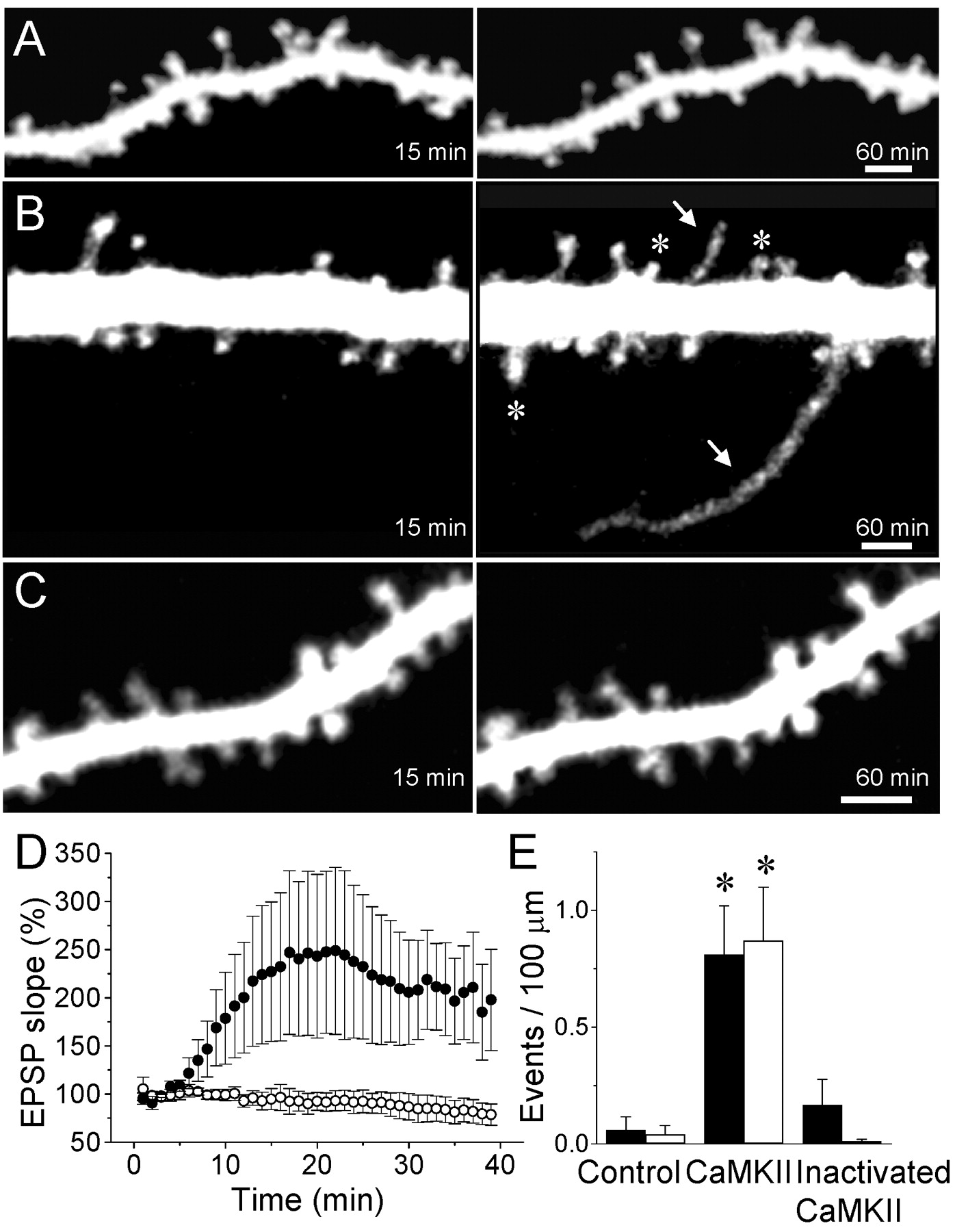
    Growth of filopodia and formation of new spines induced by intracellular injection of activated CaMKII. A, Confocal microscopic images of dendritic spines taken 15 and 60 min after intracellular injection of the fluorescent dye sulforhodamine in a control experiment. B, Growth of two filopodia (arrows) and the formation of three new spines (asterisks) in a cell injected with activated CaMKII. C, Absence of changes in a cell injected with heat-inactivated CaMKII. Scale bars, 2 μm. D, Changes in EPSC slope measured as a function of time in seven cells injected with activated CaMKII (black circles) and five cells injected with the heat-inactivated enzyme (open circles). Data are means ± SEM. E, Quantitative analysis of the growth of filopodia (black columns) and formation of new spines (open columns) expressed as events per 100 μm of dendritic segment and per 60 min under control condition (n = 16), after the injection of activated (n = 14) or heat-inactivated (n = 9) CaMKII (*p < 0.01; t test).

  • Figure 2.
    • Download figure
    • Open in new tab
    • Download powerpoint
    Figure 2.

    Structural plasticity is induced by the activation of endogenous CaMKII. A, Formation of three new spines (arrows) in a cell injected with the phosphatase inhibitor calyculin A (150 nm). B, Growth of two filopodia in a cell injected with calmodulin (150 nm; bars: 2 μm). C, Growth of filopodia (black columns) and formation of new spines (open columns), expressed as events per 100 μm of dendritic segment and per 60 min, under control conditions (n = 16), after the intracellular injection of activated CaMKII (n = 14), or the phosphatase inhibitor calyculin A (150 nm; n = 13) or calmodulin (150 and 450 nm; n = 15). Data are means ± SEM. *p < 0.01; t test.

  • Figure 3.
    • Download figure
    • Open in new tab
    • Download powerpoint
    Figure 3.

    Blockade of LTP-induced filopodia growth and spine formation by inhibition of CaMKII. A, Formation of two new spines (asterisks) induced by theta burst stimulation. B, Application of high-frequency stimulation in the presence of KN93 (10 μm) did not induce the growth of filopodia or the formations of new spines. Scale bars, 2 μm. C, Changes in EPSC amplitude triggered by theta burst stimulation under control conditions (black circles) or in the presence of KN93 (10 μm, open circles). Data are means ± SEM (n = 5, 6). D, Quantitative assessment of filopodia growth (black columns) and spine formation (open columns) observed under control conditions (n = 16), after the application of theta burst stimulation in the absence of drugs (LTP; n = 10), or after stimulation in the presence of MK801 (40 μm; n = 8) or KN93 (10 μm; n = 10). Data are means ± SEM. *p < 0.05; t test.

  • Figure 4.
    • Download figure
    • Open in new tab
    • Download powerpoint
    Figure 4.

    Blockade of anoxia/hypoglycemia-induced structural plasticity by inhibitors of CaMKII. A, Growth of two filopodia (arrows, top) and formation of two new spines (asterisks, bottom) observed after the application of a brief (5 min) period of anoxia/hypoglycemia. B, Anoxia/hypoglycemia applied in the presence of AIP (200 nm) failed to induce structural plasticity. Scale bars, 2 μm. C, Growth of filopodia (black columns) and formation of new spines (open columns) expressed as events per 100 μm of dendritic segments and per 60 min under control conditions (n = 16), after a short (5 min) period of anoxia/hypoglycemia, (n = 12), or after anoxia/hypoglycemia, but in the presence of KN93 (40 μm; n = 7) or AIP (200 nm; n = 11). Data are means ± SEM. *p < 0.01; t test.

Back to top

In this issue

The Journal of Neuroscience: 23 (33)
Journal of Neuroscience
Vol. 23, Issue 33
19 Nov 2003
  • Table of Contents
  • About the Cover
  • Index by author
Email

Thank you for sharing this Journal of Neuroscience article.

NOTE: We request your email address only to inform the recipient that it was you who recommended this article, and that it is not junk mail. We do not retain these email addresses.

Enter multiple addresses on separate lines or separate them with commas.
Calcium/Calmodulin-Dependent Protein Kinase II Contributes to Activity-Dependent Filopodia Growth and Spine Formation
(Your Name) has forwarded a page to you from Journal of Neuroscience
(Your Name) thought you would be interested in this article in Journal of Neuroscience.
CAPTCHA
This question is for testing whether or not you are a human visitor and to prevent automated spam submissions.
Print
View Full Page PDF
Citation Tools
Calcium/Calmodulin-Dependent Protein Kinase II Contributes to Activity-Dependent Filopodia Growth and Spine Formation
Pascal Jourdain, Kohji Fukunaga, Dominique Muller
Journal of Neuroscience 19 November 2003, 23 (33) 10645-10649; DOI: 10.1523/JNEUROSCI.23-33-10645.2003

Citation Manager Formats

  • BibTeX
  • Bookends
  • EasyBib
  • EndNote (tagged)
  • EndNote 8 (xml)
  • Medlars
  • Mendeley
  • Papers
  • RefWorks Tagged
  • Ref Manager
  • RIS
  • Zotero
Respond to this article
Request Permissions
Share
Calcium/Calmodulin-Dependent Protein Kinase II Contributes to Activity-Dependent Filopodia Growth and Spine Formation
Pascal Jourdain, Kohji Fukunaga, Dominique Muller
Journal of Neuroscience 19 November 2003, 23 (33) 10645-10649; DOI: 10.1523/JNEUROSCI.23-33-10645.2003
Twitter logo Facebook logo Mendeley logo
  • Tweet Widget
  • Facebook Like
  • Google Plus One

Jump to section

  • Article
    • Abstract
    • Introduction
    • Materials and Methods
    • Results
    • Discussion
    • Footnotes
    • References
  • Figures & Data
  • Info & Metrics
  • eLetters
  • PDF

Keywords

  • hippocampus
  • LTP (long-term potentiation)
  • phosphorylation
  • synapse
  • synaptogenesis
  • confocal microscopy

Responses to this article

Respond to this article

Jump to comment:

No eLetters have been published for this article.

Related Articles

Cited By...

More in this TOC Section

  • IGFBP2–Ceramide Pathway Mediates Divergent Myelin Breakdown in the PNS and CNS Following Injury
  • Smg5 Enhances Oligodendrocyte Differentiation via Nonsense-Mediated mRNA Decay of Hnrnpl Variant Transcripts
  • Sphingosine-1-Phosphate Signaling through Müller Glia Regulates Neuroprotection, Accumulation of Immune Cells, and Neuronal Regeneration in the Rodent Retina
Show more Development/Plasticity/Repair
  • Home
  • Alerts
  • Follow SFN on BlueSky
  • Visit Society for Neuroscience on Facebook
  • Follow Society for Neuroscience on Twitter
  • Follow Society for Neuroscience on LinkedIn
  • Visit Society for Neuroscience on Youtube
  • Follow our RSS feeds

Content

  • Early Release
  • Current Issue
  • Issue Archive
  • Collections

Information

  • For Authors
  • For Advertisers
  • For the Media
  • For Subscribers

About

  • About the Journal
  • Editorial Board
  • Privacy Notice
  • Contact
  • Accessibility
(JNeurosci logo)
(SfN logo)

Copyright © 2025 by the Society for Neuroscience.
JNeurosci Online ISSN: 1529-2401

The ideas and opinions expressed in JNeurosci do not necessarily reflect those of SfN or the JNeurosci Editorial Board. Publication of an advertisement or other product mention in JNeurosci should not be construed as an endorsement of the manufacturer’s claims. SfN does not assume any responsibility for any injury and/or damage to persons or property arising from or related to any use of any material contained in JNeurosci.