
Main menu

  • HOME
  • CONTENT
    • Early Release
    • Featured
    • Current Issue
    • Issue Archive
    • Collections
    • Podcast
  • ALERTS
  • FOR AUTHORS
    • Information for Authors
    • Fees
    • Journal Clubs
    • eLetters
    • Submit
    • Special Collections
  • EDITORIAL BOARD
    • Editorial Board
    • ECR Advisory Board
    • Journal Staff
  • ABOUT
    • Overview
    • Advertise
    • For the Media
    • Rights and Permissions
    • Privacy Policy
    • Feedback
    • Accessibility
  • SUBSCRIBE

User menu

  • Log out
  • Log in
  • My Cart

Search

  • Advanced search
Journal of Neuroscience
  • Log out
  • Log in
  • My Cart
Journal of Neuroscience

Advanced Search

Submit a Manuscript
  • HOME
  • CONTENT
    • Early Release
    • Featured
    • Current Issue
    • Issue Archive
    • Collections
    • Podcast
  • ALERTS
  • FOR AUTHORS
    • Information for Authors
    • Fees
    • Journal Clubs
    • eLetters
    • Submit
    • Special Collections
  • EDITORIAL BOARD
    • Editorial Board
    • ECR Advisory Board
    • Journal Staff
  • ABOUT
    • Overview
    • Advertise
    • For the Media
    • Rights and Permissions
    • Privacy Policy
    • Feedback
    • Accessibility
  • SUBSCRIBE
PreviousNext
Brief Communications

Rapid Cortical Plasticity Underlying Novel Word Learning

Yury Shtyrov, Vadim V. Nikulin and Friedemann Pulvermüller
Journal of Neuroscience 15 December 2010, 30 (50) 16864-16867; https://doi.org/10.1523/JNEUROSCI.1376-10.2010
Yury Shtyrov
  • Find this author on Google Scholar
  • Find this author on PubMed
  • Search for this author on this site
Vadim V. Nikulin
  • Find this author on Google Scholar
  • Find this author on PubMed
  • Search for this author on this site
Friedemann Pulvermüller
  • Find this author on Google Scholar
  • Find this author on PubMed
  • Search for this author on this site
  • Article
  • Figures & Data
  • Info & Metrics
  • eLetters
  • PDF
Loading

Article Figures & Data

Figures

  • Additional Files
  • Figure 1.
    • Download figure
    • Open in new tab
    • Download powerpoint
    Figure 1.

    Electric brain responses, recorded early and late in the learning session, to rarely presented critical word and pseudo-word stimuli and their corresponding frequently presented standard stimuli. Responses recorded from the vertex (electrode Cz) and time-locked to stimulus onsets are presented here; waveforms and spectrograms of critical stimulus items are overlaid on the brain response plots (see also supplemental Fig. 1, available at www.jneurosci.org as supplemental material for complete stimulus information). Note that the responses to frequent and rare stimuli in each set are similar until the divergence point at 345 ms when the final stop occurs. Note also, that following the divergence point the temporal dynamics of word and pseudo-word responses differ: larger responses to words early in the session (left) and more similar responses at the end, after pseudo-word responses had increased (right).

  • Figure 2.
    • Download figure
    • Open in new tab
    • Download powerpoint
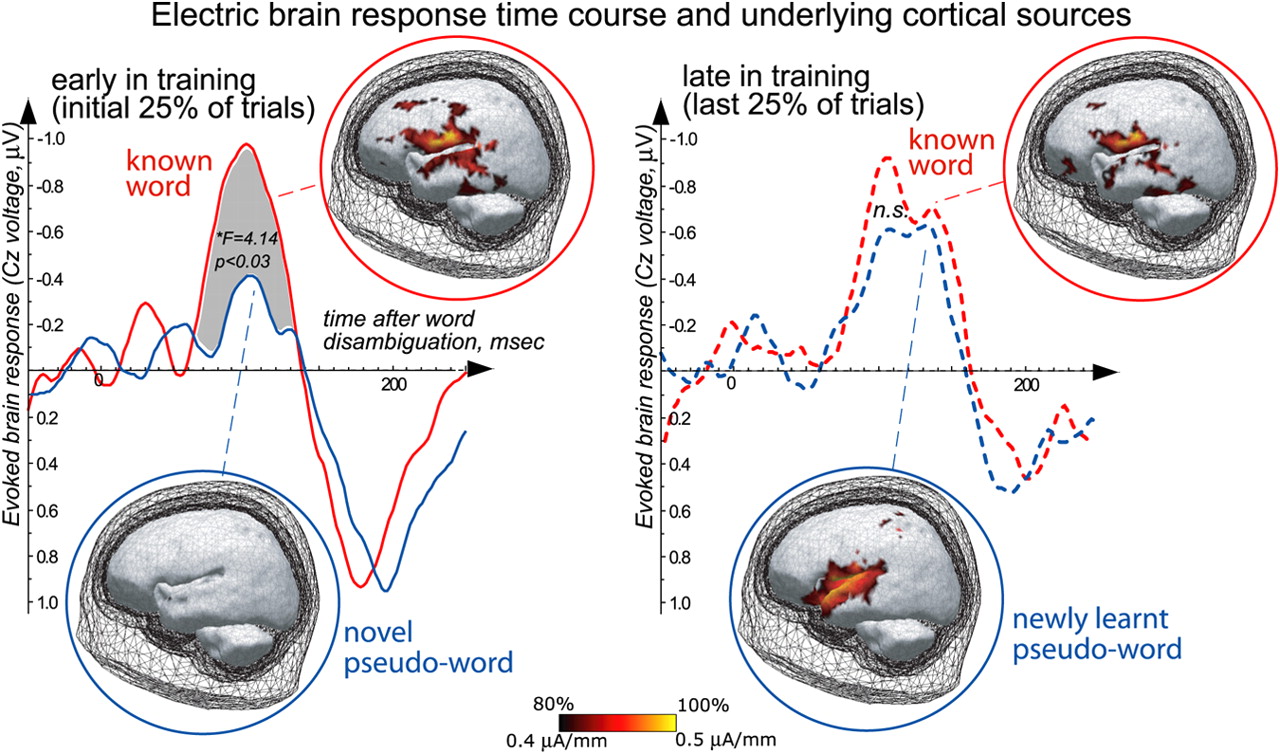
    Figure 2.

    Electric brain response registered at vertex (Cz) for word and pseudo-word stimuli early and late in the learning session. Responses are time-locked to the stimulus divergence points (final plosion onsets) when the final phoneme could be perceived and the word or pseudo-word stimulus first be recognized. Note the larger word response early in the session (left) and the similar responses at the end, after the pseudo-word response had increased (right). Cortical source distributions (L2 minimum-norm topographies at 120 ms after the divergence point, left view) are displayed in the insets. Note that known words elicited perisylvian language-area activation early and late in the session. In contrast, novel pseudo-words elicited anterior-superior-temporal activation only at the end of the session (brighter colors indicated higher dipole moment, activation thresholded at top 20%; for full unthresholded activations landscape, see supplemental Fig. 2, available at www.jneurosci.org as supplemental material).

  • Figure 3.
    • Download figure
    • Open in new tab
    • Download powerpoint
    Figure 3.

    Statistical assessment of response change through the exposure session. Note the absence of statistical change in the word response and significant increase in the pseudo-word response confirmed by both factorial comparison of early vs late 25% of trials (left) and linear regression over consecutive 10% sub-blocks (right). Individual subjects' data points and regression lines in black, group average amplitudes and regression lines in color.

Additional Files

  • Figures
  • Supplemental Material

    Files in this Data Supplement:

    • supplemental material - Supplemental Figures
Back to top

In this issue

The Journal of Neuroscience: 30 (50)
Journal of Neuroscience
Vol. 30, Issue 50
15 Dec 2010
  • Table of Contents
  • Table of Contents (PDF)
  • About the Cover
  • Index by author
  • Advertising (PDF)
  • Ed Board (PDF)
  • 2010 Author and Subject Indices
Email

Thank you for sharing this Journal of Neuroscience article.

NOTE: We request your email address only to inform the recipient that it was you who recommended this article, and that it is not junk mail. We do not retain these email addresses.

Enter multiple addresses on separate lines or separate them with commas.
Rapid Cortical Plasticity Underlying Novel Word Learning
(Your Name) has forwarded a page to you from Journal of Neuroscience
(Your Name) thought you would be interested in this article in Journal of Neuroscience.
CAPTCHA
This question is for testing whether or not you are a human visitor and to prevent automated spam submissions.
Print
View Full Page PDF
Citation Tools
Rapid Cortical Plasticity Underlying Novel Word Learning
Yury Shtyrov, Vadim V. Nikulin, Friedemann Pulvermüller
Journal of Neuroscience 15 December 2010, 30 (50) 16864-16867; DOI: 10.1523/JNEUROSCI.1376-10.2010

Citation Manager Formats

  • BibTeX
  • Bookends
  • EasyBib
  • EndNote (tagged)
  • EndNote 8 (xml)
  • Medlars
  • Mendeley
  • Papers
  • RefWorks Tagged
  • Ref Manager
  • RIS
  • Zotero
Respond to this article
Request Permissions
Share
Rapid Cortical Plasticity Underlying Novel Word Learning
Yury Shtyrov, Vadim V. Nikulin, Friedemann Pulvermüller
Journal of Neuroscience 15 December 2010, 30 (50) 16864-16867; DOI: 10.1523/JNEUROSCI.1376-10.2010
Twitter logo Facebook logo Mendeley logo
  • Tweet Widget
  • Facebook Like
  • Google Plus One

Jump to section

  • Article
    • Abstract
    • Introduction
    • Materials and Methods
    • Results
    • Discussion
    • Footnotes
    • References
  • Figures & Data
  • Info & Metrics
  • eLetters
  • PDF

Responses to this article

Respond to this article

Jump to comment:

No eLetters have been published for this article.

Related Articles

Cited By...

More in this TOC Section

  • Heteromodal Cortical Areas Encode Sensory-Motor Features of Word Meaning
  • Pharmacologically Counteracting a Phenotypic Difference in Cerebellar GABAA Receptor Response to Alcohol Prevents Excessive Alcohol Consumption in a High Alcohol-Consuming Rodent Genotype
  • Neuromuscular NMDA Receptors Modulate Developmental Synapse Elimination
Show more Brief Communications
  • Home
  • Alerts
  • Follow SFN on BlueSky
  • Visit Society for Neuroscience on Facebook
  • Follow Society for Neuroscience on Twitter
  • Follow Society for Neuroscience on LinkedIn
  • Visit Society for Neuroscience on Youtube
  • Follow our RSS feeds

Content

  • Early Release
  • Current Issue
  • Issue Archive
  • Collections

Information

  • For Authors
  • For Advertisers
  • For the Media
  • For Subscribers

About

  • About the Journal
  • Editorial Board
  • Privacy Notice
  • Contact
  • Accessibility
(JNeurosci logo)
(SfN logo)

Copyright © 2025 by the Society for Neuroscience.
JNeurosci Online ISSN: 1529-2401

The ideas and opinions expressed in JNeurosci do not necessarily reflect those of SfN or the JNeurosci Editorial Board. Publication of an advertisement or other product mention in JNeurosci should not be construed as an endorsement of the manufacturer’s claims. SfN does not assume any responsibility for any injury and/or damage to persons or property arising from or related to any use of any material contained in JNeurosci.