
Main menu

  • HOME
  • CONTENT
    • Early Release
    • Featured
    • Current Issue
    • Issue Archive
    • Collections
    • Podcast
  • ALERTS
  • FOR AUTHORS
    • Information for Authors
    • Fees
    • Journal Clubs
    • eLetters
    • Submit
    • Special Collections
  • EDITORIAL BOARD
    • Editorial Board
    • ECR Advisory Board
    • Journal Staff
  • ABOUT
    • Overview
    • Advertise
    • For the Media
    • Rights and Permissions
    • Privacy Policy
    • Feedback
    • Accessibility
  • SUBSCRIBE

User menu

  • Log out
  • Log in
  • My Cart

Search

  • Advanced search
Journal of Neuroscience
  • Log out
  • Log in
  • My Cart
Journal of Neuroscience

Advanced Search

Submit a Manuscript
  • HOME
  • CONTENT
    • Early Release
    • Featured
    • Current Issue
    • Issue Archive
    • Collections
    • Podcast
  • ALERTS
  • FOR AUTHORS
    • Information for Authors
    • Fees
    • Journal Clubs
    • eLetters
    • Submit
    • Special Collections
  • EDITORIAL BOARD
    • Editorial Board
    • ECR Advisory Board
    • Journal Staff
  • ABOUT
    • Overview
    • Advertise
    • For the Media
    • Rights and Permissions
    • Privacy Policy
    • Feedback
    • Accessibility
  • SUBSCRIBE
PreviousNext
Articles, Behavioral/Cognitive

Savings upon Re-Aiming in Visuomotor Adaptation

J. Ryan Morehead, Salman E. Qasim, Matthew J. Crossley and Richard Ivry
Journal of Neuroscience 21 October 2015, 35 (42) 14386-14396; https://doi.org/10.1523/JNEUROSCI.1046-15.2015
J. Ryan Morehead
1Department of Psychology, University of California, Berkeley, California 94720, and
  • Find this author on Google Scholar
  • Find this author on PubMed
  • Search for this author on this site
  • ORCID record for J. Ryan Morehead
Salman E. Qasim
2Department of Neurological Surgery, University of California, San Francisco, California 94143
  • Find this author on Google Scholar
  • Find this author on PubMed
  • Search for this author on this site
Matthew J. Crossley
1Department of Psychology, University of California, Berkeley, California 94720, and
  • Find this author on Google Scholar
  • Find this author on PubMed
  • Search for this author on this site
Richard Ivry
1Department of Psychology, University of California, Berkeley, California 94720, and
  • Find this author on Google Scholar
  • Find this author on PubMed
  • Search for this author on this site
  • Article
  • Figures & Data
  • Info & Metrics
  • eLetters
  • PDF
Loading

Article Figures & Data

Figures

  • Figure 1.
    • Download figure
    • Open in new tab
    • Download powerpoint
    Figure 1.

    Experimental task. a, Each participant slid his hand across a tabletop to hit visual targets. Vision of the hand was occluded by a mirror, which reflected a back-projected visual image to create the illusion that the hand and visual targets were coplanar. b, Two- (top) and four- (bottom) target sets used in experiments. On each trial, one target was pseudorandomly selected. The participant reached from a central start location, attempting to “slice” through the target with the cursor. A trial was complete when the radial distance of the movement exceeded 10 cm, indicated here by a dotted ring. c, Task design in Experiment 1 to assess savings. Veridical feedback was provided in the baseline and washout blocks. The visual feedback was perturbed during the two rotation blocks, with the size of the perturbation the same in each of these blocks.

  • Figure 2.
    • Download figure
    • Open in new tab
    • Download powerpoint
    Figure 2.

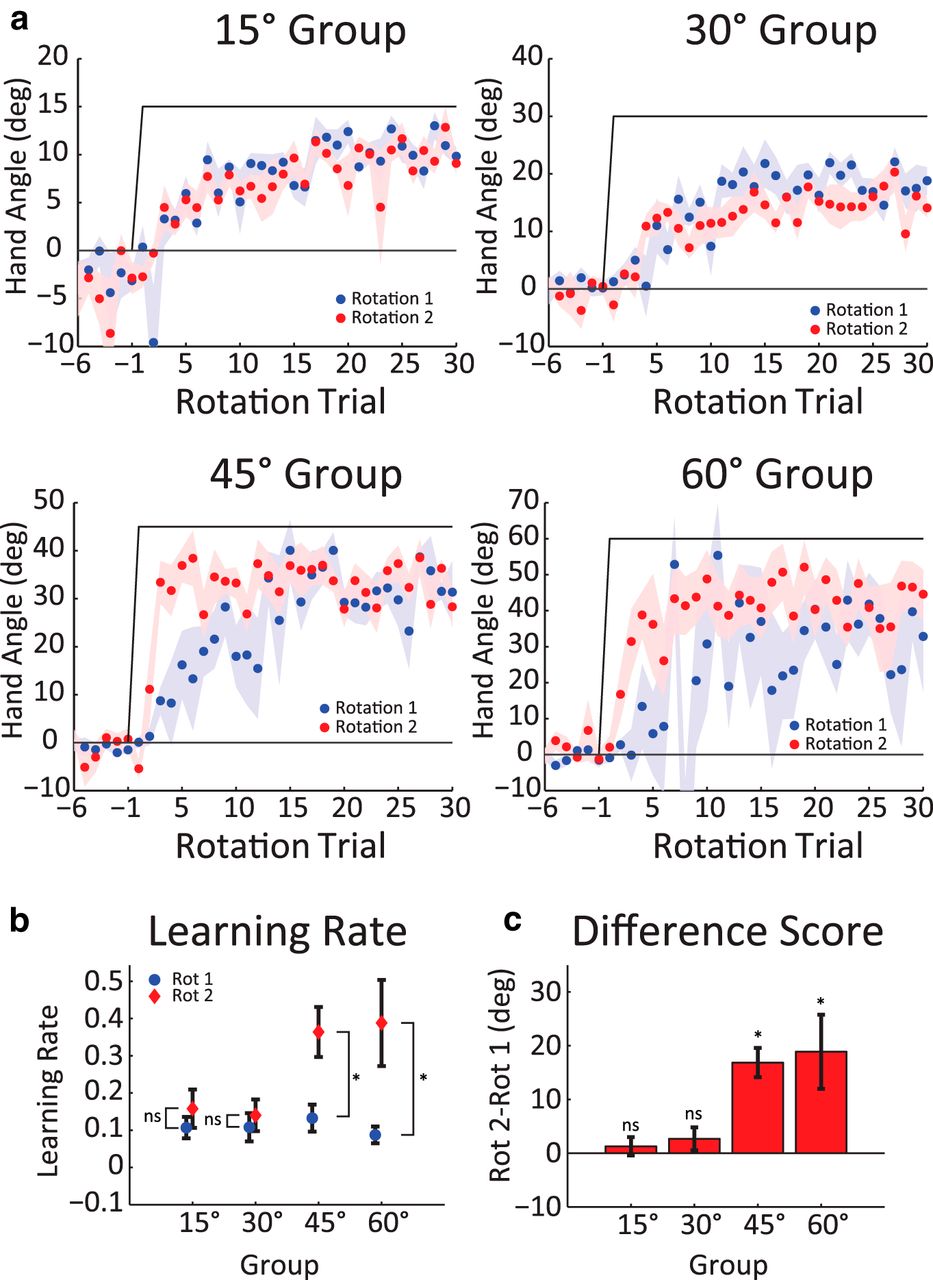
    Savings is only observed with large perturbations. a, Heading angle of the hand relative to the target during last five baseline and first 20 trials of Rotation 1 (blue) and Rotation 2 (red) in Experiment 1. The data for the two rotation blocks are displayed in a superimposed manner for the four perturbation sizes. Note the different scaling of the vertical axis for each group. The 45° and 60° groups show faster relearning for the second rotation; this savings effect is absent for the 15° and 30° groups. b, Mean learning rate from an exponential function independently fit to all trials in Rotation 1 and Rotation 2. c, Difference score measure of savings (Rotation 2 − Rotation 1). Data are mean ± SEM. *Significant difference. ns, Not significant.

  • Figure 3.
    • Download figure
    • Open in new tab
    • Download powerpoint
    Figure 3.

    Gains from savings are abolished by instructions to aim directly for the target. a, Trial schematic for Experiment 2, denoting the verbal intervention following the seventh trial of the Rotation 2 block. For the following 2 trials (blue bar), participants were instructed to aim and reach directly for the target. b, Left, Behavior during the Rotation 2 block for the two-target 45° group. There is an initial period of rapid relearning, followed by a sharp change in hand angle in response to the verbal intervention. Right, Difference score between the first 6 trials of Rotation 1 and Rotation 2 blocks (red) and between the average heading angle for the 2 intervention trials and the 2 trials preceding the intervention (blue). c, Time course of hand angles for the 45° (top) and 30° (bottom) groups in the four-target groups. Savings score (d), defined by the difference between the first 12 trials of the Rotation 1 and Rotation 2 blocks and (e), verbal intervention scores (using the 4 intervention trials and 4 preintervention trials). While savings was only reliable for the 45° group, there was a drop in hand angle following the verbal intervention for both groups. Data are mean ± SEM. *Significant difference. ns, Not significant.

  • Figure 4.
    • Download figure
    • Open in new tab
    • Download powerpoint
    Figure 4.

    Savings assessed with aiming report task in Experiment 3. a, Left, Task schematic. Numbers were visible in ascending and descending manner around the target. Participant verbally reported the number corresponding to his/her aiming location and then performed the reach. Right, Assuming performance (heading angle) is the composite of an explicit aiming strategy and implicit adaptation, the magnitude of the latter can be estimated via subtraction. b, Overall behavior for 15° (left) and 45° (right) groups. c, Mean aiming reports (red) and implicit adaptation (blue, estimated via subtraction). Participants were instructed to aim directly for the target in the final washout block. d, Aiming reports over the first 30 trials, superimposed for Rotation 1 and Rotation 2. e, Savings difference scores for each measure. Data are mean ± SEM. *Significant difference. ns, Not significant.

  • Figure 5.
    • Download figure
    • Open in new tab
    • Download powerpoint
    Figure 5.

    Control of aiming strategy by an arbitrary color cue. a, Interleaved design of Experiment 4 in which the cursor changed color on rotation trials (depicted in blue). The cursor remained white on no-rotation trials (depicted in red). b, c, Heading angle for groups exposed to 45° and 15° rotations, respectively. Note the difference in the scale of the y-axis. d, Blue bars represent mean of the cued trials, limited to those that immediately preceded an uncued trial. Red bars represent mean of uncued trials. e, Baseline subtracted hand angle on the first trial for Rotation 1 and Rotation 2. The color cue prompted the use of an aiming strategy for the 45° group, even before the participants had experienced errors caused by the perturbation in Rotation 2. Data are mean ± SEM. *Significant difference. ns, Not significant.

  • Figure 6.
    • Download figure
    • Open in new tab
    • Download powerpoint
    Figure 6.

    Inappropriate recall of aiming strategies in response to a novel perturbation. a, In Experiment 5, all participants were exposed to a novel −30° rotation after completing a training block with either a 45° or 15° rotation, followed by a washout block. b, Heading angle for the last 10 trials of the washout block and all trials of the Rotation 2 block. The 45° group initially responded to the perturbation by moving in the wrong direction and, after a few trials, reversed direction, reducing error faster than the 15° group. c, Enhanced picture of behavior over the first four trials of the Rotation 2 block, showing performance of each individual (dots). Note the expanded vertical axis relative to b. d, Mean learning rate from an exponential fit of all trials in Rotation 2 block, showing faster learning of the rotation for the 45° group. Data are mean ± SEM. *Significant difference.

Back to top

In this issue

The Journal of Neuroscience: 35 (42)
Journal of Neuroscience
Vol. 35, Issue 42
21 Oct 2015
  • Table of Contents
  • Table of Contents (PDF)
  • About the Cover
  • Index by author
  • Advertising (PDF)
  • Ed Board (PDF)
Email

Thank you for sharing this Journal of Neuroscience article.

NOTE: We request your email address only to inform the recipient that it was you who recommended this article, and that it is not junk mail. We do not retain these email addresses.

Enter multiple addresses on separate lines or separate them with commas.
Savings upon Re-Aiming in Visuomotor Adaptation
(Your Name) has forwarded a page to you from Journal of Neuroscience
(Your Name) thought you would be interested in this article in Journal of Neuroscience.
CAPTCHA
This question is for testing whether or not you are a human visitor and to prevent automated spam submissions.
Print
View Full Page PDF
Citation Tools
Savings upon Re-Aiming in Visuomotor Adaptation
J. Ryan Morehead, Salman E. Qasim, Matthew J. Crossley, Richard Ivry
Journal of Neuroscience 21 October 2015, 35 (42) 14386-14396; DOI: 10.1523/JNEUROSCI.1046-15.2015

Citation Manager Formats

  • BibTeX
  • Bookends
  • EasyBib
  • EndNote (tagged)
  • EndNote 8 (xml)
  • Medlars
  • Mendeley
  • Papers
  • RefWorks Tagged
  • Ref Manager
  • RIS
  • Zotero
Respond to this article
Request Permissions
Share
Savings upon Re-Aiming in Visuomotor Adaptation
J. Ryan Morehead, Salman E. Qasim, Matthew J. Crossley, Richard Ivry
Journal of Neuroscience 21 October 2015, 35 (42) 14386-14396; DOI: 10.1523/JNEUROSCI.1046-15.2015
Twitter logo Facebook logo Mendeley logo
  • Tweet Widget
  • Facebook Like
  • Google Plus One

Jump to section

  • Article
    • Abstract
    • Introduction
    • Materials and Methods
    • Results
    • Discussion
    • Footnotes
    • References
  • Figures & Data
  • Info & Metrics
  • eLetters
  • PDF

Keywords

  • adaptation
  • motor learning
  • reaching
  • visuomotor

Responses to this article

Respond to this article

Jump to comment:

No eLetters have been published for this article.

Related Articles

Cited By...

More in this TOC Section

Articles

  • Memory Retrieval Has a Dynamic Influence on the Maintenance Mechanisms That Are Sensitive to ζ-Inhibitory Peptide (ZIP)
  • Neurophysiological Evidence for a Cortical Contribution to the Wakefulness-Related Drive to Breathe Explaining Hypocapnia-Resistant Ventilation in Humans
  • Monomeric Alpha-Synuclein Exerts a Physiological Role on Brain ATP Synthase
Show more Articles

Behavioral/Cognitive

  • Local neuronal ensembles that co-reactivate across regions during sleep are preferentially stabilized
  • Prefrontal Default Mode Network Interactions with Posterior Hippocampus during Exploration
  • Switching between Newly Learned Motor Skills
Show more Behavioral/Cognitive
  • Home
  • Alerts
  • Follow SFN on BlueSky
  • Visit Society for Neuroscience on Facebook
  • Follow Society for Neuroscience on Twitter
  • Follow Society for Neuroscience on LinkedIn
  • Visit Society for Neuroscience on Youtube
  • Follow our RSS feeds

Content

  • Early Release
  • Current Issue
  • Issue Archive
  • Collections

Information

  • For Authors
  • For Advertisers
  • For the Media
  • For Subscribers

About

  • About the Journal
  • Editorial Board
  • Privacy Notice
  • Contact
  • Accessibility
(JNeurosci logo)
(SfN logo)

Copyright © 2025 by the Society for Neuroscience.
JNeurosci Online ISSN: 1529-2401

The ideas and opinions expressed in JNeurosci do not necessarily reflect those of SfN or the JNeurosci Editorial Board. Publication of an advertisement or other product mention in JNeurosci should not be construed as an endorsement of the manufacturer’s claims. SfN does not assume any responsibility for any injury and/or damage to persons or property arising from or related to any use of any material contained in JNeurosci.